

Where grouping provisions are available in the relevant Product Manual, they may be used for determining product groups and variants and for the grant and operation of Scheme-II licences. This provides clarity for manufacturers handling multiple furniture models and variants.
BIS Certification for Furniture
Furniture QCO 2025-26 Complete Guide: 6 Notified Categories, IS Standards, BIS Certification Process & Compliance Requirements
Quick Overview
BIS Certification for Furniture is governed by the Furniture (Quality Control) Order (QCO), 2025, which brings six furniture categories under mandatory BIS compliance in India. The notified categories include Work Chairs, General Purpose Chairs & Stools, Tables & Desks, Storage Units, Beds, and Bunk Beds, with each category linked to its respective Indian Standard, including IS 17631, IS 17632, IS 17633, IS 17634, IS 17635, and IS 17636. The Furniture QCO Amendment Order 2026 and Second Amendment Order 2026 introduced further changes to the applicable regulatory framework, while the Transition Facilitation (Quality Control) Order (TFQCO), 2026 provides specific transition provisions for covered products. Manufacturers and importers must assess the applicable BIS Certification, product testing, conformity, and ISI Mark requirements before supplying regulated furniture in the Indian market.
Table Of Content
- Quick Overview
- What is BIS Certification for Furniture?
- Furniture Quality Control Order 2025: Key Compliance Requirements
- Furniture QCO Amendment 2026: Latest Changes and Compliance Updates
- Furniture QCO Second Amendment 2026: Import Relief and Key Provisions
- Transition Facilitation Order 2026 for Furniture: What Manufacturers Should Know
- Furniture Categories Covered Under BIS Certification with IS Standards
- What is Tested for BIS Certification of Furniture?
- BIS Certification Process for Furniture in India
- BIS Certification for Domestic vs Foreign Furniture Manufacturers
- Documents Required for BIS Furniture Certification
- BIS Certification Cost for Furniture
- BIS Licence, ISI Mark and CM/L Number Requirements for Furniture
- Benefits of BIS Certification for Furniture Manufacturers
- Why EVTL India is the No. 1 Choice for BIS Certification of Furniture
- Conclusion
- Frequently Asked Questions
What is BIS Certification for Furniture?
BIS Certification for Furniture is a mandatory quality and safety approval granted by the Bureau of Indian Standards (BIS) for notified furniture products under the Furniture Quality Control Order, 2025. It confirms that the furniture product—whether manufactured in India or imported—meets the applicable Indian Standard and that the manufacturer follows the required quality control and production requirements.
Under the Transition Facilitation (Quality Control) Order, 2026 (TFQCO 2026), the notified furniture products have transitioned from Scheme-I (ISI Mark Scheme) to Scheme-II under Schedule-II of the BIS (Conformity Assessment) Regulations, 2018. Accordingly, the applicable conformity assessment requirements and certification process are governed under Scheme-II.
01
Furniture must comply with the applicable Indian Standard (IS)
02
Product testing must be carried out as required under the applicable BIS conformity assessment procedure
03
Manufacturer must have the required production facilities and quality control system
04
Eligible manufacturers may follow the Scheme-II route under the Transition Facilitation (QCO) Order, 2026
05
Applies to covered Indian manufacturers and imported furniture products
06
BIS compliance is a legal requirement for furniture products notified under the QCO, not merely a voluntary quality certification
Furniture Quality Control Order 2025: Key Compliance Requirements
The Furniture (Quality Control) Order, 2025 (Furniture QCO 2025) was notified by the Department for Promotion of Industry and Internal Trade (DPIIT), Ministry of Commerce and Industry, Government of India on 13 February 2025 through S.O. 801(E) under Section 16 of the Bureau of Indian Standards Act, 2016. The QCO makes compliance with specified Indian Standards and the use of the BIS Standard Mark under Scheme-I mandatory for covered furniture products.
| Compliance Point | Details |
|---|---|
| QCO Notification Date | 13 February 2025 |
| Notification Number | S.O. 801(E) |
| Issuing Authority | Department for Promotion of Industry and Internal Trade (DPIIT) |
| Ministry | Ministry of Commerce and Industry, Government of India |
| Legal Basis | Section 16 of the Bureau of Indian Standards Act, 2016 |
| General Mandatory Date | 13 February 2026, i.e. 12 months after notification |
| Certification Authority | Bureau of Indian Standards (BIS) |
| Certification Scheme | Scheme-I under BIS Product Certification |
| Quality Mark Required | BIS Standard Mark |
| Furniture Categories Covered | 6 product categories |
| Applicable Standards | IS 17631:2022, IS 17632:2022, IS 17633:2022, IS 17634:2022, IS 17635:2022 and IS 17636:2022 |
| Covered Products | Work Chairs; General Purpose Chairs and Stools; Tables and Desks; Storage Units; Beds; Bunk Beds |
| Large Manufacturers | QCO applies from the general implementation date, subject to applicable exemptions and transitional provisions |
| Medium Manufacturers | QCO applies, subject to the specific exemption criteria under the amended provisions |
| Micro & Small Manufacturers | Eligibility for exemption depends on the revised Udyam registration, investment and turnover conditions |
| Current MSME Exemption Threshold | Eligible Udyam-registered enterprises with investment of up to ₹1 crore and previous financial-year turnover of up to ₹5 crore, subject to the conditions prescribed in the amendment |
| Exported Furniture | Furniture manufactured exclusively for export is subject to the applicable export exemption under the QCO |
| 2026 Amendment | Furniture QCO Amendment Order issued on 12 February 2026 |
| Second Amendment | Furniture QCO Second Amendment Order issued on 2 March 2026 |
| Transition Provision | Furniture QCO is also covered under the Transition Facilitation (Quality Control) Order, 2026 |
| Manufacturer's Key Obligation | Covered furniture must conform to the applicable Indian Standard and obtain the required BIS licence before being placed in the Indian market |
Note:
The applicability of the Furniture QCO to Micro, Small, Medium and Large enterprises should be determined based on the latest amended provisions, rather than assuming separate mandatory dates for each MSME category. The 2026 amendment revised the relevant exemption criteria based on Udyam registration, investment and turnover thresholds.
Furniture QCO Amendment 2026: Latest Changes and Compliance Updates
The Furniture (Quality Control) Amendment Order, 2026, notified through S.O. 774(E) on 12 February 2026, introduced key compliance updates to the Furniture QCO 2025, covering R&D imports, existing stock, and export-oriented furniture manufacturing. However, the amendment does not change the six notified furniture categories: work chairs, general-purpose chairs and stools, tables and desks, storage units, beds, and bunk beds, which remain subject to their applicable Indian Standards under BIS Scheme-I.
Key Changes Under the Furniture QCO Amendment 2026
01
R&D Imports Up to 200 Units
BIS-certified manufacturers or manufacturers who have applied for BIS certification can import up to 200 units per financial year of notified furniture for R&D purposes. These products cannot be sold commercially and must be disposed of as scrap, with required records maintained and submitted to the Central Government.
02
Exemption for Pre-Implementation Stock
Furniture manufactured or imported before QCO implementation by BIS-certified manufacturers or applicants can be sold, displayed, or offered for sale for up to 12 months from the implementation date, subject to the required self-declaration to BIS.
03
Exemption for Export-Oriented Furniture
Non-BIS-marked furniture, components, or sub-assemblies imported for manufacturing furniture for export are exempt from the QCO, subject to prescribed conditions. Manufacturers must submit a self-declaration with invoice and consignment details and ensure the products are not sold in the domestic market.
MSME Compliance Update Under S.O. 777(E)
S.O. 777(E), dated 12 February 2026, introduced an MSME exemption for eligible enterprises registered on the Udyam Portal, with investment up to ₹1 crore and previous-year turnover up to ₹5 crore, subject to Chartered Accountant certification.
The BIS product-certification listing currently records the Furniture QCO 2025 along with the 2026 Amendment Order, S.O. 774(E), S.O. 777(E), Second Amendment Order S.O. 1125(E), and Transition Facilitation Order S.O. 3417(E), making it important for manufacturers and importers to consider the complete set of applicable updates rather than relying only on the original 2025 QCO.
Furniture QCO Second Amendment 2026: Import Relief and Key Provisions
The Furniture (Quality Control) Second Amendment Order, 2026, issued by the Department for Promotion of Industry and Internal Trade (DPIIT) through S.O. 1125(E) dated 2 March 2026, provides transitional relief for certain furniture imports connected with shipments and purchase orders made before the implementation of the Furniture QCO. The amendment introduces two specific import exemptions under the Furniture (Quality Control) Order, 2025:
01
Relief for Pre-Implementation Shipments
Furniture consignments covered by a Bill of Lading showing that the goods were shipped before the Furniture QCO implementation date are exempt from the QCO, provided the Bill of Entry is dated within 180 days from the implementation date.
02
Relief for Pre-Implementation Purchase Orders
An exemption is also available where the Purchase Order was placed before the QCO implementation date, subject to the required shipping and customs timelines. Both the Bill of Lading and Bill of Entry must fall within the prescribed 180-day period.
03
Documents to Be Submitted to BIS
For imports covered under the pre-implementation Purchase Order provision, the importer must submit supporting documents to BIS within 7 days of clearance. These include the Purchase Order, Bill of Lading, Bill of Entry and other supporting documents, duly signed by the authorised signatory on the importer's letterhead.
04
Limited Transitional Relief for Importers
The Second Amendment is intended to protect importers whose furniture consignments were already shipped or contractually committed before the QCO became applicable. It provides a defined transition period without removing the underlying BIS compliance requirement for future imports of notified furniture products.
Transition Facilitation Order 2026 for Furniture: What Manufacturers Should Know
The Transition Facilitation (Quality Control) Order (TFQCO), 2026, issued by the Department for Promotion of Industry and Internal Trade (DPIIT), allows goods covered by specified Quality Control Orders to be covered under Scheme-II of Schedule-II of the BIS (Conformity Assessment) Regulations, 2018. The Furniture (Quality Control) Order, 2025 is specifically included in the TFQCO 2026 schedule, with an implementation date of 13 February 2026.
Key Provisions for Furniture Manufacturers
The Furniture QCO 2025 is covered under TFQCO 2026, allowing eligible furniture products to be considered for Scheme-II certification.
Latest BIS Update – 13 August 2026: The BIS Central Marks Department-II & III issued Circular Ref. CMD-II & III/General/TFQCO on 13 August 2026, clarifying the applicability of grouping guidelines for products covered under TFQCO 2026. The circular states that Scheme-I grouping guidelines in respective BIS Product Manuals may also be applied, mutatis mutandis, for Scheme-II certification.
However, grouping facilitation does not exempt manufacturers from BIS compliance. These provisions apply only when consistent with the BIS Act, 2016, BIS Regulations, 2018, TFQCO 2026 and competent authority directions.
Furniture Categories Covered Under BIS Certification with IS Standards
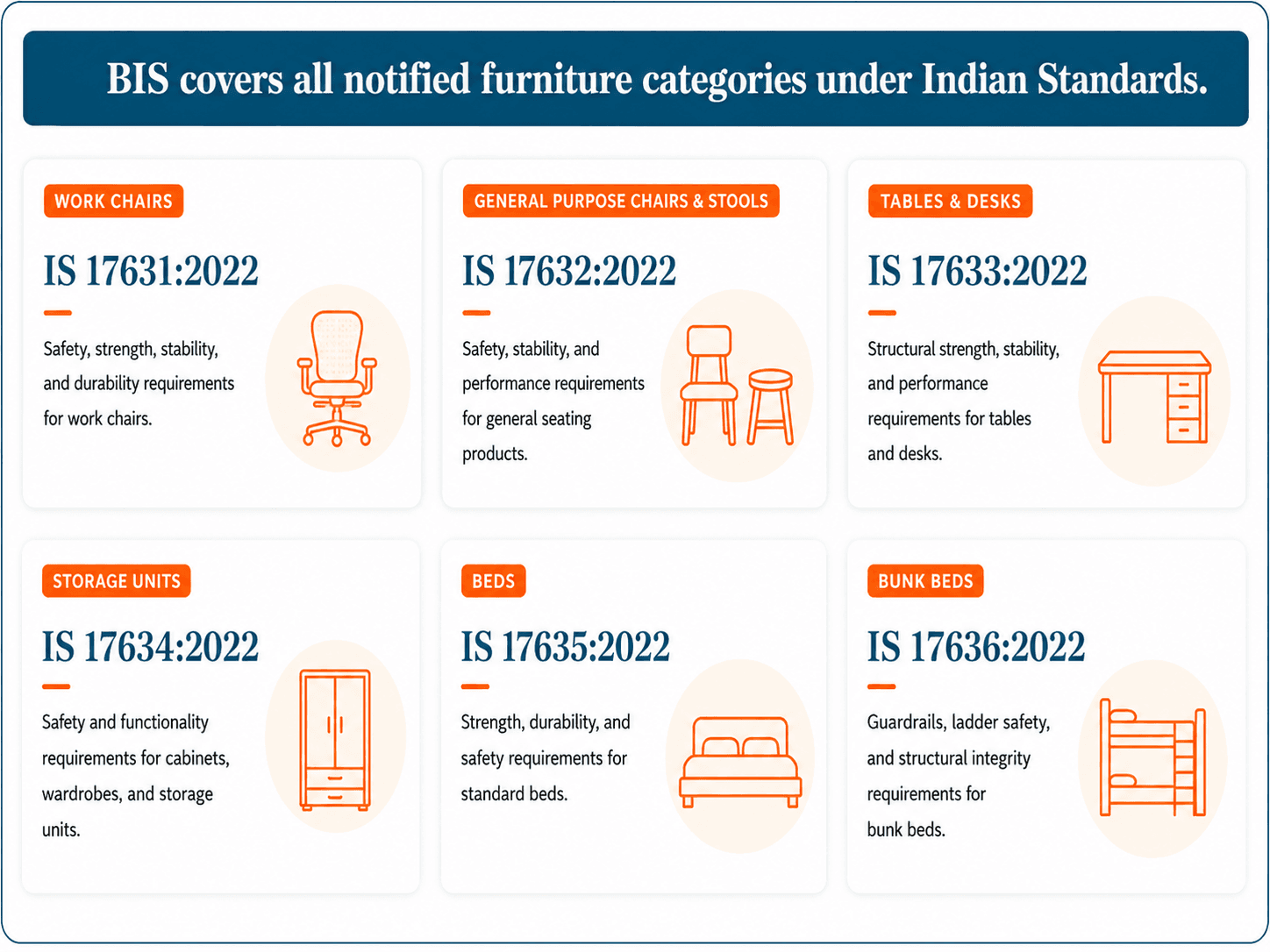
The Furniture Quality Control Order (QCO) framework has classified six broad types of furniture under which BIS Scheme-I Certification is mandatory. Each type is assigned to a particular Indian Standard (IS). Proper selection of the IS number is important to comply with BIS standards for furniture and ISI Mark certification.
| Furniture Category | Key Application | Standard | Product Manual | QCO |
|---|---|---|---|---|
| Work ChairsIS 17631:2022 | Office and workstation seating for adults in professional environments. | Click here | Click here | Click here |
| General Purpose Chairs & StoolsIS 17632:2022 | Basic seating for homes, offices, and commercial spaces. | Click here | Click here | Click here |
| Tables & DesksIS 17633:2022 | Study tables, office desks, and general-purpose work surfaces. | Click here | Click here | Click here |
| Storage UnitsIS 17634:2022 | Cabinets, wardrobes, shelves, and storage furniture. | Click here | Click here | Click here |
| BedsIS 17635:2022 | Standard residential and institutional beds for adults. | Click here | Click here | Click here |
| Bunk BedsIS 17636:2022 | Elevated beds and bunk sleeping systems with safety requirements. | Click here | Click here | Click here |
What is Tested for BIS Certification of Furniture?
For BIS Certification of Furniture, the furniture is tested according to the applicable Indian Standard (IS). These tests check whether the furniture is safe, strong, durable, and suitable for regular use.
The main tests may include:
| Test Parameter | What is Evaluated |
|---|---|
| Strength Test | Checks whether the furniture can handle the required weight and load. |
| Stability Test | Checks whether the furniture remains stable during normal use. |
| Durability Test | Checks whether the furniture can withstand repeated use over time. |
| Load Test | Checks whether chairs, tables, beds, and storage units can safely carry the required load. |
| Impact Test | Checks how the furniture performs when it is exposed to sudden impact or force. |
| Dimension Check | Ensures that the furniture has the required size and dimensions as per the applicable IS standard. |
| Material and Workmanship Check | Checks the quality of materials, joints, construction, and overall finishing. |
| Safety Check | Ensures that the furniture does not have unsafe features such as sharp edges, weak joints, or unstable structures. |
| Surface and Finish Check | Where required, the surface, coating, and finishing are checked for compliance with the applicable standard. |
BIS Certification Process for Furniture in India
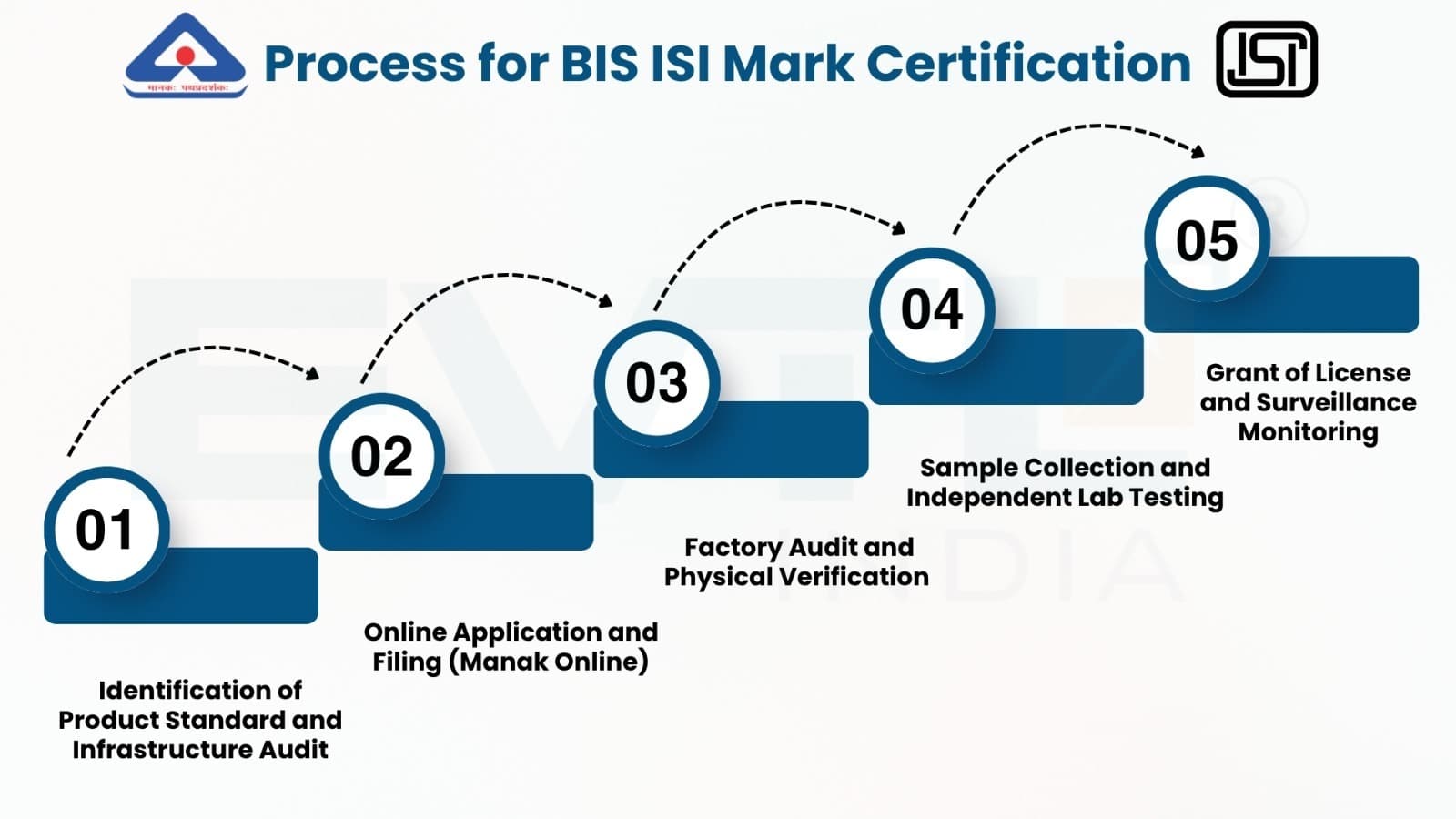
The BIS Certification process for furniture in India involves several steps, from identifying the correct Indian Standard to obtaining the BIS licence and maintaining compliance. Manufacturers should follow the process carefully to avoid application delays or rejection.
01
Identify the Correct Indian Standard
First, identify the Indian Standard (IS) applicable to your specific furniture product under the Furniture QCO. Check the product scope, including its dimensions, materials, construction, and intended use. It is also important to check any exclusions mentioned under the applicable standard.
02
Prepare Technical & Business Documents
Prepare all documents required for the BIS application, such as business registration documents, GST certificate, factory layout, machinery details, quality control procedures, raw material specifications, and product drawings. Documents should be prepared according to BIS requirements to avoid delays.
03
Submit the BIS Application
Submit the BIS application through the ManakOnline portal with complete product, factory, and standard details. The applicable BIS fees are also paid during the application process. All information should be checked carefully before submission.
04
Product Testing at a BIS-Recognized Laboratory
Furniture samples are tested at a BIS-recognized laboratory according to the applicable Indian Standard. Depending on the product, testing may cover parameters such as strength, stability, durability, safety, dimensions, and performance. Manufacturers may also conduct preliminary testing to identify compliance issues before applying.
05
BIS Document Review
BIS reviews the application, technical documents, and test reports. If BIS raises any queries or identifies deficiencies, the manufacturer must provide the required clarification or documents within the specified time.
06
Factory Inspection by BIS
A BIS officer inspects the manufacturing facility to verify the manufacturing process, raw materials, quality control procedures, testing facilities, machinery, and in-house inspection arrangements. Samples may also be selected during the inspection for further testing.
07
Grant of BIS Licence and Use of ISI Mark
After satisfactory completion of document verification, testing, and factory inspection, BIS grants the certification licence under the applicable certification scheme. The manufacturer can then use the ISI Mark on certified furniture products in accordance with BIS requirements.
08
Ongoing Surveillance and Licence Renewal
BIS may conduct periodic surveillance inspections and collect samples from the factory or market for testing. Manufacturers must continue to meet the applicable Indian Standard, maintain quality records, and renew the BIS licence before its expiry. Any significant changes to the product, raw materials, or manufacturing process should be handled as per BIS requirements.
BIS Certification for Domestic vs Foreign Furniture Manufacturers
BIS certification requirements for furniture manufacturers differ depending on whether the products are manufactured in India or outside India. Both domestic and foreign manufacturers must comply with the applicable Indian Standards covered under the Furniture Quality Control Order (QCO), but the certification routes and application procedures are different.
Indian Furniture Manufacturers – Domestic Route
Indian manufacturers apply for BIS certification under the domestic licensing process. The manufacturer must have a production facility in India and demonstrate that the furniture meets the applicable Indian Standard.
The general process includes:
01
Identify the applicable Indian Standard for the furniture product.
02
Prepare the required technical and business documents.
03
Conduct testing through a BIS-recognised laboratory.
04
Submit the BIS application with the required documents and test reports.
05
BIS conducts a factory inspection to assess manufacturing and quality-control facilities.
06
Resolve any observations or non-conformities identified during inspection.
07
Obtain the BIS licence and use the ISI Mark on certified products as permitted under the licence.
08
Maintain BIS compliance through periodic surveillance, product testing, and timely licence renewal to continue legally using the ISI Mark on certified furniture products.
Foreign Furniture Manufacturers – FMCS Route
Foreign manufacturers supplying furniture to India generally need to obtain BIS certification through the Foreign Manufacturers Certification Scheme (FMCS). The application is handled through
BIS's Foreign Manufacturers Certification Department (FMCD)
The process generally involves:
01
Identify the applicable Indian Standard and product scope.
02
Prepare technical, manufacturing and legal documents.
03
Arrange product testing as required by BIS.
04
Submit the FMCS application to BIS.
05
BIS conducts an inspection of the manufacturing premises outside India.
06
Address testing, inspection or documentation-related observations.
07
After successful evaluation, BIS grants the certification licence.
08
The manufacturer can then supply certified furniture to the Indian market with the required ISI Mark and BIS licence details.
Documents Required for BIS Furniture Certification
1
Basic Details
GST Certificate, Email ID and Contact Number, Factory and Office Address, Rent Agreement / Lease Deed, if applicable, Partnership Deed, if applicable
2
Manufacturing Details
List of Machinery, Manufacturing Process Flow Chart, Factory Layout Plan
3
Raw Material Details
List of Raw Materials, Supplier Details, Raw Material Invoices, Raw Material Test Certificates
4
Testing & Quality Control
List of Testing Equipment, Valid Calibration Certificates, QC/Laboratory In-charge Appointment Letter, Qualification Details of QC/Lab In-charge
5
Production Details
Annual Installed Production Capacity, Production Value for the Last Financial Year
6
Product & Packaging Details
Quantity per Package, Nature and Type of Packaging, Product Printing / Marking Details
7
Management Details
Top Management Details, Details of the BIS Communication Contact Person
8
Brand & Certification Documents
Trademark / Brand Certificate, Consent Letter from BIS-Recognized Laboratory
9
Additional Documents
Weekly Off Details, Hygiene Documents, if applicable, Relaxation Letter, if applicable, Any Other Relevant Supporting Documents
10
Additional Requirements for Foreign Manufacturers
Agreement with the Authorized Indian Representative (AIR), Aadhaar Card of AIR, AIR Nomination Form, Required Undertakings, Proposed Scope of BIS Licence
BIS Certification Cost for Furniture
The charges for BIS Certification of Furniture vary depending on factors such as the type of furniture, applicable Indian Standard, testing requirements, and manufacturing location. In addition to the certification fee, manufacturers should also consider product testing, application processing, factory inspection, marking, and annual licence-related charges.
| Charge Type | Indian Manufacturers | Foreign Manufacturers |
|---|---|---|
| Application Fee | INR 1,000 | USD 15 |
| Audit Charges | INR 7,000 | USD 3,200 - 5,900 |
| License Fee | INR 1,000 | USD 15 |
| Marking Fee | As applicable | As applicable |
| Testing Charges | As applicable | As applicable |
| EVTL India Consultancy Fee | As per actual | As per actual |
Note:
The actual BIS certification cost may vary based on the applicable product standard, number of products/models, testing requirements, factory location, and other certification-related factors.
BIS Licence, ISI Mark and CM/L Number Requirements for Furniture
Furniture manufacturers covered under the applicable BIS requirements must obtain a valid BIS Licence before manufacturing, importing, selling, or distributing products in India. Once certification is granted, the manufacturer can use the ISI Mark on certified furniture products as per the applicable Indian Standard.
The CM/L Number is the licence number issued by BIS to the manufacturer. It must be displayed along with the ISI Mark on the product or packaging, as specified in the relevant Product Manual.
Key Requirements
| Requirement | Details |
|---|---|
| BIS Licence | Manufacturers must obtain BIS certification under the applicable Indian Standard and Quality Control Order (QCO). |
| ISI Mark | Certified furniture must carry the prescribed ISI Standard Mark in the required manner. |
| CM/L Number | The BIS licence number must be marked along with the ISI Mark as specified by BIS. |
| Product Testing | Furniture must meet the applicable performance, safety, strength, durability, and construction requirements. |
| Marking Requirements | Product labels, packaging, or other required locations must contain the information prescribed in the relevant BIS Product Manual. |
| Manufacturing Compliance | The manufacturer must maintain the required production and quality-control facilities and comply with BIS inspection requirements. |
Why BIS Licence and CM/L Number Are Important

The BIS Licence confirms that the manufacturer's furniture complies with the applicable Indian Standard. The ISI Mark and CM/L Number help buyers, regulators, and market authorities identify products manufactured under a valid BIS licence.
Manufacturers should also ensure that the licence remains valid and that the ISI Mark is used only for products covered under the approved scope of the BIS Licence.
Benefits of BIS Certification for Furniture Manufacturers
Obtaining BIS Certification for Furniture is beneficial for manufacturers and importers in meeting Indian quality standards and increasing customer trust. Whether you require assistance from a BIS Consultant for Furniture or not, you must comply with the BIS standards for furniture. This certification ensures that your products are eligible for sale in India. The main advantages of the process include:
01
Compliance with the BIS QCO for Furniture.
02
Confirmation that furniture products satisfy the BIS Testing Requirement for Furniture.
03
Use of the ISI Mark by the manufacturer after being authorized by BIS.
04
Increased customer trust and better brand reputation.
05
Prevention of any penalties due to non-compliance.
06
More business opportunities in government and institutional tenders.
The ISI Mark Certification for Furniture can become easier and faster with the help of professional assistance from EVTL India.
Why EVTL India is the No. 1 Choice for BIS Certification of Furniture
Furniture compliance changed significantly with the Furniture (Quality Control) Order, 2025, which covers six categories under mandatory BIS certification: Work Chairs (IS 17631:2022), General Purpose Chairs and Stools (IS 17632:2022), Tables and Desks (IS 17633:2022), Storage Units (IS 17634:2022), Beds (IS 17635:2022), and Bunk Beds (IS 17636:2022).
At EVTL India, we focus specifically on understanding the applicable standard, product scope, testing requirements, documentation and BIS certification procedure rather than treating every furniture product in the same way.
01
We work with the actual six BIS furniture standards. Our approach is based on the specific IS code applicable to your product, from IS 17631:2022 for work chairs to IS 17636:2022 for bunk beds. This helps avoid applying under an incorrect product category or standard.
02
We keep up with the latest furniture QCO amendments. The original Furniture QCO was issued through S.O. 801(E) in February 2025 and has subsequently been amended through notifications including S.O. 774(E) and S.O. 1125(E) in 2026. Our compliance guidance is aligned with these updates rather than relying only on the original QCO.
03
We understand that furniture certification involves product-specific testing. BIS laboratory information for IS 17631, for example, includes tests covering areas such as static loads, durability, overturning and material-related performance requirements. The exact testing requirements depend on the applicable product standard and construction.
04
We help manufacturers prepare for BIS inspection. Certification is not limited to submitting an application. Manufacturers need appropriate production arrangements, quality-control systems, testing facilities or access to required testing arrangements, technical records and supporting documents. Our team helps organise these requirements before the BIS assessment.
05
We support both Indian and overseas manufacturers. Furniture covered by a QCO cannot simply be manufactured or imported for commercial sale without meeting the applicable BIS requirements. For foreign manufacturers, the certification route and additional requirements need to be assessed based on the manufacturing location and applicable BIS scheme. BIS confirms that products covered by compulsory certification require the prescribed Standard Mark under the relevant BIS licence or conformity route.
06
We verify the scope before recommending certification. Not every item described commercially as “furniture” automatically falls under these six notified standards. We first examine the product type, construction, intended use and applicable standard before advising on the certification requirement.
07
We use BIS product manuals and standard-specific information. BIS publishes product manuals for furniture standards including IS 17631, IS 17632, IS 17633, IS 17634, IS 17635 and IS 17636. These documents help define the conformity-assessment requirements for the respective products.
08
We provide end-to-end certification support. From identifying the applicable IS standard and preparing documentation to coordinating testing, application submission, inspection and subsequent BIS compliance, EVTL India supports manufacturers through the complete certification process.
09
We focus on compliance, not just licence procurement. The objective is to help manufacturers establish a process that continues to meet the applicable Indian Standard after certification. This is particularly important because BIS states that the latest version of the applicable Indian Standard, including notified amendments, applies under the Furniture QCO.
With dedicated knowledge of the furniture QCO, six notified product standards, BIS testing requirements and the latest regulatory amendments, EVTL India helps furniture manufacturers approach BIS certification with greater clarity and fewer compliance surprises.
Conclusion
BIS Certification for Furniture is mandatory for six categories covered under the Furniture QCO, 2025: Work Chairs, General Purpose Chairs & Stools, Tables & Desks, Storage Units, Beds, and Bunk Beds. Each product must meet its relevant Indian Standard, from IS 17631:2022 to IS 17636:2022.
The 2026 amendments and Transition Facilitation Order have added important rules for MSMEs, R&D imports, existing stock, export furniture, and certain imports made before the QCO came into effect. The TFQCO 2026 also provides guidance on Scheme-II requirements, product grouping, and variants.
Manufacturers and importers must identify the correct IS standard, complete product testing, prepare the required documents, meet quality and manufacturing requirements, and obtain BIS certification before selling covered furniture in India. They must also follow the requirements for the BIS Licence, ISI Mark, and CM/L Number.
As BIS requirements continue to change, manufacturers should keep track of the latest BIS notifications and amendments. Taking professional support from EVTL India can make the certification process easier, from selecting the right standard and testing to BIS application, inspection, and ongoing compliance.
FAQs
Our Partners


















Need BIS Certification or Compliance Support?
Talk to Our Experts Today!
Get personalized guidance from our compliance specialists.
Expert Guidance
Fast Approval
End-to-End Support
Confidential & Reliable