
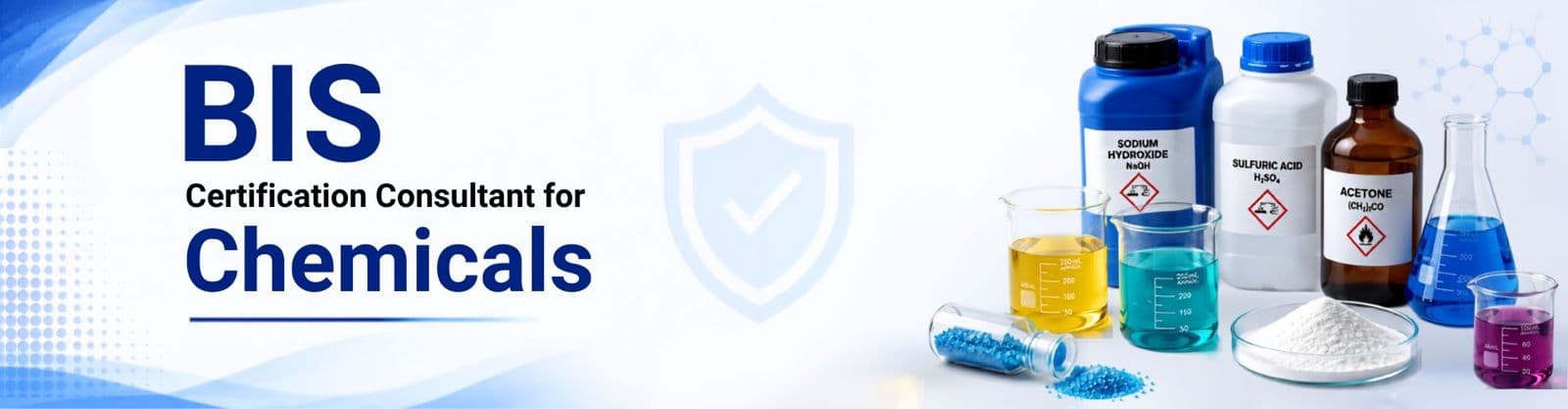
BIS CERTIFICATION FOR CHEMICALS
[ Table Of Content ]
- Introduction
- What is BIS Certification for Chemical Products?
- Why is BIS Certification Mandatory?
- Latest Chemical QCO Updates
- New BIS Standards for Chemical Products
- List of Chemicals Covered
- BIS Certification Process
- Documents Required
- BIS Testing Requirements
- BIS Licence Approval Timeline
- Foreign Manufacturers (FMCS Route)
- BIS Certification Cost
- How to Check if Your Product Requires Certification
- Common Reasons for Delay
- Penalties for Non-Compliance
- Benefits of BIS Certification
- Why Choose EVTL India
- Frequently Asked Questions (FAQ)
Quick Overview
BIS Certification for Chemicals in India is a compulsory regulatory requirement for chemical products to ensure compliance with the Indian standard. The notified chemical product must obtain a valid BIS licence and the ISI mark before being manufactured or sold in the Indian market. With more and more chemicals being made compulsory for certification, manufacturers and importers must stay updated with the latest BIS requirements and QCOs notifications.
Introduction
Are you a manufacturer or importer of chemicals, wondering whether BIS certification is required for your products in India? BIS Certification for Chemical Products is a mandatory requirement for all chemical products which fall under the Quality Control Orders (QCOs) by the Government of India. The BIS ISI certificate for chemicals is necessary in order to ensure that the chemicals manufactured or imported to India meet the BIS standards for chemicals and the Indian Standard specifications.
With the increasing number of chemical QCOs, it is important to understand the BIS requirements, test procedure, documents, and certification process to stay away from any sort of problems regarding compliance. Chemical products are evaluated under the Bureau of Indian Standards (BIS) through product testing, manufacturing plant inspection and quality control assessment.
EVTL India is a regulatory compliance partner for chemical products, helping manufacturers get their products certified smoothly. From identifying applicable Indian Standards, preparation of documents, product testing, to the entire process of BIS application, EVTL India offers complete assistance in getting BIS certification for your chemical products.
What is BIS Certification for Chemical Products?
BIS Certification of Chemical Products is a process through which the Bureau of Indian Standards certifies that the chemical product satisfies the requirements of the particular Indian Standard (IS). Manufacturers and importers must ensure that the notified chemical products meet the mandatory regulatory compliance requirements as per Quality Control Orders (QCOs) issued in India. This process helps businesses achieve complete BIS chemical compliance before selling the product to the Indian customer.
When the chemical products are compliant with BIS quality and safety requirements, they must have the ISI Mark. This process comes under the BIS Act, 2016, where the non-compliance of products could result in penalties, seizure, legal action, etc.
Although QCOs are issued by authorities like the Department of Chemicals and Petrochemicals (DCPC) and the Department for Promotion of Industry and Internal Trade (DPIIT), the entire process of product certification is governed by BIS.
Why is BIS Certification Mandatory for Chemical Products in India?
Earlier, obtaining a BIS mark certification for chemical products was not mandatory for all product categories. The ISI mark was marked by the manufacturer only if required. However, the Government of India began issuing the mandatory Quality Control Orders (QCOs) for chemical products starting from 2018.
A BIS certification for industrial chemicals ensures that substandard chemicals are not used across industries. A low-quality chemical product may affect various industries such as paints, plastics, medicines, packaging and water treatment.
Due to such strict laws, BIS certification has become important for chemical manufacturers to sell their products legally in India. Some of the important points include:
QCOs are released by the authorities like DCPC and DPIIT.
63+ chemical products have been covered under the mandatory BIS Approval process through QCO notification.
Compliance checks are carried out through BIS inspections, testing and market surveillance.
Latest Chemical QCO Updates
In 2025, BIS improved the rules for chemical products by introducing new Quality Control Orders (QCOs) along with revising other requirements. Some of the changes include:
49 additional chemicals were reviewed for possible inclusion under mandatory BIS certification. This includes acids, solvents, disinfectants and adhesives.
Implementation of QCOs for Vinyl Sulphone and H-Acid was extended to 13 May 2026, allowing industries additional time for compliance.
Certain QCOs for chemicals like p-xylene, toluene, acrylates, vinyl acetate monomer, ethylene dichloride and vinyl chloride monomer were withdrawn to reduce regulatory challenges.
BIS regulations are moving towards a risk-based approach, with stricter control on important chemicals and simplified requirements for selected products.
New BIS Standards for Chemical Products
BIS regularly introduces new IS codes for the purpose of enhancing the quality, safety and uniformity of the chemicals. Several recently published standards are linked to existing or upcoming Quality Control Orders (QCOs), making them important for manufacturers and importers.
| Indian Standard | Chemical / Product | Key Updates |
|---|---|---|
| IS 17988:2022 | CPVC Resin | Introduces specifications for chlorine content, viscosity, particle size, and volatile matter. |
| IS 17658:2021 | PVC Homopolymers | Introduces specifications for PVC suspension and paste/emulsion resins with updated quality and performance requirements. |
| IS 18174:2023 | Polyether Polyols | Establishes limits for hydroxyl value, viscosity, and water content used in polyurethane manufacturing. |
| IS 17916:2022 | Toluene Diisocyanate (TDI-80) | Defines purity, acidity, stability, and quality parameters for TDI-80 used in polyurethane applications. |
| IS 17927 (Part 1):2022 | Ethylene-Vinyl Acetate (EVA) | Establishes classification based on vinyl acetate content and melt flow properties for consistent processing. |
| IS 18103:2022 | Polyacrylamide | Provides material classification and quality requirements for industrial and water treatment applications. |
| IS 17928 (Part 1):2022 | PMMA | Specifies requirements for optical quality, softening temperature, and melt flow characteristics. |
| IS 17982:2022 | Methyl Methacrylate (MMA) | Updates limits for purity, colour, density, and moisture content to ensure reliable product quality. |
| IS 17992:2022 | Superabsorbent Polymer (SAP) | Defines absorption capacity, liquid retention, and safety requirements for hygiene applications. |
Manufacturers should regularly check the official website or contact EVTL India for new BIS standards and QCO notifications. This will ensure continued compliance with India's evolving chemical regulations.
List of Chemicals Covered Under Mandatory BIS Certification
Some important chemicals covered under BIS requirements include:
| Chemicals | Indian Standard (IS Code) |
|---|---|
| Polycarbonate | IS 14434 |
| Acetic Acid | IS 695 |
| Vinyl Chloride Monomer | IS 17442 |
| Sodium Tripolyphosphate, Anhydrous, Technical | IS 6100 |
| Methanol | IS 517 |
| Ethylene Vinyl Acetate Copolymers | IS 13601 |
| Boric Acid | IS 10116 |
| Acrylonitrile | IS 12540 |
| Potassium Carbonate | IS 7129 |
| Poly Aluminium Chloride | IS 15573 |
| Toluene | IS 537 |
| Phthalic Anhydride | IS 5158 |
| Polyethylene Material for Moulding and Extrusion | IS 7328 |
| Pyridine | IS 8058 |
| Maleic Anhydride | IS 5149 |
| Stabilised Hydrogen Peroxide | IS 2080 |
| Ethylene Glycol | IS 5295 |
| Gamma Picoline | IS 16113 |
| Linear Alkyl Benzene | IS 12795 |
| Caustic Soda | IS 252 |
| Methyl Acrylate | IS 14707 |
| Morpholine | IS 12084 |
| Acetone | IS 170 |
| Polyurethanes | IS 17397 (Part 1) |
| Sodium Sulphide | IS 297 |
| SBR Latex | IS 11356 |
| Ethyl Acrylate | IS 14708 |
| Phosphorous Oxychloride | IS 11657 |
| Aniline | IS 2833 |
| EDC (Ethylene Dichloride) | IS 869 |
| Terephthalic Acid | IS 15030 |
| Beta Picoline | IS 16112 |
| Synthetic Micro-Fibres for Cement Matrix | IS 16481 |
| SM (Styrene Monomer) | IS 4105 |
| n-Butyl Acrylate | IS 14709 |
| Phosphorous Pentachloride | IS 11744 |
| Precipitated Barium Carbonate, Technical | IS 3205 & IS 12928 |
| Polypropylene Materials for Moulding and Extrusion | IS 10951 |
| Ether | IS 336 |
| Ortho Phosphoric Acid | IS 798 |
| Acrylonitrile-Butadiene Styrene (ABS) | IS 17077 |
| Phosphorous Trichloride | IS 4581 |
| Sodium Formaldehyde Sulphoxylate | IS 4505 |
| Poly Vinyl Chloride (PVC) Homopolymers | IS 17658 |
These are some of the important chemicals covered under the mandatory BIS standards for chemicals. As the list is continuously updated, one can contact EVTL India for the latest product list.
BIS Certification Process for Chemical Products in India
The BIS certification ensures that the manufacturer complies with the relevant Indian Standard before obtaining a BIS license for chemical manufacturers. The BIS tests the quality of the product, production process, testing facilities, etc., before issuing the BIS license. The major steps involved in the BIS registration process for chemical products include:
Online Application: An online application is made by the manufacturer via the Manak Portal, providing information about the manufacturer, the chemical product, the manufacturing plant, the manufacturing process and the quality control system. Foreign manufacturers need to appoint an Authorized Indian Representative (AIR).
Product Testing: The chemical product will be subjected to testing in a BIS-accredited laboratory to check whether the product meets the relevant Indian Standard (IS Code) as stated in the corresponding Quality Control Order (QCO).
Application Submission: The BIS application must be submitted with the necessary test reports, technical data, manufacturing and quality control data.
Factory Inspection: A Factory inspection will be conducted by the officials from BIS to assess the manufacturing process, testing facilities, raw material control, manufacturing capability and quality control systems.
Issue of BIS Licence: If all the processes are successfully verified then BIS will provide the manufacturer with the BIS licence.
ISI Mark Usage: Once the product gets certified, then manufacturers can use the ISI Mark for chemical products along with CM/L number as proof that their products are meeting the relevant Indian Standard.
Documents Required for BIS Certification of Chemical Products
Manufacturers need to submit various documents during the BIS certification process. Proper BIS documentation for chemicals is essential for the timely approval of the product license.
| Document Category | Documents Required |
|---|---|
| Business Details | GST certificate, company registration documents, address proof |
| Manufacturing Details | Factory layout, machinery details, manufacturing process flow |
| Product Details | Product specifications, formulation details, technical datasheets |
| Quality Control Documents | QC procedures, testing equipment details, calibration certificates |
| Testing Documents | Laboratory test reports and sample details |
| Management Details | Authorized signatory details and communication details |
| Brand Documents | Trademark documents, if applicable |
BIS Testing Requirements for Chemical Products
Testing requirements vary depending on the chemical product and the applicable Indian Standard. Common evaluation parameters include:
| Test Parameter | Purpose |
|---|---|
| Chemical Composition | Verification of product formulation and composition |
| Purity Level | Ensures required quality standards are maintained |
| Physical Properties | Checks characteristics such as appearance, density, and stability |
| Performance Testing | Evaluates product suitability for intended use |
| Safety Parameters | Ensures compliance with safety requirements |
| Contaminant Limits | Checks restricted substances and impurities |
Product testing is one of the most important steps in BIS chemical compliance, as every notified chemical product must successfully meet the BIS testing requirements.
BIS Licence Approval Timeline for Chemical Products
| Stage | Approximate Time |
|---|---|
| Standard Identification | 1–3 Days |
| Documentation | 5–10 Days |
| Product Testing | 20–40 Days |
| Factory Inspection | As scheduled by BIS |
| Licence Approval | Depends on BIS verification |
BIS Certification for Foreign Chemical Manufacturers (FMCS Route)
Foreign manufacturers supplying notified chemical products must get their BIS certificate for chemical products through the Foreign Manufacturer Certification Scheme (FMCS). Under the FMCS process, foreign manufacturers must complete the BIS registration, submit samples for testing and undergo a factory audit of the facility. Some of the important things which a foreign manufacturer needs to do under FMCS are:
Appointment of Authorized Indian Representative (AIR) who will act on behalf of the foreign manufacturer and work with BIS.
Testing of the product in an Indian laboratory approved by BIS to test conformity with the Indian Standard applicable to that product.
Factory inspection by BIS officials at the overseas manufacturing facility.
Documents should be provided in English; however, translated and notarized documents might be required for other languages.
Payment of the BIS FMCS fee in foreign currency by foreign manufacturers.
Note: EVTL India offers full BIS Certification assistance for chemical manufacturers, which includes AIR appointment, pre-testing coordination, BIS License application, FMCS assistance, factory audit preparation and technical inspection from retired BIS officers.
BIS Certification Cost for Chemical Products
The cost for obtaining the BIS license for chemical products depends on several factors. The table below shows the cost breakdown:
| Charge Type | Indian Manufacturers | Foreign Manufacturers |
|---|---|---|
| Application Fee | INR 1,000 | USD 15 |
| Audit Charges | INR 7,000 | USD 3,200 - 5,900 |
| License Fee | INR 1,000 | USD 15 |
| Marking Fee | As applicable | As applicable |
| Testing Charges | As applicable | As applicable |
| EVTL India Consultancy Fee | As per actual | As per actual |
How to Check Whether Your Chemical Product Requires BIS Certification?
Before manufacturing, importing or distributing any chemical products in India, it is necessary to first confirm whether your product needs BIS Certification or not. The same can be confirmed by looking at the QCO, IS and BIS Notifications. In case you find that your product is notified under any QCO, then you are required to obtain a BIS license.
Check the applicable Quality Control Order (QCO) issued by the department.
Identify the relevant Indian Standard (IS) applicable to your chemical product.
Verify whether your product is included in the latest list of chemicals covered under mandatory BIS certification.
Review the latest BIS notifications and amendments for any changes in compliance requirements.
Confirm the applicable certification scheme, such as Scheme-I (ISI Mark) or FMCS for foreign manufacturers.
Seek expert guidance from EVTL India to complete the BIS certification process smoothly.
Common Reasons for Delay in BIS Certification for Chemical Products
Several companies face delays in the BIS certification process due to a lack of proper preparation. Some of the reasons for the delay in BIS ISI certification for chemical products are:
Incorrect Selection of Indian Standard.
Incomplete Documentation.
Product Test Failure.
Inadequate Quality Control System.
Lack of Regulatory Understanding.
Many manufacturers seek assistance from a BIS consultant for chemicals, such as EVTL India, to easily obtain a product license.
Penalties for Non-Compliance with BIS Certification for Chemical Products
The manufacture, import or sale of notified chemical products without getting the necessary BIS license is an offence under the BIS Act, 2016 and the relevant Quality Control Orders (QCOs). Non-compliance with the BIS requirements may lead to regulatory actions. Some of the consequences include:
Imposition of monetary fines as per the BIS Act, 2016.
Seizure or recall of non-conforming chemical products.
Limitations to manufacture, importing, or sell the notified products.
Legal action against the manufacturer or importer for non-compliance.
Loss of business opportunities, including government tenders and institutional procurement.
Benefits of Getting BIS Certification for Chemicals
There are several advantages of obtaining the BIS ISI Mark certification for Chemical Products. A few benefits include:
Ensures complete BIS chemical compliance.
Allows the legal sale of notified chemical products in India.
BIS certified chemical products gain higher customer confidence.
Improves acceptance in industrial and government markets.
Reduces risks related to non-compliance penalties.
Demonstrates commitment to quality and safety standards.
Provides a competitive advantage in the Indian market.
EVTL India - Your Trusted BIS Compliance Partner for Chemical Products
EVTL India is a trusted regulatory consultant helping businesses obtain a BIS license for chemical manufacturers, achieve complete BIS chemical compliance and comply with the latest BIS standards for chemicals. Having 12+ Years of BIS compliance expertise in chemical products, our service includes:
Identification of the relevant Indian Standards.
BIS QCO applicability assessment.
Preparation and review of technical documents.
Coordination with BIS-recognized laboratories.
Assistance with product testing.
BIS application filing and follow-up.
Factory inspection preparation.
FMCS assistance for foreign manufacturers.
AIR appointment support.
Post-certification services including renewal and compliance guidance.
Conclusion
BIS Certification for Chemical Products in India is an essential regulatory requirement for those involved in handling chemical products governed by Quality Control Orders (QCOs). Obtaining a valid BIS certificate for chemical products will ensure that the chemical products meet the relevant Indian Standard.
BIS ISI certification for chemicals involves different steps, such as standard identification, documentation preparation, testing, factory inspection and BIS application approval.
At EVTL India, we offer you the best BIS compliance services for your chemical products in India. We assist at every stage, starting with standard identification and documentation and ending with testing coordination, BIS application submission and FMCS services.
Contact EVTL India today for expert guidance and end-to-end BIS certification support.
Frequently Asked Questions (FAQs)
Our Partners


Need BIS Certification or Compliance Support?
Talk to Our Experts Today!
Get personalized guidance from our compliance specialists.