Wrought aluminium and aluminium alloy plates are flat metal plates made from aluminium or aluminium alloys. They are made to offer strength, durability, and convenience to use in different applications.These aluminium plates are commonly used in various industries such as construction, transport, aerospace, etc. This is because aluminium plates are light, strong, and corrosion-resistant. They can be used in any application where performance and longevity are key factors to be considered.
For quality purposes, aluminium plates need to follow the standards set by the standard. BIS certification of aluminium plates ensures that the plates meet to set standards in terms of composition, strength, size, etc. This makes aluminium plates suitable for use in various industrial applications.
overview of indian standard is 736:1986
This standard defines the technical requirements for aluminium alloy plates to ensure proper quality, strength, and performance for industrial use.
Key Features include:
- Chemical Composition: Ensures correct element mix for strength and corrosion resistance
- Mechanical Properties: Confirms durability and ability to handle load
- Dimensions and Tolerances: Maintains proper size and thickness for accurate use.
Meeting these requirements is essential to obtain ISI Certification and ensure reliable product performance.
testing and inspection requirements
To ensure the quality of aluminium alloy plates, IS 736: 1986 defines specific inspection and testing practices during manufacturing. These checks help maintain consistency and ensure the material meets required standards.
freedom from defects
The plates must be free from harmful defects such as cracks or surface imperfections. Adequate inspection is carried out during production to ensure the material is sound and suitable for use.
chemical composition test
The chemical composition is checked to ensure the correct alloy is used.
- Sample: One from each heat (raw material batch)
This ensures proper strength and corrosion resistance.
mechanical properties test
Tensile Test
The tensile test is conducted to check the strength and durability of the plates
- Sample: One from each control unit (batch)
This ensures the material can handle load and stress during use.
dimension and tolerances
The size, thickness, and tolerances of the plates are checked during production. Proper inspection ensures that the material meets the required specifications for accurate fitting and application.
Importance of These Checks
These testing and inspection practices help maintain consistent quality, reduce defects, and ensure that aluminium alloy plates meet the required standards for industrial applications.
Process for BIS Certification

The certification process of BIS ensures that the quality and performance requirements specified under the standard are met. The process is simple and requires the following steps to be followed:
- Online Registration: The first step in getting BIS certification is to register on the Manak portal, BIS’s
online platform. Manufacturers need to create an account, fill in company details,
and provide information about the product and manufacturing process. They also
have to upload supporting documents like technical specifications and test
reports. For foreign manufacturers, a hard copy of the application and documents
must be sent to the BIS office, and an Authorized Indian Representative (AIR)
should be appointed to handle communications.
- Testing at BIS-Approved Laboratory: Product samples are tested in a BIS-recognized lab to check compliance with
requirements like composition, strength, size, and surface finish.
- Application Submission: The application is submitted along with test reports, technical documents, and
KYC details. Foreign manufacturers must also appoint an Authorized Indian
Representative (AIR).
- Factory Inspection: BIS officials inspect the manufacturing unit to verify:
- Manufacturing process
- Quality of raw materials
- Factory setup and infrastructure
- In-house testing and quality control
- Grant of BIS License: After successful verification of documents, test results, and inspection, BIS
grants the license.
- Use of ISI Mark: Once certified, the manufacturer can use the ISI mark along with the CML
number on the product or packaging to show compliance with standard.
documents required for bis certification
| Basic Details | - GST Certificate
- Email ID & Contact Number
- Factory & Office Address
- Rent Agreement / Lease Deed (if applicable)
|
| Legal Documents | - Partnership Deed (if partnership firm)
|
| Manufacturing Details | - List of machinery
- Process flow chart
- Layout Plan of Factory
|
| Raw Material Details | - List of Raw Materials
- Supplier Details
- Raw Material Invoices
- Raw Material Test Certificates
|
| Testing & Quality Control | - List of Testing Equipment
- Calibration Certificates
- QC / Lab In-charge Appointment Letter & Qualification
|
| Production Details | - Annual Installed Capacity
- Last Year Production Value
|
| Product & Packaging Details | - Quantity per Package
- Nature of Packing
- Nature of Printing / Marking on Product
|
| Management Details | - Top Management Details
- Concerned Person for BIS Communication
|
| Brand & Certification Documents | - Trademark / Brand Certificate
- Consent Letter from BIS Recognized Laboratory
|
| Additional Documents | - Weekly Off Details
- Hygiene Document (if applicable)
- Relaxation Letter (if applicable)
- Any Other Relevant Document
|
Foreign manufacturers must additionally appoint an Authorized Indian Representative (AIR) to coordinate with the Bureau of Indian Standards (BIS) and manage compliance requirements in India.
Marking Requirements & License Validity
Marking Requirements
After obtaining the BIS license, the product should display the ISI Mark on the product
or its package. This indicates that the plates follow the requirements of the standard.
In addition to the ISI Mark, other information to be indicated on the product is as given in
the table below:
| Requirement | Details |
|---|
| ISI Mark | Shows the product is BIS certified |
| Standard Number | IS 736: 1986 |
| CML Number | Certification Marks Licence number issued by
BIS |
| Manufacturer Details | Name or registered trademark |
| Product Details | Type of aluminium plates |
| Size Details | Dimensions such as thickness and length |
| Alloy Information | Type/grade of aluminium alloy used |
| Batch / Date | Batch number, heat number, or manufacturing date for traceability |
Note:
Marking is typically applied using durable stamping, tagging, or permanent printing to ensure clear identification during handling, storage, and transportation, as per BIS marking requirements.
Validity of BIS Licence for Wrought Aluminium And Aluminium Alloy Plates
After obtaining BIS Certification for the product, the license is valid for a fixed period and must be maintained by following BIS rules and standards.
| Particulars | Details |
|---|
| Initial Validity | Typically 1 to 2 years, depending on BIS approval conditions |
| Renewal | Must be renewed before expiry by submitting the application along with the prescribed fee and updated documents |
| Surveillance | Includes periodic factory inspections and market sample testing conducted by BIS |
| Compliance | You must keep following the standard and related quality rules at
continuous manner. |
| Risk | Non-compliance may lead to suspension or cancellation of the BIS
license |
bis certification cost
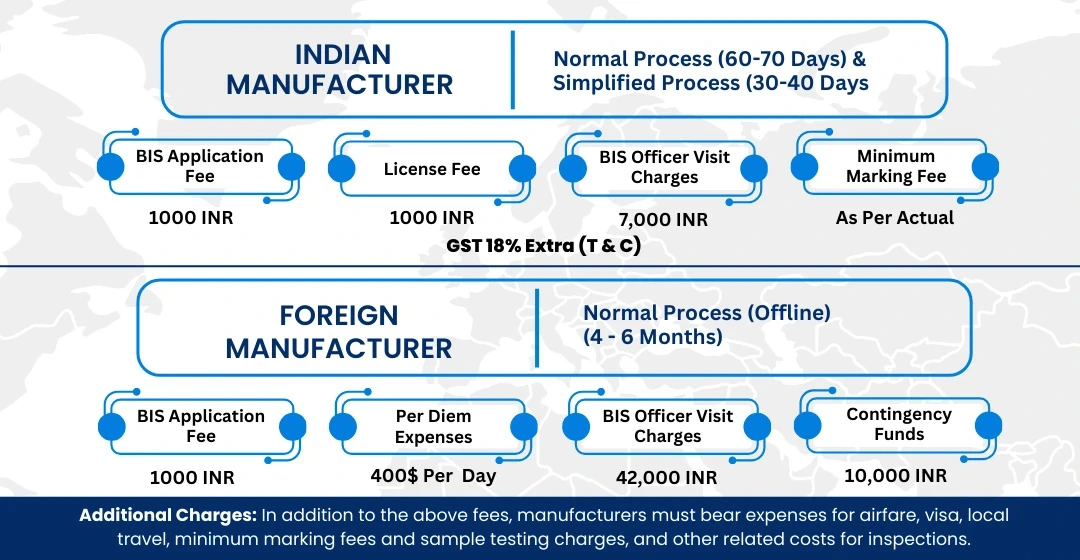
cost breakdown
| S. No. | Particular | Amount (INR) | Remarks |
|---|
| 1 | Application Fee | 1000 | To be paid to BIS |
| 2 | Audit / Inspection Fee | 7000 | To be paid to BIS |
| 3 | License Fee | 1000 | To be paid to BIS |
| 4 | Sample Testing Fee | As applicable | Varies by product and lab |
| 5 | Minimum Advance Marking Fee | As applicable | Depends on production and standard |
| 6 | Renewal Fee | 1000 | To be paid to BIS |
| 7 | Inclusion Fee | 5000 | To be paid to BIS |
| 8 | Service Fee | As applicable | Consultant charges (if any) |
Note:
- Additional costs like inspection or pre-testing may apply.
- Total cost may vary based on product type, testing needs, and BIS requirements.
Marking Fee (As Per Manak Portal Reference - IS 736:1986)
Note: The marking fee is based on reference data from the Manak portal. The actual fee may vary depending on production volume, unit size, and BIS guidelines.
Conclusion
The certification from BIS as per IS 736: 1986 ensures that the quality and performance standards are met for the wrought aluminum and aluminum alloy plates. This certification ensures that the composition, strength, and testing of the materials are carried out as per the guidelines.
The certification process may take some time as it involves steps such as documentation, product testing, and factory inspection. However, if guidance from an experienced BIS consultant like EVTL INDIA is taken, the certification process can be completed smoothly.