Polypropylene-Random Copolymer (PPR) pipes are generally used for carrying hot and
cold water in homes, buildings, and plumbing systems. These pipes are strong,
lightweight, and resistant to heat and corrosion, making them suitable for long-term use.
They are widely used for water supply in bathrooms, kitchens, and commercial spaces.
BIS certification for PPR pipes ensures that these pipes meet quality parameters and
safety requirements as per IS 15801:2008 set by the Bureau of Indian Standards (BIS).
what is is 15801:2008 ?
This is the Indian Standard for Polypropylene-Random Copolymer (PPR) pipes used for hot and cold water supply systems. This standard is set by the Bureau of Indian Standards (BIS) to ensure that the pipes meet proper performance and operational efficiency for safe use in plumbing systems and also checks these pipes must be :
- Safe for carrying drinking water
- Strong enough to handle pressure and temperature changes
- Resistant to corrosion, scaling, and chemical effects
- Durable for long-term use in hot and cold water systems
- Made with good quality material and proper finish
testing and inspection requirements
To ensure proper performance and best quality of PPR pipes, the Bureau of Indian Standards (BIS) provides clear testing and inspection requirements during manufacturing under the applicable standard.
what is r & s ?
- R (Required): Test must be done in the manufacturer’s own laboratory.
- S (Subcontracting Allowed): Test can be done in a BIS-approved or external laboratory.
raw material tests
- Material Quality Check (S) – Ensures proper raw material is used
- Density Test (R) – Checks strength and consistency of material
- Melt Flow Rate (R) – Ensures proper flow and processing of material
- Additives & Composition (S) – Verifies quality of stabilizers and color materials
Dimensional and physical tests
- Pipe Dimensions Test (R) – Ensures correct size, thickness, and diameter
- Visual Appearance (R) – Checks surface finish and defects
- Ovality and Length Check (R) – Ensures proper pipe shape and uniformity
performance tests
- Hydrostatic Pressure Test (R) – Ensures pipes can handle pressure at different temperatures
- Fusion Compatibility Test (R) – Ensures proper jointing and welding of pipes
- Reversion Test (R) – Checks pipe stability under heat
- Impact Strength Test (R) – Ensures pipes can resist physical damage
material property tests
- Density (R) – Confirms material consistency in finished pipes
- Melt Flow Rate (R) – Checks processing quality of final product
- Carbon Black Test (R) – Ensures protection against sunlight (UV resistance)
special tests
- Thermal Stability Test (S) – Ensures long-term performance under high temperature and pressure
- Opacity Test (S) – Ensures pipes prevent light penetration to avoid algae growth
bis certification process for ppr pipes
The BIS certification process ensures that Polypropylene-Random Copolymer (PPR) pipes meet the required standards for proper and efficient operation. This process is defined by the Bureau of Indian Standards (BIS) and includes the following steps:
- Online Registration:Manufacturers register on the BIS Manak portal by submitting company, factory,
and product details. Foreign manufacturers must appoint an Authorized Indian
Representative (AIR).
- Testing at BIS-Approved Laboratory:Product samples are tested in BIS-approved labs to check safety, insulation,
heating performance, and electrical protection.
- Application Submission:The application is submitted along with test reports, technical documents, and
factory details. Foreign manufacturers must also submit AIR-related documents.
- Factory Inspection: BIS officials inspect the manufacturing unit to verify the production process,
safety measures, and quality control system.
- Grant of BIS License: If all requirements are met, BIS grants the certification license under Scheme-I.
- Use of ISI Mark: After approval, the manufacturer can use the ISI mark on portable immersion
heaters with a CM/L number, confirming that the product meets BIS standards.
documents required for is 15801 certification
| Basic Details | - GST Certificate
- Email ID & Contact Number
- Factory & Office Address
- Rent Agreement / Lease Deed (if applicable)
|
| Legal Documents | - Partnership Deed (if partnership firm)
|
| Manufacturing Details | - List of Machinery
- Process Flow Chart
- Layout Plan of Factory
|
| Raw Material Details | - List of Raw Materials
- Supplier Details
- Raw Material Invoices
- Raw Material Test Certificates
|
| Testing & Quality Control | - List of Testing Equipment
- Calibration Certificates
- QC / Lab In-charge Appointment Letter & Qualification
|
| Production Details | - Annual Installed Capacity
- Last Year Production Value
|
| Product & Packaging Details | - Quantity per Package
- Nature of Packing
- Nature of Printing / Marking on Product
|
| Management Details | - Top Management Details
- Concerned Person for BIS Communication
|
| Brand & Certification Documents | - Trademark / Brand Certificate
- Consent Letter from BIS Recognized Laboratory
|
| Additional Documents | - Weekly Off Details
- Hygiene Document (if applicable)
- Relaxation Letter (if applicable)
- Any Other Relevant Document
|
Foreign manufacturers must additionally appoint an Authorized Indian Representative (AIR) to coordinate with the Bureau of Indian Standards (BIS) and manage compliance requirements in India.

marking requirements & license validity
marking requirements
When a manufacturer obtains the BIS License, the ISI mark for PPR pipes must be applied clearly and permanently on the product or its packaging. In addition to the ISI Mark, other important details must also be provided on the product or packaging, as specified in the table below. This ensures the product meets to all quality and safety standards.
Note:
Marking is typically applied using durable stamping, tagging, or permanent printing to ensure clear identification during handling, storage, and transportation, as per BIS marking requirements.
validity of bis license for irrigation equipment
After obtaining BIS certification for the product, the license is valid for a fixed period and must be maintained by following BIS rules and standards.
cost of bis certification for irrigation equipments
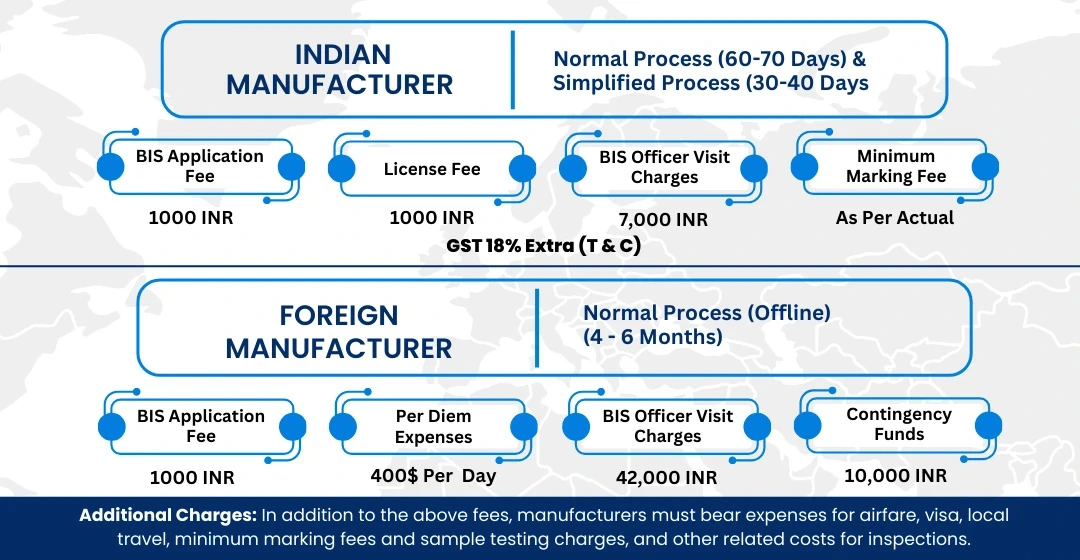
The cost of BIS certification includes charges for application, inspection, license, testing, and marking. These fees are paid to BIS as per Scheme I guidelines.
cost breakdown
Indian Manufacturers
| S. No. | Major Charges | Particulars | Amount (INR) | Remarks |
| 1 | BIS Fees | Application Fee | INR 1,000 | - |
|
| Audit Charges | INR 7,000 | - |
|
| License Fee | INR 1,000 | - |
| | Marking Fee | Depends on product | Discount as per MSME |
| 2 | Testing Charges | Sample Testing Fee | As applicable | Payable to a BIS-approved laboratory |
| 3 | EVTL India Service Fee | Consultancy & Support | As per actual | Depends on product type and factory location. |
Foreign Manufacturers
| S. No. | Major Charges | Particulars | Amount | Remarks |
| 1 | BIS Fees | Application Fee | USD 15 | Payable via SWIFT to BIS. SAARC countries can pay INR with 18% GST. |
|
| Audit Charges | USD 3,200 – 5,900 | Depend on Country |
|
| License Fee | USD 15 | - |
| | Marking Fee | Depends on product | - |
| 2 | Testing Charges | Sample Testing Fee | As applicable | Payable to a BIS-approved laboratory |
| 3 | EVTL India Service Fee | Consultancy & Support | As per actual | Based on product and manufacturing location.
|
Note: Additional costs such as pre-testing or factory pre-inspection may apply. The total cost may vary depending on product type, testing requirements, and current BIS guidelines.
conclusion
BIS certification for Polypropylene-Random Copolymer (PPR) pipes as per IS 15801:2008 ensures that the pipes must meet the required quality parameters and safety standards for efficient performance in hot and cold water supply systems. It also ensures that the pipes are properly tested for strength, pressure resistance, durability, and safety for drinking water, making them suitable for long-term plumbing applications. With the support of an experienced BIS consultant like EVTL India, manufacturers can complete the certification process smoothly, avoid errors, and get timely approval for their products.