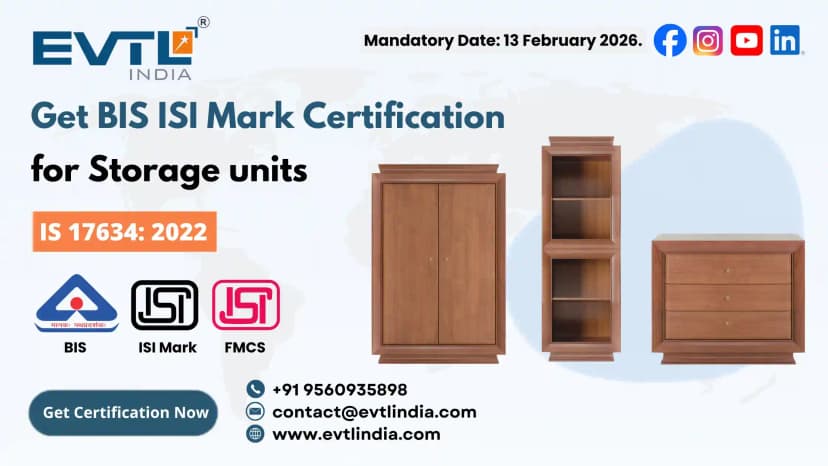
Storage units are furniture items used to keep and organize things in homes, offices,
and commercial spaces. These include cupboards, cabinets, shelves, lockers, and other
storage systems used for daily storage needs. They are designed to handle weight and
keep items safe and well arranged. Since these furniture items are used regularly and
carry different loads, they must be strong, stable, and safe
To ensure this, they follow IS 17634:2022, which sets the requirements for strength,
safety, design, and performance of storage furniture. BIS certification confirms that the
storage unit has been tested as per this standard and meets Indian quality
requirements.
Who Needs BIS Certification for Furniture Storage Units?
- Manufacturers (India): Must get BIS certification if storage units are covered
under QCO
- Foreign Manufacturers: Need certification to export furniture to India
- Importers/Brand Owners: Must ensure products are BIS certified before selling
- Sellers/Distributors: Should only sell certified products
Certification is regulated by the Bureau of Indian Standards (BIS) under IS 17634:2022.
What is IS 17634:2022?
This is an Indian Standard issued by the Bureau of Indian Standards (BIS) that defines
the requirements for storage units such as cupboards, cabinets, and similar furniture.
It provides guidelines on how these products should be designed, manufactured, and
tested before being sold in India.
This standard ensures that storage units:
- Are structurally strong and stable
- Can safely carry the intended load
- Have proper durability for daily use
- Follow required safety and performance rules
Testing and Inspection Requirements for Storage Units
To ensure proper strength, durability, performance, and safety of storage units, the standard
defined by the Bureau of Indian Standards (BIS) under IS 17634:2022 specifies detailed testing
and inspection requirements during manufacturing and certification.
What are R and S
- R (Required): Test must be conducted in the manufacturer’s in-house laboratory
- S (Subcontracting Allowed): Test can be conducted in an external BIS-recognized /
accredited laboratory
Raw Material Testing
- Surface Material Tests (S) – All rigid surfaces, fabric, and leather (natural/synthetic)
must comply with performance requirements
- Mechanical & Surface Resistance Tests (S) – Includes resistance to heat, liquids,
scratches, and adhesion
- Fabric & Leather Tests (S) – Includes tearing strength, colour fastness, abrasion
resistance, and seam strength
Design and Dimensional Requirements
- Design & Workmanship Check (R) – Ensures proper construction, finishing, and
absence of defects
- Dimensional Verification (R) – Checks height, width, thickness, and tolerances using
measuring tool.
Structural and Load Performance Tests
- Shelf Strength Test (R) – Ensures shelves can withstand defined loads
- Top & Bottom Load Test (R) – Verifies durability under static and sustained loads
- Clothes Rail Strength Test (R) – Ensures rails and supports can handle weight
- Structure Strength Test (R) – Evaluates overall frame stability and durability
- Drop Test (R) – Checks resistance to impact
Movable Components Testing
Doors and Flaps
- Door Strength Test (R) – Checks vertical and horizontal load resistance
- Slam Test (R) – Ensures durability under repeated opening/closing
- Durability Test (S) – Long-term performance validation
Sliding & Roll-Front Systems
- Stability Test (R) – Ensures units do not topple under load or when doors are open
- Overturning Load Test (R) – Checks resistance against tipping
- Wall Attachment Strength Test (R) – For mounted units
- Dynamic Stability Test (S) – For units with castors/wheels
Durability Tests
- Cyclic Load Test (S) – Ensures long-term durability under repeated usage
- Impact Test (S) – For units with seating surfaces
- Fatigue Testing (S) – Evaluates wear and tear over time
Surface Performance Tests
Rigid Surfaces
Resistance to:
- Mechanical damage
- Wet and dry heat
- Cold liquids, oils, and fats
- Surface marking
Fabric & Leather Surfaces
- Breaking Strength (S)
- Elongation (S)
- Abrasion Resistance (S)
- Colour Fastness (S)
- Pilling Resistance (S)
Inspection and Quality Control (QAP)
- Manufacturers must implement a Quality Assurance Plan (QAP)
- Control Unit: storage units of the same model family produced in one month
- Regular testing must be conducted as per defined frequency
BIS CERIFICATION PROCESS FOR STORAGE UNITS

The BIS certification process ensures that storage units comply with the required quality, safety,
and performance standards as specified under IS 17634:2022. This process is governed by the
Bureau of Indian Standards under Scheme-I (ISI Mark Scheme) and involves the following
steps:
- Online Registration: Manufacturers must register on the BIS Manak Portal by providing
details of the company, manufacturing unit, and product specifications. Foreign manufacturers
are required to appoint an Authorized Indian Representative (AIR).
- Testing at BIS-Approved Laboratory: Samples of storage units are tested in
BIS-recognized laboratories to evaluate parameters such as strength, durability, load-bearing
capacity, material quality, and safety requirements.
- Application Submission: The manufacturer submits the BIS application along with test
reports, technical specifications, manufacturing process details, and quality control documents.
In the case of foreign manufacturers, AIR-related documents must also be included.
- Factory Inspection: BIS officials conduct an inspection of the manufacturing premises to
verify infrastructure, production processes, testing facilities, and the implementation of quality
control measures.
- Grant of BIS License: Upon successful evaluation of the application, test results, and factory
inspection, BIS grants the certification license under Scheme-I.
- Use of ISI Mark: After obtaining the license, manufacturers are authorized to affix the ISI
Mark on storage units along with the CM/L number, indicating compliance with IS 17634:2022
and ensuring product reliability and safety.
Documents Required for IS 17634: 2022 License
Additional documentation may be required based on product specifications and environmental regulations.
| Basic Details | - GST Certificate
- Email ID & Contact Number
- Factory & Office Address
- Rent Agreement / Lease Deed (if applicable)
|
| Legal Documents | - Partnership Deed (if partnership firm)
|
| Manufacturing Details | - List of machinery
- Process flow chart
- Layout Plan of Factory
|
| Raw Material Details | - List of Raw Materials
- Supplier Details
- Raw Material Invoices
- Raw Material Test Certificates
|
| Testing & Quality Control | - List of Testing Equipment
- Calibration Certificates
- QC / Lab In-charge Appointment Letter & Qualification
|
| Production Details | - Annual Installed Capacity
- Last Year Production Value
|
| Product & Packaging Details | - Quantity per Package
- Nature of Packing
- Nature of Printing / Marking on Product
|
| Management Details | - Top Management Details
- Concerned Person for BIS Communication
|
| Brand & Certification Documents | - Trademark / Brand Certificate
- Consent Letter from BIS Recognized Laboratory
|
| Additional Documents | - Weekly Off Details
- Hygiene Document (if applicable)
- Relaxation Letter (if applicable)
- Any Other Relevant Document
|
Marking Requirement & License Validity
Marking Requirements
When a manufacturer obtains the BIS license, the ISI Mark for Storage Units must be applied
clearly and permanently on the product or its packaging. In addition to the ISI Mark, essential
details must also be provided as per the requirements of the Bureau of Indian Standards to
ensure quality, safety, and traceability.
| Requirement | Details |
|---|
| ISI Mark | Indicates that the product is BIS certified and follows to the standard |
| Standard Number | IS 17634:2022 |
| CML Number | Certification Marks Licence (CML) number issued by BIS |
| Manufacturer Details | Name of manufacturer or registered trademark |
| Alloy Information | Grade or designation of aluminium alloy used |
| Batch / Date | Batch number, heat number, or manufacturing date for traceability |
Note:
Marking should be done through durable methods such as labeling, engraving, embossing, or
printing to ensure visibility and legibility during storage, handling, and transportation, in
accordance with BIS guidelines.
Validity of BIS Licence for Storage Units
After obtaining BIS certification for Storage Units, the license remains valid for a specified period
and must be maintained through continuous compliance with BIS regulations.
| Particulars | Details |
|---|
| Initial Validity | Typically 1 to 2 years, depending on BIS approval conditions |
| Renewal | Must be renewed before expiry by submitting the application along with the prescribed fee and updated documents |
| Surveillance | Includes periodic factory inspections and market sample testing conducted by BIS |
| Compliance | Continuous following to standard and applicable Quality Control Orders (QCOs) is mandatory |
| Risk | Non-compliance, test failure, or violation of BIS norms may lead to
suspension or cancellation of the license |
>Cost of BIS Certification for IS 17634: 2022
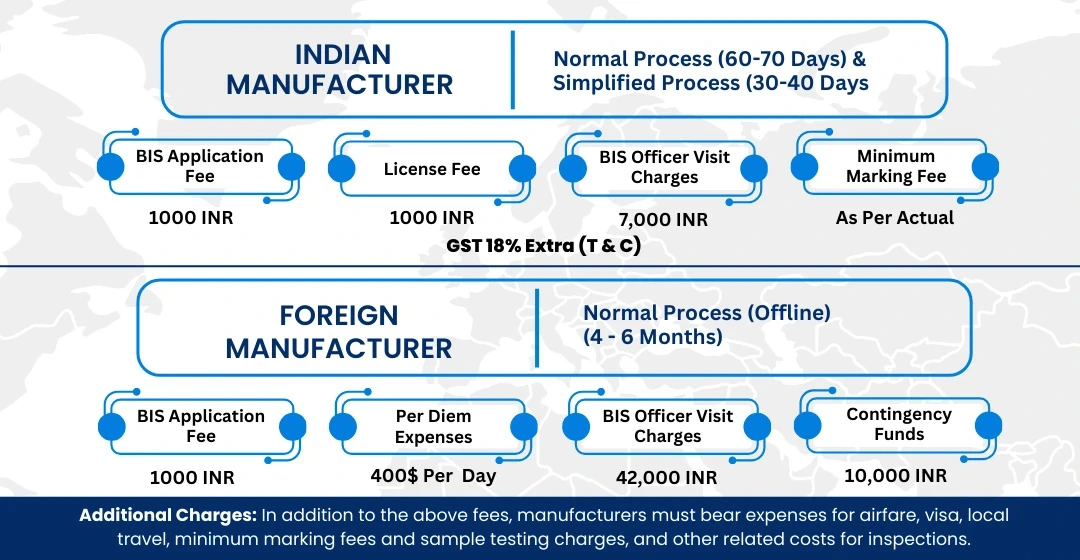
The cost of obtaining certification from the Bureau of Indian Standards includes application fees,
testing charges, inspection (audit) charges, and marking fees. The overall cost may vary
depending on the type of manufacturer, product specifications, and compliance requirements.
For Indian Manufacturers
| No. | Major Charges | Particulars | Amount | Remark |
| 1 | BIS Fees | Application Fee | INR 1,000 | — |
|
| Audit / Inspection Fee | INR 7,000 | — |
|
| License Fee | INR 1,000 | — |
|
| Marking Fee | Depends on product | Discount as per MSME |
| 2. | Testing Charges | Sample Testing Fee | As Applicable | Payable to a BIS-approved laboratory. |
| 3. | EVTL India Service Fee | Consultancy & Support | As per actual | Depends on product type and factory location. |
For Foreign Manufacturers
| No. | Major Charges | Particulars | Amount | Remark |
| 1. | BIS Fees | Application Fee | USD 15 | Payable via SWIFT to BIS. SAARC countries can pay INR with 18% GST. |
|
| Audit Charges | USD 3,200 – 5,900 | Depend on Country |
|
| License Fee | USD 15 | — |
|
| Marking Fee | Depends on product | — |
| 2. | Testing Charges | Sample Testing Fee | As Applicable | Payable to a BIS-approved laboratory. |
| 3. | EVTL India Service Fee | Consultancy & Support | As per actual
| Based on product and manufacturing location. |
To Know The Process in Detail, Please Visit:
Under BIS Registration Products ISI and CRS
CONCLUSION
BIS certification for storage units as per IS 17634:2022 ensures that these products
meet the required Indian standards for safety, strength, and proper use. It confirms that
storage units like cabinets and cupboards are properly tested and are designed to be
safe and durable for everyday use.
With the support of an experienced BIS consultant like EVTL India, manufacturers can
follow a simple and clear certification process and can get help with documentation,
testing support, and inspection preparation, making the process smoother and helping
avoid delays.