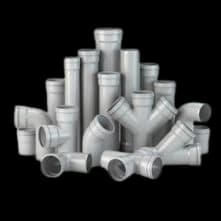
PVC-U pipes are commonly used in soil and waste discharge systems in building structures, which include internal and external drains, ventilation, and rainwater. These pipes are designed to guarantee the safe and effective disposal of wastewater. The pipes used for draining are made from materials that have high resistance to corrosion, chemical reaction, and are durable. This makes the plastic pipes suitable for long-term underground and above-ground applications.
To maintain the quality of the water pipes, the Bureau of Indian Standards has established guidelines under IS 13592: 2013. This standard outline guideline is about material composition, dimensional accuracy, mechanical strength, and performance characteristics of PVC-U pipe. The plastic pipes with BIS certification on them ensure product reliability and are easily accepted in the Indian market.
What is IS 13592: 2013?
This is the Indian Standard for PVC pipes used in waste discharge systems, which outlines the standard requirements for mechanical strength, dimensions, material composition, and pressure ratings. This standard is set by the BIS (Bureau of Indian Standards) to ensure that product quality and safety are met, and the drainage and rainwater pipes are
- Made from approved PVC-U compound materials.
- Designed for efficient soil, waste, ventilation, and rainwater flow systems.
- Verified for mechanical strength and impact resistance.
- Tested for socket fitment and wall thickness.
- Manufactured under controlled extrusion processes to ensure uniform quality .
Eligibility Criteria for PVC Pipes BIS License
BIS authorisation under IS 13592: 2013 is required for businesses involved in manufacturing, importing, or supplying PVC-U soil and waste pipes in India.
Applicable to:
- Manufacturers (India)- Must get BIS authorisation if the pipes are covered under QCO.
- Foreign Manufacturers - Need certification to export UPVC pipes to India.
- Importers/Brand Owners - Must ensure that the products are BIS certified before selling.
- Sellers/Distributors - Should only sell certified PVC drainage pipes.
Testing and Inspection Requirements
To ensure the quality, safety needs, and adequate performance of Soil and Waste Discharge PVC Pipes, the standard set by the Bureau of Indian Standards (BIS) defines proper testing and inspection requirements during manufacturing.
Manufacturing & Standards Compliance Tests
- IS 13592 Compliance Verification (R): Ensures PVC-U pipes meet all IS 13592:2013 requirements, including amendments.
- Process Control Verification (R): Ensures proper extrusion, cooling, sizing, and finishing processes.
- Specification Compliance Review (R): Confirms dimensional, physical, and performance compliance with BIS standards.
- Production Traceability Check (R): Ensures traceability from raw material stage to finished pipe.
Material & Chemical Verification Tests
- PVC Resin & Additives Verification (S): Ensures raw materials conform to IS requirements.
- Material Composition Check (S): Verifies consistency of formulation and chemical compliance.
- Sulphated Ash Content Test (S): Determines inorganic residue in material .
- Density Test (R): Confirms material density compliance as per IS 12235 (Part 1/14 where applicable) .
Dimensional & Geometrical Tests
- Outside Diameter Test (R): Measures the mean OD and OD at any point.
- Wall Thickness Test (R): Ensures thickness conformity as per IS limits.
- Length Verification Test (R): Confirms correct pipe length.
- Socket Dimension Test (R): Verifies socket depth and tolerance.
- Pipe End Inspection (R): Ensures proper finishing of pipe ends.
- Dimensional Tolerance Check (R): Ensures all dimensions comply with IS 13592.
Mechanical & Functional Tests
- Resistance to External Blows at 0°C (R): Tests impact strength under cold conditions.
- Reversion Test (R): Checks dimensional stability under heat exposure.
- Stress Relief Test (R): Ensures internal stress removal after manufacturing.
- Tensile Strength Test (R): Determines the mechanical strength of PVC pipes.
- Axial Shrinkage Test (R): Type B Only: Evaluates shrinkage after heat exposure.
- Water Tightness of Joints Test (R): Ensures leak-proof joint performance.
- Dichloromethane Resistance Test (R): Evaluates resistance at specified temperature.
Performance & Environmental Tests
- Vicat Softening Temperature Test (S): Determines softening point of PVC material.
- Effect on Water Test (S): Ensures pipes do not release harmful substances into potable water.
- Effect of Sunlight Test (S): Evaluates resistance to UV exposure and degradation.
- Sulphuric Acid Resistance Test (S): Checks chemical resistance performance.
Surface Quality & Visual Inspection
- Visual Appearance Test (R): Ensures pipes are free from cracks, voids, or defects.
- Colour Uniformity Check (R): Confirms consistent pipe coloration.
- End Finish Inspection (R): Ensures proper cutting and finishing quality .
Sampling & Control Unit Tests
- Control Unit Identification (R): Defines batch based on machine, material, and time cycle.
- Sample Selection (R): Ensures representative sampling per production lot.
- Batch Traceability Check (R): Maintains linkage between raw material and finished product.
- Random Sampling Compliance (R): Ensures statistical sampling accuracy.
PVC Drainage and Rainwater Pipes BIS Approval Process
The BIS Authorisation process ensures that the rainwater PVC pipes meet the required standards for proper and efficient operation. This process is set by the Bureau of Indian Standards (BIS) and includes the following steps:
- Online Registration : Manufacturers register on the BIS Manak portal by submitting company, factory, and product details. Foreign manufacturers must appoint an Authorized Indian Representative (AIR).
- Testing at BIS-Approved Laboratory: Product samples are tested in BIS-approved laboratories to verify material quality, dimensional accuracy, mechanical strength, and overall performance suitability for soil, waste, ventilation, and rainwater discharge systems.
- Application Submission : The application is submitted along with test reports, technical documents, and factory details. Foreign manufacturers must also submit AIR-related documents.
- Factory Inspection: BIS officials inspect the manufacturing units to verify the production process, safety measures, and quality control system.
- Grant of BIS License: If all requirements are satisfied, BIS grants the certification license under Scheme-I.
- Use of ISI Mark: After approval, the manufacturer can use the ISI mark on the product with a CM/L number, confirming that the product meets BIS standards.

IS 13592: 2013 Required Documents List
The following documents are typically required for obtaining BIS approval:
Basic Details: - GST Certificate
- Email ID, Contact Number
- Factory, Office Address
- Rent and Lease Agreement(if applicable)
- Partnership Deed (if partnership firm)
| Product and Packing Details: - Quantity per Package
- Nature of Packing
- Nature of Printing / Marking on Product
|
Testing and Quality Control: - List of testing Equipment
- Calibration Certificates
- QC or Lab In-charge Appointment Letter
- Qualification
| Raw Material Details: - List of Row Materials
- Supplier Details
- Raw Material Invoices
- Raw Material Test Certificates
|
Manufacturing Details: - List of Machinery
- process flow chart
- Layout plan of Factory
| Brand and Certification Documents: - Trademark / Brand Certificate
- Consent Latter From BIS Recognized Laboratory
|
Production Details: - Annual Installed Capacity
- Last Year Production Value
| Additional Documents: - Weekly Off Details
- Hygiene Documents(if applicable)
- Relaxation Latter(if applicable)
- Any Other Relevant Documents
|
Management Details: - Top Management Details
- Concerned Person for BIS Communication
| Required Documents: - Agreement with AIR
- Aadhaar Card with AIR
- AIR Nomination Form
- Required Undertakings
- Scope of License
|
Foreign manufacturers must additionally appoint an Authorized Indian Representative (AIR) to coordinate with the Bureau of Indian Standards (BIS) and manage compliance requirements in India.
Marking Requirements & License Validity
Marking Requirements
When a manufacturer obtains BIS Approval, the ISI Mark for Ventilation system PVC-U pipes must be clearly and permanently marked on its packaging or on the product. In addition to the ISI Mark, other important details must also be provided on the product or packaging, as specified in the table below, this ensures the product meets all quality and safety standards.
| Requirement | Details |
|---|
| ISI Mark | Indicates that the product is BIS certified and conforms to standards |
| Standard Number | IS 13592: 2013 |
| CML Number | Certification Marks License (CML) number issued by BIS |
| Manufacturer Details | Name of manufacturer or registered trademark |
| Batch / Date | Batch number, heat number, or manufacturing date for traceability |
Note: Marking is typically applied using durable stamping, tagging, or permanent printing to ensure clear identification during handling, storage, and transportation, as per BIS marking requirements.
Soil and Waste Discharge PVC pipes BIS Approval Time
After obtaining BIS approval for the plastic drainage pipes, the approval is valid for a fixed period and must be maintained by following BIS rules and standards.
| particulars | Details |
|---|
| Initial Validity | Typically 1 to 2 years, depending on BIS approval conditions |
| Renewal | Must be renewed before expiry by submitting the application along with the prescribed fee and updated documents |
| Surveillance | Includes periodic factory inspections and market sample testing conducted by BIS |
| Compliance | Continuous following to standard and applicable Quality Control Orders (QCOs) is mandatory |
| Risk | Non-compliance or failed sample testing may lead to suspension or cancellation of the BIS license |
Fees for PVC-U Pipes Used in Drainage Systems BIS License
The cost of BIS Approval for plastic pipes includes charges for application, inspection, license, testing, and marking. These fees are paid to BIS as per Scheme I guidelines.
| Charge Type | Indian Manufacturers | Foreign Manufacturers |
|---|
| Application Fee | INR 1,000 | USD 15 |
| Audit Charges | INR 7,000 | USD 3,200 – 5,900 |
| License Fee | INR 1,000 | USD 15 |
| Marking Fee | As applicable | As applicable |
| Testing Charges | As applicable | As applicable |
| EVTL India Consultancy Fee | As per actual | As per actual |
Note:
- Application fee for foreign manufacturers is payable via SWIFT (SAARC countries may pay in INR with applicable GST).
- Audit charges for foreign manufacturers vary based on country/location.
- Marking fee depends on the product category and production volume (MSME benefits may apply).
- Testing charges are paid directly to BIS-approved laboratories.
- Consultancy fees depend on product type and factory location.
Conclusion
The Bureau of Indian Standards has defined the minimum requirements for UPVC pipes used in soil, waste discharge, ventilation, and rainwater systems under IS 13592: 2013. This license guarantees that the pipes meet the minimum quality requirement for use in building drainage systems. It also guarantees reliable operation during constant flow and prolonged use without leakage. BIS certification is mandatory for manufacturers to sell PVC-U pipes in India and avoid any legal issues. It also improves product credibility and strengthens market acceptance. Manufacturers can take support from professionals to simplify the certification process. EVTL India provides complete assistance in documentation, application filing, and testing coordination for smooth BIS approval.