Low Heat Portland Cement (LHPC) is engineered to release lower heat during the hydration process, making it ideal for large-scale concrete pours in structures like dams, bridges, and large foundations. This cement type minimizes the risk of thermal cracking by controlling heat generation, ensuring structural integrity in massive constructions. It is widely used in settings where temperature rise from cement hydration could otherwise compromise the structure’s durability. LHPC’s formulation and slow hydration rate provide enhanced stability in mass concrete applications, especially in hot climates, contributing to its high demand in specialized construction projects.
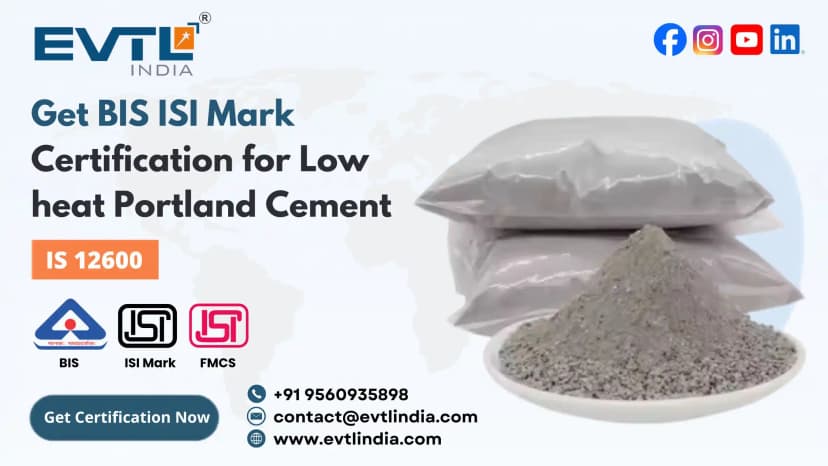
The DPIIT, under the Ministry of Commerce and Industry, has introduced the Quality Control Order 2023, which mandates BIS certification for Low Heat Portland Cement according to IS 12600: 2023. Effective from January 1, 2024, manufacturers are required to obtain BIS certification to market LHPC in India. This regulation ensures that only high-quality LHPC, marked by the ISI certification, is available for critical infrastructure projects, aligning with India’s goals of enhancing construction safety and durability.
BIS certification for LHPC is crucial to maintaining high standards in the construction industry. By mandating compliance with IS 12600: 2023, the government ensures that LHPC meets strict quality parameters, including optimal heat reduction during hydration. Non-compliance with this Quality Control Order, 2023 is penalized under the Bureau of Indian Standards Act, 2016, emphasizing its significance. BIS certification under IS 12600 provides assurance to contractors and clients that LHPC will perform effectively, especially in large-scale projects where temperature control is crucial.
Indian Standard IS 12600: 2023 establishes quality and performance guidelines for LHPC, specifying requirements for heat generation, strength, durability, and chemical composition. Compliance with IS 12600 is necessary for manufacturers to ensure that the cement is suitable for large concrete structures without risking thermal cracking. Through BIS certification, the government enforces these standards to promote the safe use of LHPC in India, supporting a uniform level of quality and performance in large construction projects.
The BIS certification process for LHPC is detailed, involving rigorous steps to verify product quality. Here’s an overview of the process:
To apply for BIS certification, manufacturers must provide the following documents:
Additional documents for environmental and safety compliance may also be required based on the specific product.


BIS certification for Low Heat Portland Cement under IS 12600: 2023 is essential for ensuring the safety and durability of large-scale construction projects. This compliance requirement supports government efforts to establish a standard for cement quality, especially for critical infrastructure projects where temperature control is crucial.
For manufacturers, navigating the BIS certification process can be challenging. EVTL India, a top consultancy firm, provides expert guidance through the certification process, including managing BIS portal submissions, documentation, and regulatory fees. By partnering with EVTL India, manufacturers can secure BIS certification for their products, facilitating market access within India and abroad. Additionally, EVTL India offers ongoing support to help manufacturers maintain BIS compliance and manage license renewals.