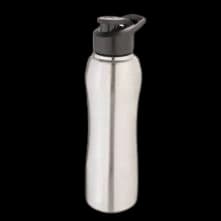
A Domestic Stainless Steel Vacuum Flask/Bottle refers to a reusable container used to keep
beverages, which is used for keeping beverages like water, tea, or coffee either cool or warm.
These steel flasks are commonly used in offices, educational institutions, homes, and even
while travelling. The bottles are manufactured using high-grade stainless steel with vacuum
insulation technology for thermal effect.
The BIS certification for the Stainless Steel Vacuum Bottle guarantees it meets the standards
outlined in IS 17526:2021. This certificate guarantees that the product is safe for carrying drinks
and doesn't have any harmful chemicals in it. Besides that, it also ensures that the products are
durable and are of leak-proof quality.
What is IS 17526: 2021?
This is the Indian Standard for Domestic Stainless Steel Vacuum Flask/Bottle, which are
commonly used to store hot or cold beverages. This standard is set by the BIS (Bureau of
Indian Standards) to ensure that product quality and safety are met, and the vacuum bottles are
- Made from high quality stainless steel
- Hygienic and suitable for daily use
- Provide effective thermal insulation
- Free from harmful chemicals
- Durable and sturdy design
Who Needs BIS Certification for Insulated Flask/Bottle
BIS certification under IS 17526: 2021 is required for businesses involved in manufacturing,
importing, or supplying steel vacuum flasks in India.
Applicable to:
- Manufacturers (India): Must get BIS certification if insulated bottles are covered under
QCO.
- Foreign Manufacturers: Need certification to export stainless steel vacuum bottles to
India.
- Importers/Brand Owners: Must ensure that products are BIS certified before selling.
- Sellers/Distributors: Should only sell certified insulated flasks.
Testing and Inspection Requirements
To ensure the best quality, safety needs, and proper performance of these steel vacuum flasks,
the standard set by the Bureau of Indian Standards (BIS) defines proper testing and inspection
requirements during manufacturing.
What are R and S
- R (Required): Test must be conducted in the manufacturer’s in-house laboratory
- S (Subcontracting Allowed): Test can be conducted in a BIS-recognized or
NABL-accredited external laboratory
Material & Raw Material Tests
- Material (Cl. 7.1) (S) - Ensures stainless steel and other raw materials meet IS 17526
requirements
- Welding Material Check (S) - Verifies suitability of welding consumables used in
fabrication
Manufacturing & Workmanship Tests
- Manufacture & Workmanship (R) - Ensures overall product quality, finish, and
construction compliance
- Welding Defects Check (R) - Ensures absence of cracks, porosity, or defects in welded
joints
Dimensional & Physical Tests
- Minimum Thickness of Outer Container (R) - Ensures required wall thickness for
durability
- Coating Thickness Test (R) - Checks uniform protective coating layer
- Capacity Test (R) - Verifies correct volumetric capacity of flask/bottle
- Length of Shoulder Strap (R) - Ensures correct strap dimensions as per standard
Thermal Performance Tests
- Heat Retention Capability (R) - Checks ability to maintain temperature over specified
time
- Cold Retention Capability (R) - Ensures effective cooling performance retention
Mechanical Strength & Durability Tests
- Drop Impact Test (S) - Checks resistance against accidental drops
- Pendulum Impact Test (S) - Evaluates impact resistance under controlled conditions
- Fixing Strength of Handle (S) - Ensures handle can withstand load without failure
- Strength of Shoulder Strap (S) - Verifies durability under load conditions
- Strength of Cord (S) - Checks the strength of the cord suspension system
- Endurance Test for O-Ring, Stopper and Washer (S) - Ensures long-term mechanical
durability
Leakage & Sealing Tests
- Leakage Test (R) - Ensures no leakage under normal usage conditions
- Joint Leakage Test (R) - Checks sealing performance at joints and welds
Stability & Functional Tests
- Stability of Flask/Bottle (R) - Ensures product remains stable on inclined surfaces
- Pour Test (R) - Verifies smooth and controlled pouring without spillage
Surface & Appearance Tests
- Staining Test (R) - Ensures surface resistance to stains and discoloration
- Finish & Appearance Check (R) - Ensures smooth surface and defect-free finish
Coating & Corrosion Tests
- Salt Water Corrosion Test (S) - Checks resistance to corrosion in harsh environments
- Adhesion Test (S) - Ensures coating strongly adheres to metal surface
- Lead & Cadmium Test (S) - Ensures safety from toxic heavy metals
- Coating Thickness Uniformity (R) - Ensures consistent protective coating
Chemical Safety & Leaching Tests
- Leaching Test (S) - Ensures no harmful substances migrate into stored liquid
- Sensorial Test (S) - Ensures no odour, taste, or contamination in water
Material Composition Tests
- Chemical Composition of Inner Container (S) - Verifies stainless steel grade and
composition compliance
BIS Certification Process for Stainless Steel Bottles

The BIS certification process ensures that domestic insulated bottles meet the required
standards for proper and efficient operation. This process is defined by the Bureau of Indian
Standards (BIS) and includes the following steps:
- Online Registration: Manufacturers register on the BIS Manak portal by submitting company, factory, and
product details. Foreign manufacturers must appoint an Authorized Indian
Representative (AIR).
- Testing at BIS-Approved Laboratory: Product samples are tested in BIS-approved laboratories for material safety, chemical
migration, durability, leakage resistance, transparency, and overall hygienic suitability for
the storage of hot or cold drinks.
- Application Submission: The application is submitted along with test reports, technical documents, and factory
details. Foreign manufacturers must also submit AIR-related documents.
- Factory Inspection: BIS officials inspect the manufacturing unit to verify the production process, safety
measures, and quality control system.
- Grant of BIS License: If all requirements are met, BIS grants the certification license under Scheme-I.
- Use of ISI Mark: After approval, the manufacturer can use the ISI mark on an insulated bottle with a CM/L
number, confirming that the product meets BIS standards.
Documents Required for IS 17526: 2021 Certification
The following documents are typically required for obtaining BIS certification:
| Basic Details | - GST Certificate
- Email ID & Contact Number
- Factory & Office Address
- Rent Agreement / Lease Deed (if applicable)
|
| Legal Documents | - Partnership Deed (if partnership firm)
|
| Manufacturing Details | - List of Machinery
- Process Flow Chart
- Layout Plan of Factory
|
| Raw Material Details | - List of Raw Materials
- Supplier Details
- Raw Material Invoices
- Raw Material Test Certificates
|
| Testing & Quality Control | - List of Testing Equipment
- Calibration Certificates
- QC / Lab In-charge Appointment Letter & Qualification
|
| Production Details | - Annual Installed Capacity
- Last Year Production Value
|
| Product & Packaging Details | - Quantity per Package
- Nature of Packing
- Nature of Printing / Marking on Product
|
| Management Details | - Top Management Details
- Concerned Person for BIS Communication
|
| Brand & Certification Documents | - Trademark / Brand Certificate
- Consent Letter from BIS Recognized Laboratory
|
| Additional Documents | - Weekly Off Details
- Hygiene Document (if applicable)
- Relaxation Letter (if applicable)
- Any Other Relevant Document
|
Marking Requirements & License Validity
Marking Requirements
When a manufacturer obtains the BIS License, the ISI Mark for Domestic Stainless Steel
Vacuum Flask must be applied clearly and permanently on the product or its packaging. In
addition to the ISI Mark, other important details must also be provided on the product or
packaging, as specified in the table below, this ensures the product meets all quality and safety
standards.
| ISI Mark | Indicates that the product is BIS certified and follows the standard |
| Standard Number | IS 17526: 2021
|
| CML Number | Certification Marks License number issued by BIS |
| Manufacturer Details | Name of manufacturer or registered trademark |
| Batch / Date | Batch number or manufacturing date for traceability |
Note:
Marking is typically applied using durable stamping, tagging, or permanent printing to ensure
clear identification during handling, storage, and transportation, as per BIS marking
requirements.
Validity of BIS Licence for a Stainless Steel Vacuum Bottle
After obtaining BIS Certification for the steel bottle, the license is valid for a fixed period and
must be maintained by following BIS rules and standards.
| Particulars | Details |
|---|
| Initial Validity | Typically 1 to 2 years, depending on BIS approval conditions |
| Renewal | Must be renewed before expiry by submitting the application along with the prescribed fee and updated documents |
| Surveillance | Includes periodic factory inspections and market sample testing conducted by BIS |
| Compliance | Continuous following to standard and applicable Quality Control Orders (QCOs) is mandatory |
| Risk | Non-compliance or failed sample testing may lead to suspension or cancellation of the BIS license |
Stainless Steel Flask Certification Cost
The cost of BIS Certification for a steel flask includes charges for application, inspection,
license, testing, and marking. These fees are paid to BIS as per Scheme I guidelines.
Cost Breakdown
Indian Manufacturers
| No. | Major Charges | Particulars | Amount | Remark |
| 1 | BIS Fees | Application Fee | INR 1,000 | — |
|
| Audit / Inspection Fee | INR 7,000 | — |
|
| License Fee | INR 1,000 | — |
|
| Marking Fee | Depends on product | Discount as per MSME |
| 2. | Testing Charges | Sample Testing Fee | As Applicable | Payable to a BIS-approved laboratory. |
| 3. | EVTL India Service Fee | Consultancy & Support | As per actual | Depends on product type and factory location. |
Foreign Manufacturers
| No. | Major Charges | Particulars | Amount | Remark |
| 1. | BIS Fees | Application Fee | USD 15 | Payable via SWIFT to BIS. SAARC countries can pay INR with 18% GST. |
|
| Audit Charges | USD 3,200 – 5,900 | Depend on Country |
|
| License Fee | USD 15 | — |
|
| Marking Fee | Depends on product | — |
| 2. | Testing Charges | Sample Testing Fee | As Applicable | Payable to a BIS-approved laboratory. |
| 3. | EVTL India Service Fee | Consultancy & Support | As per actual
| Based on product and manufacturing location. |
Note: Additional costs such as pre-testing or factory pre-inspection may apply. The total cost
may vary depending on product type, testing requirements, and current BIS guidelines.
conclusion
The BIS certification process for Domestic Stainless Steel Vacuum Flask/Bottle follows the
requirements mentioned as per the IS 17526: 2021 standards. This ensures that the steel flask
meets the safety and quality benchmarks for daily use. The BIS certification reduces the risk of
any potential risk associated with faults in the product's material, insulation failure, or
contamination, thereby ensuring safe consumption of the stored liquid.
Getting expert support from EVTL India for consultation services can simplify the certification
journey. The consultancy assists the manufacturers with complete documentation, coordination
of product testing, and preparation for inspections, enabling a smoother certification process.