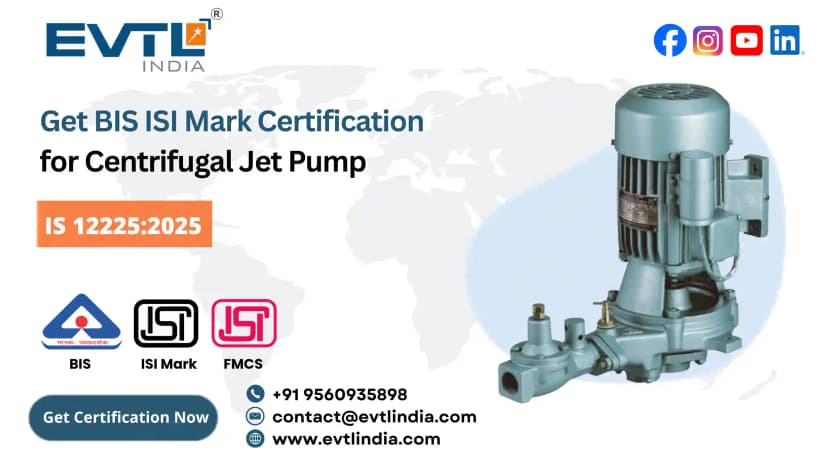
Centrifugal Jet Pumps are commonly used for domestic water supply and small-scale irrigation. These pumps work on the principle of using the centrifugal force along with the jet effect. This results in better water lifting from a relatively shallow depth while providing good flow performance. Easy installation and adaptability to varying suction conditions make the jet pumps ideal for agricultural use.
To ensure consistent quality, safety, and performance reliability, these pumps are governed under IS 12225:2025, set by the Bureau of Indian Standards. The standard mentions requirements for design, materials, construction, and testing to maintain product efficiency and durability. Meeting these norms ensures that pumps perform reliably under different operating conditions. Manufacturers are required to obtain BIS certification to sell these pumps when covered under an Quality Control Order (QCO).
What is IS 12225: 2025?
This is the Indian Standard for jet pumps used for water lifting, which defines performance, construction, and efficiency of the product. This standard is set by the BIS (Bureau of Indian Standards) to ensure that product quality and safety are met, and the pumps are
- Engineered for proper sealing and system compatibility in pumping applications
- Tested for hydraulic performance
- Made with BIS-compliant materials
- Designed for consistent water suction
Eligibility for Agricultural Jet Pump BIS Certification
BIS certification under IS 12225: 2025 is required for businesses involved in manufacturing, importing, or supplying centrifugal pump motors in India.
Applicable to:
- Manufacturers (India): Must get BIS certification if the pumps are covered under QCO.
- Foreign Manufacturers - Need certification to export the product to India.
- Importers/Brand Owners - Must ensure that the products are BIS certified before selling.
- Sellers/Distributors - Should only sell certified jet pumping systems.
Testing and Inspection Requirements
To ensure the premium quality, safety needs, and adequate performance of water jet pump systems, the standard set by the Bureau of Indian Standards (BIS) defines proper testing and inspection requirements during manufacturing.
What is R and S?
- R (Required): Test must be conducted in the manufacturer’s in-house laboratory
- S (Subcontracting Allowed): Test can be conducted in a BIS-recognized or NABL-accredited external laboratory
Materials & Construction Tests
- Material of Construction Verification (R) - Ensures compliance with approved standards and durability requirements
- Constructional Feature Inspection (R) - Verifies design and structural conformity of centrifugal jet pump
- Casting Quality Check (R) - Ensures defect-free casting of pump body and jet unit
- Component Integrity Test (S) - Verifies strength and suitability of assembled parts
Prime Mover & Motor Tests
- High Voltage Test (R) - Ensures dielectric strength of motor insulation
- Insulation Resistance Test (R) - Verifies winding insulation health
- No Load Current & Power Test (R) - Checks motor performance without load
- Locked Rotor Test (R) - Measures starting current and torque characteristics
- Reduced Voltage Running Test (R) - Ensures safe starting under low voltage conditions
- Stator Winding Resistance Test (R) - Verifies electrical winding resistance
- Breakaway Torque Test (R) - Checks starting torque capability
Hydraulic & Performance Tests
- Performance Test (S) - Evaluates pump efficiency, head, and discharge
- Discharge Flow Test (S) - Measures water output capacity
- Total Head Test (S) - Ensures required pumping height performance
- Operating Pressure Test (S) - Verifies system pressure stability
- Submergence Test (S) - Ensures proper suction performance at duty point
Thermal & Endurance Tests
- Temperature Rise Test at Rated Voltage (R) - Checks heating during normal operation
- Temperature Rise Test at Reduced Voltage (R) - Evaluates thermal stability under low voltage conditions
- Continuous Duty Test (S) - Ensures long-duration operational reliability Mechanical & Structural Tests
- Hydrostatic Pressure Test (R) - Verifies strength of pump body and jet unit
- Dynamic Balancing Test (R) - Ensures vibration-free operation
- Dimensional Verification Test (S) - Confirms compliance with design specifications
- Flywheel Size & Weight Check (R) - Ensures correct rotational mass balance
Functional & Operational Tests
- Prime Mover Coupling Test (S) - Ensures proper mechanical connection with pump
- Fuel Consumption Test (S) - Evaluates efficiency for engine-driven systems
- Governing Test (S) - Checks speed regulation under varying load
- Starting Performance Test (R) - Verifies smooth pump start-up
Quality Control & Routine Tests
- Routine Testing of Each Pump (R) - Ensures production consistency
- Batch Sampling Test (S) - Confirms uniformity across production lots
- Test Record Maintenance (R) - Ensures traceability of all test results
- Calibration of Equipment (R) - Maintains accuracy of test instruments
Type & Periodic Tests
- Type Test for Design Approval (S) - Conducted for new pump designs
- Annual Type Verification Test (S) - Ensures continued compliance
- Design Change Re-Testing (S) - Required when critical modifications occur
- Periodic Performance Testing (S) - Ensures long-term conformity
Marking & Certification Tests
- ISI Marking Verification (R) - Ensures correct BIS Standard Mark usage
- Labelling Compliance Check (R) - Verifies correct product marking
- Licence Scope Verification (R) - Confirms rated parameters match certification
How to get BIS Approval for Jet Pumping System?

The BIS certification process ensures that the agricultural jet pumps meet the required standards for proper and efficient operation. This process is set by the Bureau of Indian Standards (BIS) and includes the following steps:
- Online Registration - Manufacturers register on the BIS Manak portal by submitting company, factory, and product details. Foreign manufacturers must appoint an Authorized Indian Representative (AIR).
- Testing at BIS-Approved Laboratory - Product samples are tested in BIS-approved laboratories for material safety and structural durability.
- Application Submission - The application is submitted along with test reports, technical documents, and factory details. Foreign manufacturers must also submit AIR-related documents.
- Factory Inspection - BIS officials inspect the manufacturing unit to verify the production process, safety measures, and quality control system.
- Grant of BIS License - If all requirements are met, BIS grants the certification license under Scheme-I.
- Use of ISI Mark - After approval, the manufacturer can use the ISI mark on the product with a CM/L number, confirming that the product meets BIS standards.
Mandatory Documents for IS 12225: 2025 Certification
The following documents are typically required for obtaining BIS certification:
| Basic Details | - GST Certificate
- Email ID & Contact Number
- Factory & Office Address
- Rent Agreement / Lease Deed (if applicable)
|
| Legal Documents | - Partnership Deed (if partnership firm)
|
| Manufacturing Details | - List of machinery
- Process flow chart
- Layout Plan of Factory
|
| Raw Material Details | - List of Raw Materials
- Supplier Details
- Raw Material Invoices
- Raw Material Test Certificates
|
| Testing & Quality Control | - List of Testing Equipment
- Calibration Certificates
- QC / Lab In-charge Appointment Letter & Qualification
|
| Production Details | - Annual Installed Capacity
- Last Year Production Value
|
| Product & Packaging Details | - Quantity per Package
- Nature of Packing
- Nature of Printing / Marking on Product
|
| Management Details | - Top Management Details
- Concerned Person for BIS Communication
|
| Brand & Certification Documents | - Trademark / Brand Certificate
- Consent Letter from BIS Recognized Laboratory
|
| Additional Documents | - Weekly Off Details
- Hygiene Document (if applicable)
- Relaxation Letter (if applicable)
- Any Other Relevant Document
|
Foreign manufacturers must additionally appoint an Authorized Indian Representative (AIR) to coordinate with the Bureau of Indian Standards (BIS) and manage compliance requirements in India.
Marking Requirements & License Validity
Marking Requirements
When a manufacturer obtains the BIS License, the ISI Mark for Jet Pumping Systems must be applied clearly and permanently on the product or its packaging. In addition to the ISI Mark, other important details must also be provided on the product or packaging, as specified in the table below, this ensures the product meets all quality and safety standards.
| Requirement | Details |
|---|
| ISI Mark | Indicates that the product is BIS certified and follows to the standard |
| Standard Number | IS 12225: 2025 |
| CML Number | Certification Marks License (CML) number issued by BIS |
| Manufacturer Details | Name of manufacturer or registered trademark |
| Batch / Date | Batch number, heat number, or manufacturing date for traceability |
Note: Marking is typically applied using durable stamping, tagging, or permanent printing to ensure clear identification during handling, storage, and transportation, as per BIS marking requirements.
BIS Validity Rules for Centrifugal Water Pump System
After obtaining BIS Certification for the high suction centrifugal pump, the license is valid for a fixed period and must be maintained by following BIS rules and standards.
Water Jet Pumps Certification Fees
The cost of BIS Certification for a jet pumping system includes charges for application, inspection, license, testing, and marking.These fees are paid to BIS as per Scheme I guidelines.
Cost Breakdown
Note:
- Application fee for foreign manufacturers is payable via SWIFT (SAARC countries may pay in INR with applicable GST).
- Audit charges for foreign manufacturers vary based on country/location.
- Marking fee depends on the product category and production volume (MSME benefits may apply).
- Testing charges are paid directly to BIS-approved laboratories.
- Consultancy fees depend on product type and factory location.
Conclusion
The Centrifugal Jet Pump follows the requirements mentioned in IS 12225: 2025 set by Bureau of Indian Standards. It ensures that the water jet pumps meet the safety, reliability and performance standards. BIS certification reduces the risk related to pump inefficiency or mechanical failure. This ensures consistent water delivery for everyday use. With proper help, one does not have to worry about getting the BIS certificate for Centrifugal Pumps. EVTL India provides all sorts of help, from documentation, filing an application, testing, compliance advice, and even inspections. Getting expert assistance ensures a worry-free certification journey.