In India, the products for irrigation need to be reliable and safe. The Bureau of Indian Standards (BIS) helps in ensuring this through their certification process. One of the standards is IS 7092 (Part 2): 1987, which is applicable to extruded aluminium alloy tubes for use in irrigation. Extruded Tube is a type of tube that is produced using aluminium alloy that is passed through a die to achieve a desired shape and size. They are reliable, durable, and can be used for carrying water for irrigation.
BIS Certification helps in ensuring that these tubes are produced with quality, strength, and performance. The certification is must for the manufacturers as well as the importers of these tubes under the respective Quality Control Orders (QCOs).
overview of indian standard is 7092 (part 2):1987
The standard specifies the technical requirements for extruded aluminium alloy tubes used in irrigation.This standard ensures that the tubes used in irrigation are strong, durable, and suitable for long-term use.
Key aspects covered include:
- Chemical Composition: The alloy mix needs to be durable.
- Dimensions and Tolerances: It must be compatible with standard irrigation systems.
- Surface Finish: It must be able to withstand wear and environmental conditions.
It is important to meet these standards to obtain ISI Certification for Aluminium Alloy Extruded Tubes for Irrigation Purposes.
testing and inspection requirements
To maintain the quality and reliability of aluminium alloy tubes, IS 7092 (Part 2) defines specific inspection and testing practices during production. These checks ensure that each tube and every batch meets the required standards before being approved.
workmanship & surface finish
Tubes must be free from visible defects such as cracks, dents, or poor finish. Each tube is checked individually during production, and any defective tube is not allowed to be marked with the ISI mark.
chemical composition check
The chemical composition is verified to ensure the correct aluminium alloy is used. This test is conducted for each raw material batch (heat). If the raw material is ISI marked and comes with a test certificate, further testing may not be required.
mechanical strength test
To ensure strength and performance, tests are conducted on each production batch (control unit):
- Tensile Test: Checks the strength of the tube
- Drift Expansion Test: Ensures the tube can expand without cracking
Two samples are tested from each batch. If any sample fails, additional testing is done,and if failure continues, the entire batch is rejected.
hydrostatic pressure test
This test checks the ability of tubes to withstand internal pressure without leakage. Each tube is tested, and samples are selected across the production batch. If any sample fails:
- Additional tubes are tested
- If failure continues, the entire batch is rejected
Only tubes that pass this test are accepted.
dimensions & tolerances
The diameter, thickness, and length of tubes are checked regularly during production. Testing is done every hour to ensure consistency. If a sample fails, that hour’s production is not approved for marking.
in-house testing requirements
All major tests must be conducted within the factory (R), as required by the standard. This ensures better control over product quality during manufacturing.
Importance of These Checks
These inspection and testing practices help in:
- Ensuring quality at every stage of production
- Detecting defects early and preventing faulty supply
- Maintaining consistency across batches
- Complying with BIS standards
- Allowing only conforming tubes to carry the ISI mark
BIS Certification process

The process of obtaining BIS certification for extruded aluminium alloy tubes ensures that the tubes meet the quality, safety, and performance standards. The main steps are:
- Online Registration: The first step in getting BIS certification is to register on the Manak portal, BIS’s
online platform. Manufacturers need to create an account, fill in company details,
and provide information about the product and manufacturing process. They also
have to upload supporting documents like technical specifications and test
reports. For foreign manufacturers, a hard copy of the application and documents
must be sent to the BIS office, and an Authorized Indian Representative (AIR)
should be appointed to handle communications.
- Testing at BIS-Approved Laboratory: Samples of extruded tubes are tested in a BIS-approved laboratory as per
standard to check chemical composition, strength, dimensions, and durability.
- Application Submission: The completed application, test reports, supporting documents, and KYC details
are submitted to BIS. Foreign manufacturers must also complete the nomination
process with official communication to BIS.
- Factory Inspection: BIS officials inspect the manufacturing unit to verify:
- Production process and techniques
- Raw material quality
- Factory layout and infrastructure
- In-house testing facilities
- Quality control measures
- Grant of BIS License: After successful verification of documents, test reports, and factory inspection,
BIS issues the license. For foreign manufacturers, the confidential test report is
reviewed by the Foreign Manufacturers Certification Department before granting
the license.
documents required for bis certification
| Basic Details | - GST Certificate
- Email ID & Contact Number
- Factory & Office Address
- Rent Agreement / Lease Deed (if applicable)
|
| Legal Documents | - Partnership Deed (if partnership firm)
|
| Manufacturing Details | - List of machinery
- Process flow chart
- Layout Plan of Factory
|
| Raw Material Details | - List of Raw Materials
- Supplier Details
- Raw Material Invoices
- Raw Material Test Certificates
|
| Testing & Quality Control | - List of Testing Equipment
- Calibration Certificates
- QC / Lab In-charge Appointment Letter & Qualification
|
| Production Details | - Annual Installed Capacity
- Last Year Production Value
|
| Product & Packaging Details | - Quantity per Package
- Nature of Packing
- Nature of Printing / Marking on Product
|
| Management Details | - Top Management Details
- Concerned Person for BIS Communication
|
| Brand & Certification Documents | - Trademark / Brand Certificate
- Consent Letter from BIS Recognized Laboratory
|
| Additional Documents | - Weekly Off Details
- Hygiene Document (if applicable)
- Relaxation Letter (if applicable)
- Any Other Relevant Document
|
Foreign manufacturers must additionally appoint an Authorized Indian Representative (AIR) to coordinate with the Bureau of Indian Standards (BIS) and manage compliance requirements in India.
Marking Requirements & License Validity
Marking Requirements
Once the license is issued under the BIS, the ISI mark has to be permanently marked
on each tube. Other required details are also marked on the tube, as given in the
following table. These markings show that the product meets the required standards
and can be easily identified and traced.
| Requirement | Details |
|---|
| ISI Mark | Shows the product is certified |
| Standard Number | IS 7092 (Part 2)
|
| CML Number | License number issued after
certification |
| Manufacturer Details | Name or registered trademark |
| Size Details | Tube diameter and thickness |
| Alloy Information | Type of aluminium alloy used |
| Batch / Date | Batch number or manufacturing
date for tracking |
Validity of BIS Licence for Aluminium Alloy Tubes For Irrigation Purposes (Extruded Tubes)
| Particulars | Details |
|---|
| Initial Validity | 1 to 2 years depending on approval conditions |
| Renewal | Renewal required before expiry through application and fee
submission |
| Surveillance | Periodic factory inspections and market sample testing by BIS |
| Compliance | Continuous Follow standard and applicable BIS QCOs for
Aluminium Alloy Extruded Tubes |
| Risk | Non-compliance may result in suspension or cancellation of the
BIS License |
bis CERTIFICATION cost
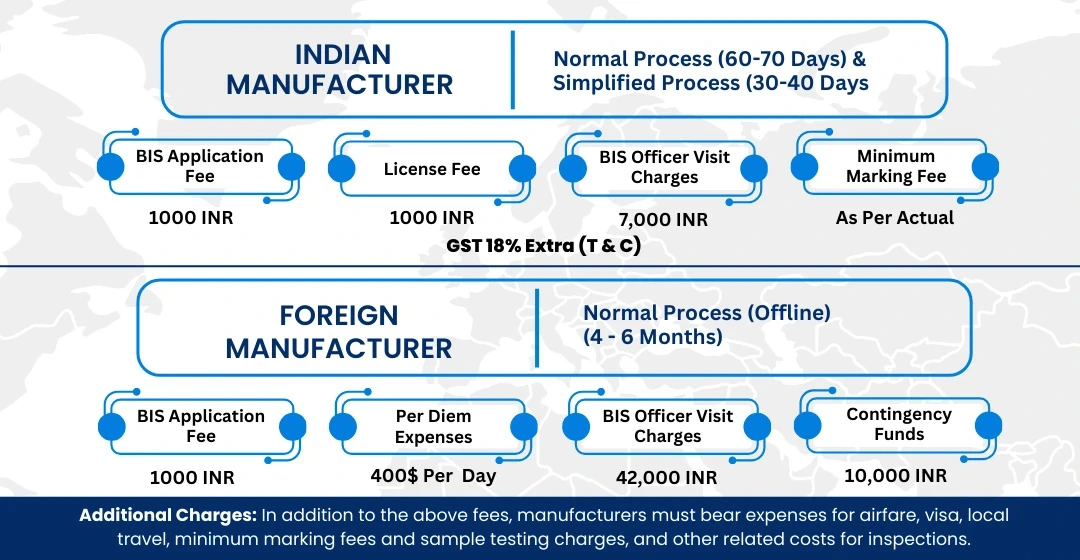
The cost of getting BIS certification for aluminium alloy extruded tubes includes fees for the application, inspection, license, testing, and marking. These charges must be paid to BIS according to Scheme-I guidelines.
cost breakdown
| S. No. | Particular | Amount (INR) | Remarks |
| 1 | Application Fee | 1000 | To be paid to BIS |
| 2 | Audit / Inspection Fee | 7000 | To be paid to BIS |
| 3 | License Fee | 1000 | To be paid to BIS |
| 4 | Sample Testing Fee | As applicable | Varies by product and lab |
| 5 | Minimum Advance Marking Fee | As applicable | Depends on production and standard |
| 6 | Renewal Fee | 1000 | To be paid to BIS |
| 7 | Inclusion Fee | 5000 | To be paid to BIS |
| 8 | Service Fee | As applicable | Consultant charges |
Note:
- Additional costs such as pre-inspection (factory visit) may apply to verify compliance
- Final cost may vary depending on product type, testing requirements, and BIS guidelines
marking fee (as per manak portal reference - is 7092)
Note: This marking fee is based on Manak portal reference data. Actual marking fee may vary depending on production volume, and current BIS guidelines.
Conclusion
BIS certification under IS 7092 (Part 2): 1987 for extruded aluminium alloy tubes ensures that the quality, safety, and performance of the product are met. This certification covers critical parameters such as quality of materials, testing of materials, marking of materials, and conformity to the guidelines of the BIS.
The process of obtaining BIS certification is quite complex and consists of several steps. However, with the help of a reliable BIS Consultant for Aluminium Alloy Extruded Tubes for Irrigation Purposes ,such as EVTL INDIA, the process can be simplified to obtain the certification without any delay.