
Why Manufacturers Need a BIS Certification Consultant in India | Avoid Delays & Achieve Faster BIS Approvals
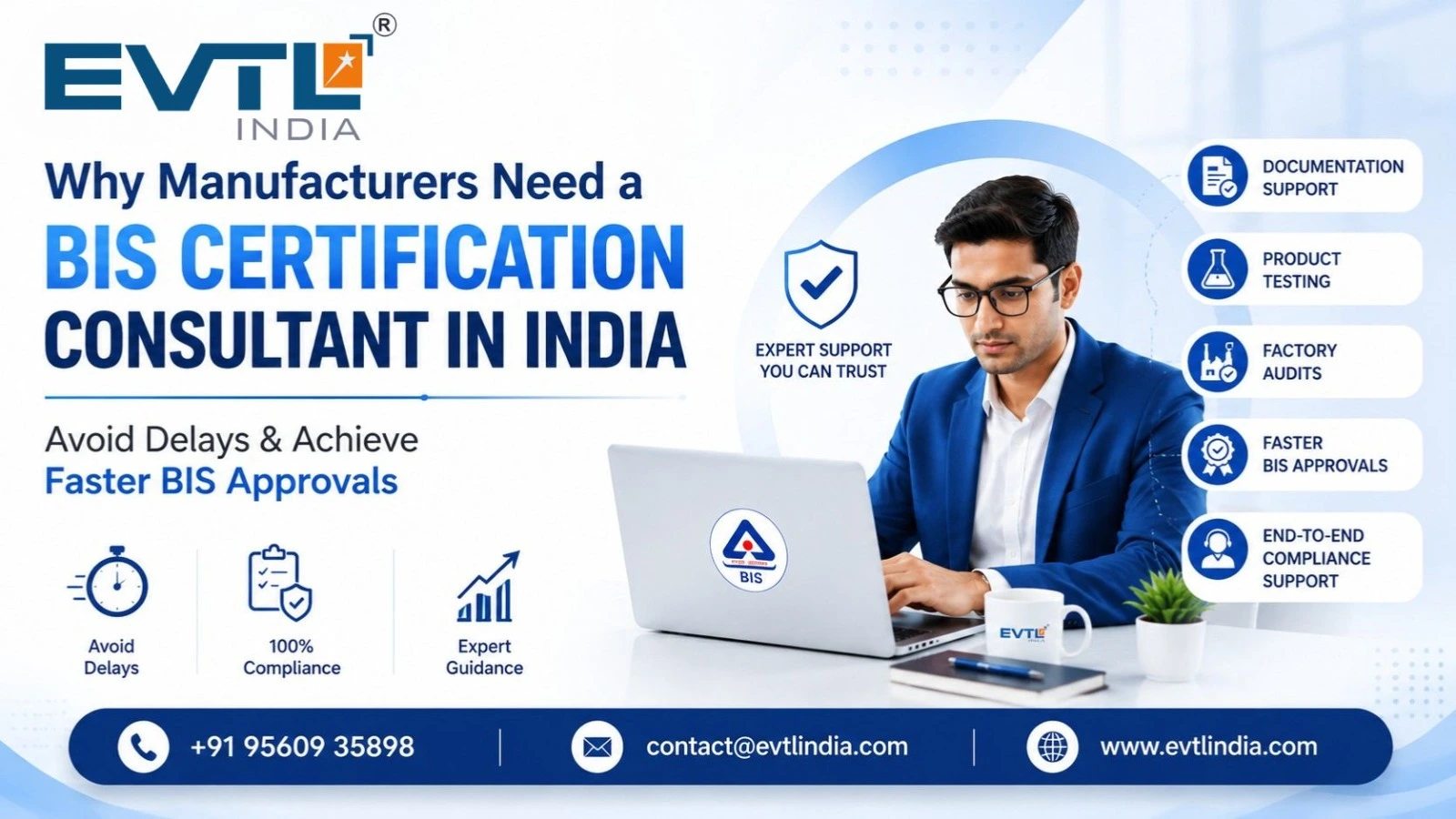
Why Manufacturers Need a BIS Certification Consultant in India
In today's regulatory environment, BIS certification has become a critical requirement for manufacturers, importers, brand owners, startups, MSMEs, and foreign manufacturers looking to sell products in India. With the increasing number of Quality Control Orders (QCOs) issued by the Government of India, businesses must ensure their products comply with applicable Indian Standards before they can be legally manufactured, imported, distributed, or sold in the Indian market.
While BIS certification offers significant benefits such as legal market access, improved product credibility, customer trust, regulatory compliance, and business growth, the certification process itself can be complex. Manufacturers must deal with product testing, technical documentation, factory inspections, compliance requirements, regulatory communication, and ongoing obligations even after certification approval.
This is why businesses across India increasingly rely on professional BIS Certification Consultants, ISI Mark Certification Consultants, and BIS Registration Consultants to manage the certification process efficiently and avoid costly mistakes.
What Do Manufacturers Actually Want From a BIS Consultant?
When manufacturers search for a BIS Certification Consultant, they are not simply looking for someone to submit an application. They are looking for an experienced compliance partner who can simplify the certification process, reduce compliance risks, and help them obtain approvals without unnecessary delays.
Most manufacturers want clear answers to practical questions such as whether their product requires BIS certification, which certification scheme applies, how much time the process will take, what documents are required, and how product testing and factory inspections are managed. They also want to know what happens if their product fails testing, if BIS raises objections, or if there are delays during the approval process.
A professional BIS consultant helps businesses understand these requirements, avoid common mistakes, coordinate certification activities, and manage the entire process from initial assessment to final approval.
Can Manufacturers Apply for BIS Certification Without a Consultant?
Yes, manufacturers can apply for BIS certification directly. However, many businesses underestimate the complexity of the certification process. Identifying the correct Indian Standard, preparing technical documentation, coordinating laboratory testing, handling factory inspections, and responding to BIS observations often require specialized knowledge and experience.
Without proper guidance, businesses may face documentation errors, testing delays, compliance gaps, regulatory queries, and application rejections. A BIS consultant helps manufacturers navigate these challenges and improve certification readiness from the beginning.
Common Challenges Faced During BIS Certification
BIS certification involves multiple stages, and manufacturers often encounter difficulties during the process. Common challenges include understanding applicable Quality Control Orders (QCOs), selecting the correct certification scheme, preparing technical documentation, coordinating product testing, managing factory inspections, and maintaining compliance after certification approval.
These challenges can lead to delayed approvals, increased costs, and postponed product launches if not managed properly.
What Happens If Your Product Fails BIS Testing?
Product testing is one of the most critical stages of BIS certification. If a product fails testing, manufacturers may face additional laboratory costs, product modifications, retesting requirements, and delays in certification approval.
An experienced BIS consultant helps identify potential compliance gaps before testing begins, reviews testing requirements, coordinates with laboratories, and assists manufacturers in resolving technical issues quickly to minimize delays.
What Happens If BIS Raises Queries or Objections?
During the certification process, BIS may seek additional documents, technical clarifications, quality control records, or corrective actions. Delayed or inaccurate responses can significantly impact approval timelines.
A BIS consultant helps businesses prepare proper responses, coordinate with relevant stakeholders, and manage communication with regulatory authorities to ensure the certification process continues smoothly.
How Consultants Help During Factory Audits
Factory inspections are an important part of many BIS certification schemes. During audits, BIS officials may evaluate manufacturing infrastructure, production processes, quality control systems, testing facilities, calibration records, and quality documentation.
A BIS consultant helps manufacturers prepare for inspections by reviewing records, identifying compliance gaps, organizing documentation, and ensuring audit readiness. Proper preparation reduces the risk of audit observations and certification delays.
Why Certification Delays Can Be Expensive
Many businesses focus only on certification costs and overlook the financial impact of delays. Delayed approvals can postpone product launches, affect customer commitments, increase inventory holding costs, disrupt supply chains, and result in lost sales opportunities.
Working with an experienced BIS consultant helps businesses manage certification timelines more effectively and reduce the risk of unnecessary delays.
What Can Happen If You Don't Hire a BIS Consultant?
Although manufacturers can manage certification independently, mistakes often lead to additional costs and longer approval timelines. Incorrect certification scheme selection, failed product testing, documentation errors, factory audit observations, and regulatory queries can significantly delay approvals.
For products covered under mandatory BIS requirements, non-compliance may also result in import restrictions, regulatory penalties, product seizures, or limitations on manufacturing and sales activities.
Startups and MSMEs often have limited compliance resources and may not be familiar with BIS requirements. Importers and foreign manufacturers face additional challenges such as FMCS certification, CRS registration, Authorized Indian Representative (AIR) requirements, product testing, and factory inspections.
A BIS consultant helps these businesses understand regulatory requirements, manage certification activities, reduce compliance risks, and achieve smoother market access in India.
Why Large Manufacturers Also Hire BIS Consultants
Even large organizations with dedicated compliance teams often work with BIS consultants. Consultants provide specialized regulatory expertise, updated knowledge of BIS requirements, dedicated certification support, and assistance with multi-product certification projects.
This allows internal teams to focus on manufacturing and business operations while certification experts manage compliance requirements and regulatory coordination.
Common Myths About BIS Certification
Many businesses delay certification or make compliance mistakes because of common misconceptions about BIS requirements. Understanding the facts can help manufacturers, importers, startups, MSMEs, and foreign manufacturers make informed decisions and avoid unnecessary delays.
Myth 1: BIS Certification Is Only for Large Manufacturers
One of the most common misconceptions is that BIS certification is only required for large companies. In reality, BIS regulations apply to businesses of all sizes. Whether you are a startup, MSME, importer, brand owner, or foreign manufacturer, you must obtain the required certification if your product falls under applicable BIS regulations or Quality Control Orders (QCOs).
Myth 2: BIS Certification Is Just Documentation
Many businesses believe BIS certification is simply a paperwork exercise. However, the certification process involves much more than documentation. Product testing, factory inspections, quality control verification, technical evaluations, regulatory reviews, and ongoing compliance requirements are all important parts of the certification process.
Myth 3: Any Laboratory Can Conduct BIS Testing
Manufacturers often assume that product testing can be conducted at any laboratory. In reality, BIS certification generally requires testing through BIS-recognized laboratories as per the applicable certification scheme and product category. Using the wrong testing facility can lead to delays and additional costs.
Myth 4: Compliance Ends After Certification Approval
Obtaining a BIS license is not the end of the compliance journey. Businesses must continue managing renewals, surveillance inspections, product modifications, scope extensions, marking fee obligations, and regulatory updates to maintain compliance and avoid certification-related issues in the future.
Why Businesses Need a Complete Compliance Partner
Modern businesses often require multiple certifications and regulatory approvals beyond BIS certification. Managing separate consultants, testing agencies, laboratories, and regulatory authorities for each approval can be time-consuming and inefficient.
Depending on the product category and business requirements, companies may need support for BIS ISI Mark Certification, BIS CRS Registration, BIS FMCS Certification, BIS Scheme-X Certification, BIS Hallmark Registration, BEE Registration, CDSCO Registration, EPR Registration, TEC & MTCTE Certification, WPC Approval, LMPC Registration, PESO Approvals, and Product Testing & Inspection Services.
Working with a complete compliance partner helps businesses streamline certification activities, reduce coordination challenges, avoid delays, and manage multiple regulatory requirements under one roof. This approach saves valuable time, improves compliance efficiency, and allows businesses to focus on manufacturing, sales, and growth while compliance experts handle certification and regulatory obligations.
Conclusion
BIS certification is more than a regulatory requirement—it is a critical step toward legal market access, product credibility, customer trust, and long-term business growth. However, navigating BIS regulations, product testing, factory inspections, documentation requirements, and ongoing compliance obligations can be challenging without the right expertise.
This is why manufacturers, importers, startups, MSMEs, brand owners, and foreign manufacturers increasingly rely on professional BIS Certification Consultants to simplify the certification process, reduce compliance risks, avoid costly delays, and improve approval readiness.
As a trusted compliance partner, EVTL India provides end-to-end support for BIS ISI Mark Certification, BIS CRS Registration, BIS FMCS Certification, BIS Scheme-X Certification, BIS Hallmark Registration, BEE Registration, CDSCO Registration, EPR Registration, TEC Certification, WPC Approval, LMPC Registration, PESO Approvals, Product Testing Coordination, Factory Audit Preparation, Documentation Management, License Renewals, and ongoing compliance support.
Whether you are launching a new product, importing regulated goods, expanding manufacturing operations, or entering the Indian market for the first time, EVTL India helps simplify complex certification requirements and provides complete regulatory support under one roof—allowing businesses to focus on growth while our experts handle compliance and certification requirements.