Product Testing Services in India – NABL, EMI-EMC, RoHS and BIS Testing Explained
Introduction
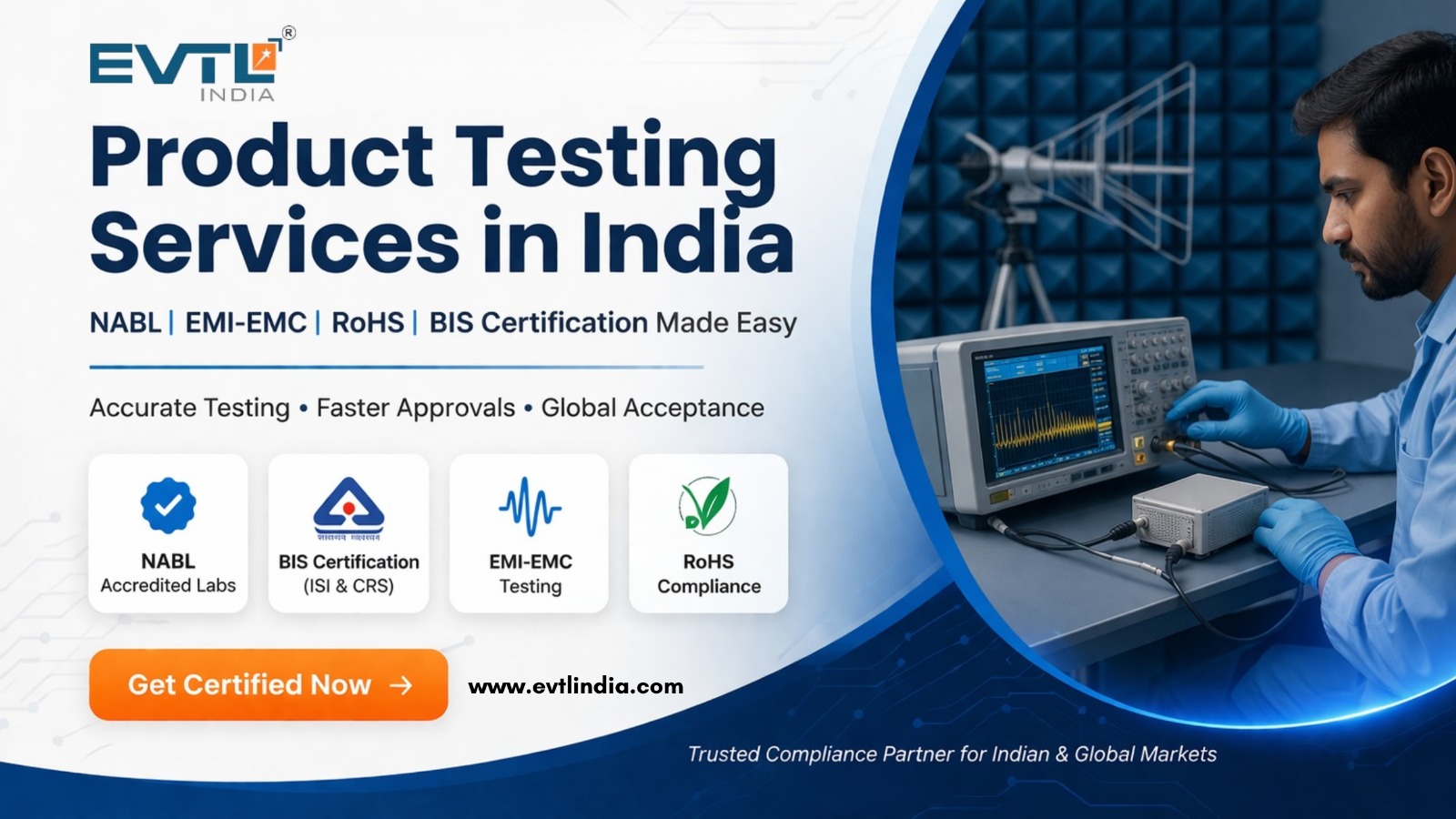
Product testing services in India play a crucial role in ensuring that products meet required safety, quality, and performance standards before they reach the market. With growing regulatory requirements and increasing consumer awareness, businesses must comply with strict guidelines to avoid legal issues and build trust.
Organizations like the Bureau of Indian Standards (BIS) and the National Accreditation Board for Testing and Calibration Laboratories (NABL) provide a strong framework for standardization and reliable testing. NABL-accredited laboratories ensure accurate results, while BIS certification is mandatory for various products under Quality Control Orders (QCOs). These services cover multiple sectors, including electronics, textiles, chemicals, and medical devices, involving tests such as safety checks, EMI/EMC testing, and environmental compliance like RoHS.
Overall, product testing services help businesses ensure compliance, maintain product quality, and enhance credibility in both domestic and international markets.
Why Product Testing Matters in India
Product testing is essential in India to ensure that goods meet required safety, quality, and regulatory standards before reaching the market. Authorities like the Bureau of Indian Standards (BIS) mandate testing for many products to ensure compliance with Indian Standards (IS). Without proper testing, businesses may face penalties, product recalls, or market rejection.
Testing also protects consumers by identifying potential hazards such as electrical faults, chemical risks, or structural weaknesses. It plays a key role in sectors like electronics, healthcare, and construction where safety is critical.
Moreover, product testing enhances brand credibility and builds customer trust. Certified products are more likely to gain consumer confidence and succeed in competitive markets. It also helps manufacturers detect defects early, reduce costs, and maintain consistent product quality and compliance.
NABL Accreditation: The Gold Standard for Indian Testing Labs
The National Accreditation Board for Testing and Calibration Laboratories (NABL) is an autonomous body under the Department for Promotion of Industry and Internal Trade (DPIIT), Government of India. NABL provides accreditation to testing and calibration laboratories that demonstrate technical competence in accordance with ISO/IEC 17025.
What Does NABL Accreditation Mean for You?
Choosing a NABL-accredited laboratory ensures that the lab has been independently assessed for measurement accuracy, equipment calibration, and technical staff competence. It guarantees reliable and internationally accepted test results.
Test reports issued by NABL-accredited labs are globally recognized through the International Laboratory Accreditation Cooperation Mutual Recognition Arrangement (MRA), enabling acceptance in over 100 countries.
Key Benefits of NABL Accreditation
- Global Acceptance – Reports are accepted worldwide through the ILAC-MRA network
- Regulatory Compliance – Mandatory for approvals from authorities like Bureau of Indian Standards (BIS), Food Safety and Standards Authority of India (FSSAI), and Central Pollution Control Board (CPCB)
- Cost Efficiency – Eliminates the need for repeated testing in international markets
- Enhanced Credibility – Builds trust with buyers, clients, and procurement teams
- Government Eligibility – Often required for participation in government tenders
In summary, NABL accreditation ensures quality, reliability, and global acceptance of laboratory results, making it a critical requirement for businesses involved in manufacturing, testing, and exports.
EMI-EMC Testing in India: Protecting Your Electronics from Interference
EMI-EMC testing is essential to ensure that electronic and electrical products function properly without causing or being affected by electromagnetic disturbances. Electromagnetic Interference (EMI) refers to unwanted signals emitted by a device, while Electromagnetic Compatibility (EMC) ensures that the device performs reliably even in the presence of external interference. This testing is crucial for products like smartphones, routers, industrial machines, and medical equipment.
Key Points of EMI-EMC Testing
- Mandatory for Certification: Required for approvals like BIS CRS (India), CE Marking (Europe), and FCC Authorization (USA).
- Emission Testing: Measures radiated and conducted emissions to ensure the device does not interfere with other electronics.
- Immunity Testing: Checks resistance to disturbances such as ESD, surges, and RF interference.
- Global Standards: Conducted as per CISPR, IEC 61000, and IS 13252 standards.
- Multi-Market Access: Helps manufacturers launch products in India, Europe, and the USA with a single test plan.
- Advanced Labs: India has modern testing facilities accredited by the National Accreditation Board for Testing and Calibration Laboratories, ensuring accurate and reliable results.
In summary, EMI-EMC testing is not just a regulatory requirement but also a quality assurance step that ensures product safety, performance, and global acceptance.
RoHS Testing in India: Meeting Environmental Compliance Standards
The Restriction of Hazardous Substances (RoHS) directive was introduced by the European Union to limit the use of harmful materials in electrical and electronic equipment (EEE). Although it is an EU regulation, RoHS testing in India has become increasingly important for manufacturers and exporters who want to access European markets. Ensuring compliance not only helps meet legal requirements but also builds trust with global buyers.
Substances Restricted Under RoHS
Under RoHS 3 (EU Directive 2015/863), the use of 10 hazardous substances is restricted. The key limits include:
- Lead (Pb): Maximum 0.1% by weight
- Mercury (Hg): Maximum 0.1% by weight
- Cadmium (Cd): Maximum 0.01% by weight
- Hexavalent Chromium (Cr VI): Maximum 0.1% by weight
- Polybrominated Biphenyls (PBB): Maximum 0.1% by weight
- Polybrominated Diphenyl Ethers (PBDE): Maximum 0.1% by weight
- Phthalates (DEHP, BBP, DBP, DIBP): Maximum 0.1% each
Testing Process and Standards
RoHS testing usually starts with X-Ray Fluorescence (XRF) screening to quickly detect restricted substances. If required, detailed analysis is carried out using advanced techniques like ICP-OES and GC-MS, following the IEC 62321 standards.
BIS Certification in India: ISI Mark & Compulsory Registration Scheme
Bureau of Indian Standards (BIS) is the official standards authority in India, functioning under the Ministry of Consumer Affairs. BIS certification is essential for a wide range of products sold in the Indian market, especially as regulations continue to expand rapidly in the electronics and electrical sectors.
Two Key BIS Schemes You Should Know
1. ISI Mark Certification (Scheme I)
The ISI Mark certification applies to products such as electrical cables, switches, plugs, helmets, cement, and various consumer goods.
This process involves:
- Factory inspection and audit
- Product sample testing
- Continuous surveillance
Typically, obtaining ISI certification takes around 60 to 120 days, depending on the product and compliance readiness.
2. Compulsory Registration Scheme (CRS)
The CRS scheme is mainly designed for electronics and IT products like laptops, mobile phones, televisions, LED lights, and power banks.
Key highlights:
- Products must be tested in BIS or NABL-recognized laboratories
- Registration is completed through an online process
- Faster approval timeline of 30 to 60 days for domestic manufacturers
BIS Certification for Foreign Manufacturers (FMCS)
Foreign manufacturers exporting products to India must comply with the Foreign Manufacturers Certification Scheme (FMCS). This includes:
- Appointing an Authorized Indian Representative (AIR)
- Undergoing a factory audit in the country of origin
- Product testing at BIS-recognized labs in India
Conclusion
Product testing services in India are no longer optional—they are a critical part of ensuring compliance, safety, and market success. From reliable results through NABL-accredited laboratories to mandatory certifications by the Bureau of Indian Standards, every step in the testing process plays a vital role in maintaining product integrity.
Whether it is EMI-EMC testing for electronic performance, RoHS testing for environmental compliance, or BIS certification for legal market entry, each framework contributes to building a strong foundation for quality assurance. These testing mechanisms not only help businesses meet regulatory requirements but also enhance brand reputation and consumer trust.
In an increasingly competitive and regulated marketplace, partnering with experienced compliance experts like Evtl India can further streamline the testing and certification process. Their industry knowledge and end-to-end support help businesses navigate complex regulations with ease. Ultimately, investing in proper product testing ensures smoother approvals, reduced risks, and greater acceptance in both domestic and international markets—empowering businesses to deliver safe, high-quality products while staying compliant with evolving standards.