
DPIIT Notifies Mandatory BIS Certification for Hand Tools Before 1 October 2026
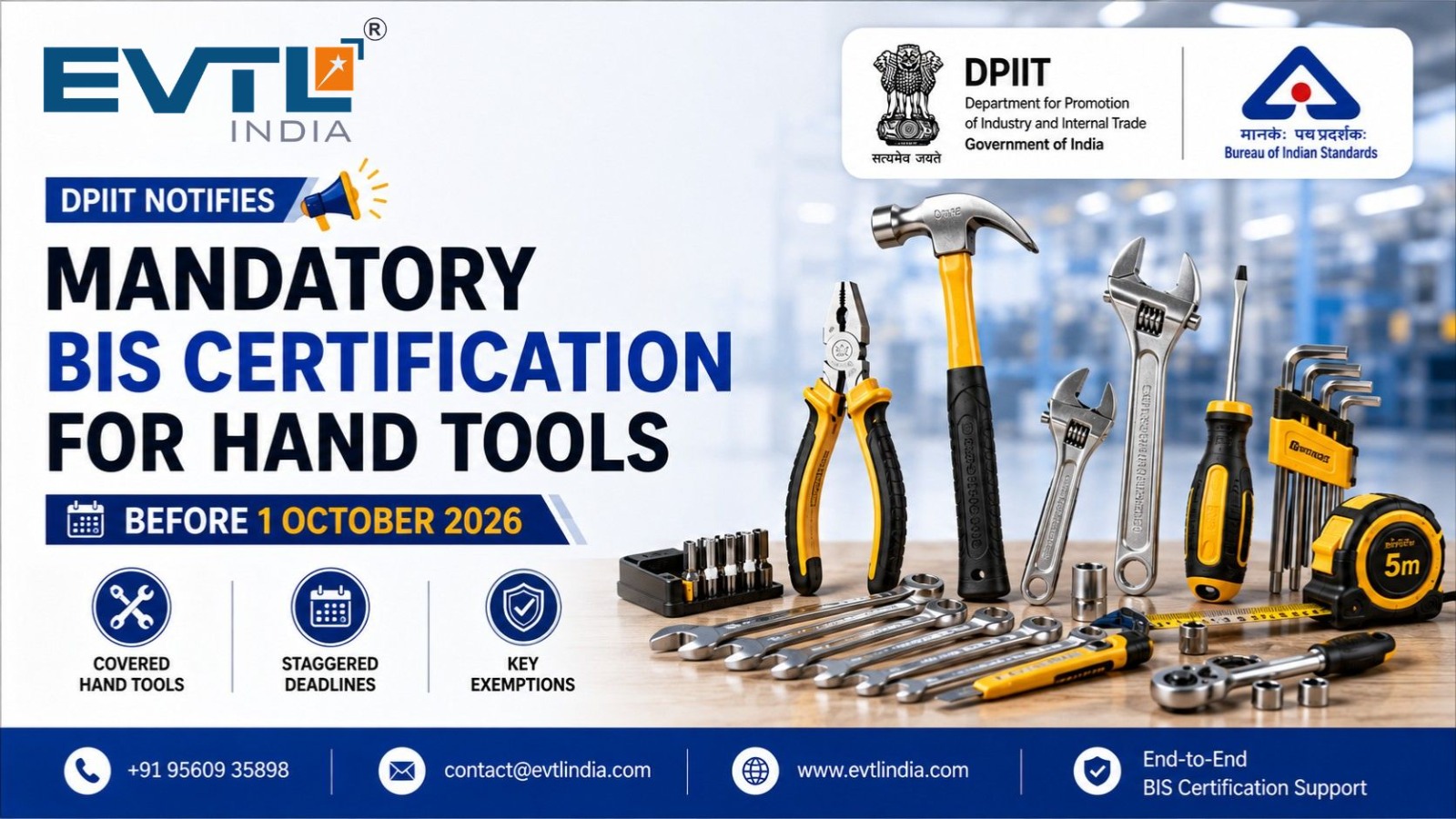
The Department for Promotion of Industry and Internal Trade (DPIIT), under the Ministry of Commerce and Industry, has announced a significant regulatory update by making BIS Certification mandatory for specified Hand Tools under the Hand Tools (Quality Control) Order, 2025. The notification is aimed at improving the quality, durability, and safety of hand tools sold in the Indian market. As per the notification, manufacturers and importers must ensure that the covered hand tools conform to the relevant Indian Standards (IS) and bear the ISI Mark issued by the Bureau of Indian Standards (BIS) before they are manufactured, imported, sold, or distributed in India. The Quality Control Order (QCO) will become effective for large and medium enterprises from 1 October 2026, while MSMEs have been granted additional time to obtain BIS Certification for Hand Tools and achieve compliance.
This latest move is part of the Government of India's broader strategy to strengthen product quality, encourage domestic manufacturing, and eliminate the circulation of substandard industrial products. By bringing hand tools under mandatory BIS certification, DPIIT seeks to establish uniform quality benchmarks and ensure that users receive reliable and safe products across industrial, commercial, and household applications.
Hand Tools Covered Under the New QCO
The Hand Tools (Quality Control) Order covers several widely used industrial tools that are essential in engineering, construction, automotive, manufacturing, maintenance, and repair activities. The products notified include -
Each of these products must comply with its respective Indian Standard and obtain a valid BIS licence under Scheme-I before being placed on the Indian market.
Compliance Timeline
The implementation schedule has been designed to provide industries with adequate time to obtain BIS Compliance for hand tools and align their manufacturing processes with the new regulatory requirements.
- Large and Medium Enterprises: Mandatory from 1 October 2026
- Small Enterprises: Mandatory from 1 January 2027
- Micro Enterprises: Mandatory from 1 April 2027
This phased implementation gives MSMEs additional time to complete product testing, documentation, factory inspections, and licence approvals while ensuring a smooth transition to the new regulatory framework.
Purpose of Mandatory BIS Certification
The primary objective of this notification is to improve the overall quality of hand tools available in India. Inferior-quality tools often lead to operational failures, workplace accidents, higher maintenance costs, and reduced productivity. By mandating compliance with BIS standards, the government aims to ensure that only tested and quality-assured products are available in the market.
Mandatory certification will also promote fair competition by creating a level playing field for manufacturers who invest in quality production. Imported products will also have to meet the same standards as domestically manufactured tools, thereby maintaining consistent quality across the market.
Impact on Manufacturers and Importers
Manufacturers and importers dealing in the notified hand tools should begin their compliance preparations well before the enforcement date. Obtaining a BIS licence involves several stages, including -
- Product testing at BIS-recognized laboratories.
- Preparation of technical documentation.
- Submission of the BIS application.
- Factory inspection by BIS officials.
- Grant of BIS licence.
- Proper use of the ISI Standard Mark on certified products.
Since the certification process may require several weeks or even months depending on documentation and testing timelines, businesses are advised not to wait until the implementation deadline.
Foreign manufacturers exporting these products to India must also obtain the required BIS certification before supplying the Indian market.
Exemptions Under the Order
The Quality Control Order provides limited exemptions for certain categories. Products manufactured exclusively for export are generally exempt from the mandatory certification requirement. Additionally, a limited quantity of products imported for research and development purposes may also qualify for exemption, subject to the conditions specified in the notification.
Benefits for Consumers and Industry
Mandatory BIS certification offers several advantages to both consumers and the manufacturing sector.
- Better product quality
- Improved safety during usage
- Reliable performance
- Longer service life
- Standardized dimensions and specifications
- Market credibility
- Customer confidence
- Access to government procurement opportunities
- Competitive advantage in domestic and international markets
- Improved quality management practices
The implementation of uniform quality standards also helps reduce counterfeit and low-quality products, benefiting the entire supply chain.
Penalties for Non-Compliance
Once the Quality Control Order becomes effective, manufacturers, importers, distributors, and sellers will not be permitted to manufacture or market the notified hand tools without a valid BIS licence. Non-compliance may attract action under the Bureau of Indian Standards Act, 2016, including product seizure, monetary penalties, cancellation of licences, and other legal consequences depending on the nature of the violation.
Industry Should Begin Compliance Now
Although the mandatory enforcement date for large and medium enterprises is 1 October 2026, companies should initiate the certification process at the earliest. Product testing, documentation, factory audits, and licence approval require sufficient preparation time, and early compliance will help businesses avoid disruptions in manufacturing or imports once the regulation comes into force.
The DPIIT notification reflects the Government of India's continued commitment to strengthening the country's quality infrastructure and supporting the objectives of Make in India and Atmanirbhar Bharat. Manufacturers and importers of hand tools should closely review the notified standards, assess their product portfolio, and begin the BIS certification process well before the applicable compliance deadline to ensure uninterrupted business operations.
Conclusion
The Hand Tools (Quality Control) Order, 2025 marks a significant step toward improving the quality, safety, and reliability of hand tools available in the Indian market. By making BIS Certification for Hand Tools mandatory, the Government aims to ensure that all notified products comply with the relevant Indian Standards (IS) and meet consistent quality benchmarks before they reach consumers. The phased implementation timeline provides manufacturers, importers, and MSMEs with sufficient time to achieve BIS Compliance for hand tools through product testing, factory inspections, and licensing. Businesses should begin the certification process well in advance to avoid regulatory delays and ensure uninterrupted market access. Ultimately, this initiative will strengthen consumer confidence, promote fair competition, support high-quality manufacturing, and contribute to India's vision of building a robust and globally competitive industrial sector.