
BIS Certification for Industrial Safety Belts and Harness IS 3521
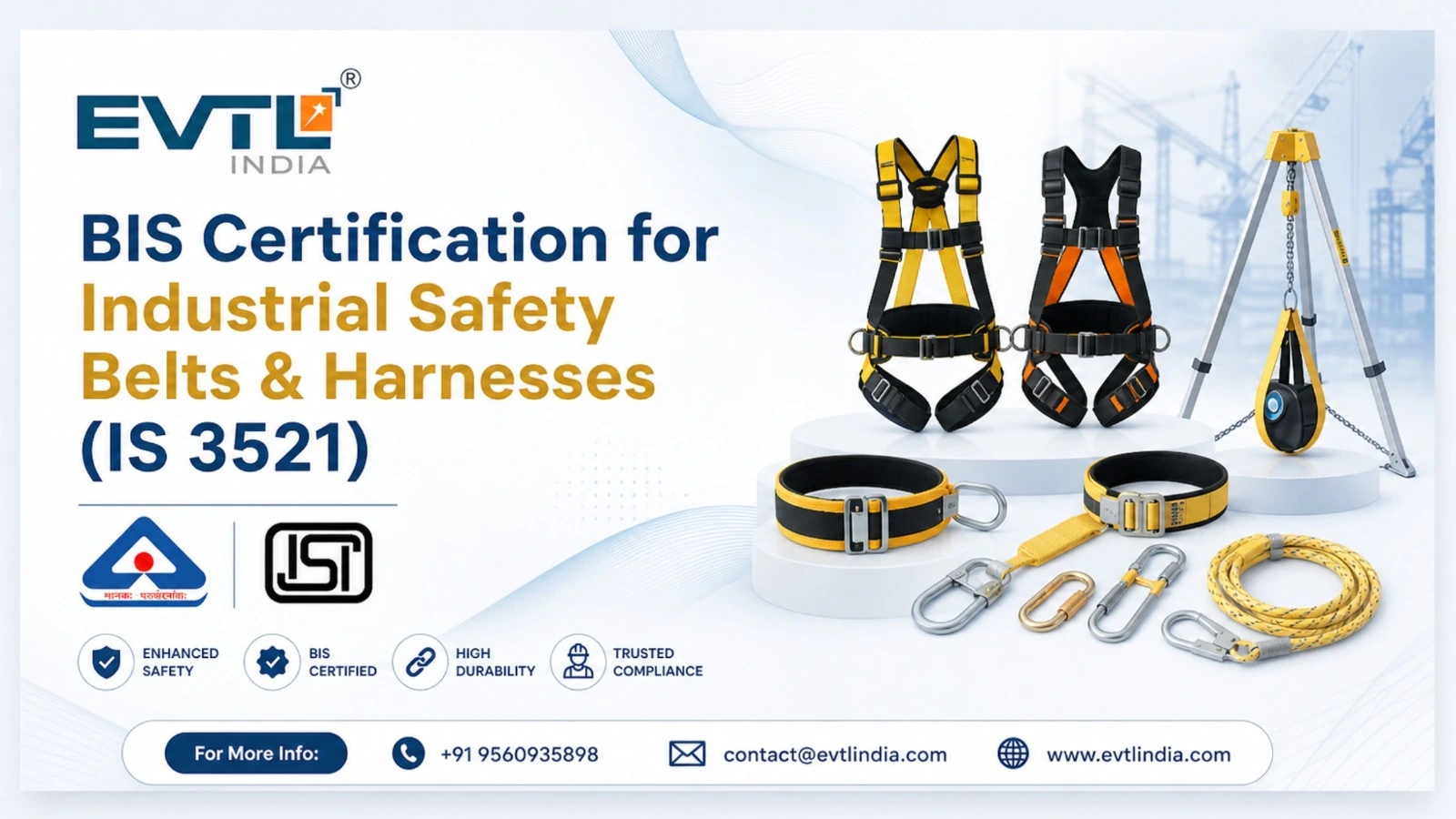
Industrial Safety Belts and Harnesses are protective safety equipment used to protect workers from falls while working at heights or in hazardous industrial environments. They are commonly used in construction sites, electrical work, telecom towers, maintenance activities, mining, and other industries where worker safety is essential during high-risk operations.
To ensure the safety, strength, and quality of these products, the Bureau of Indian Standards (BIS) provides certification as per IS 3521. This certification ensures that Industrial Safety Belts and Harnesses are properly tested for durability, load-bearing capacity, material quality, stitching strength, and overall performance, making them safe and reliable for industrial use while reducing the risks of falls, injuries, and workplace accidents.
Overview of IS 3521
This is the Indian Standard for Industrial Safety Belts and Harnesses used to protect workers while working at heights or in hazardous industrial environments. It is a standard set by the Bureau of Indian Standards to ensure these safety products are reliable, strong, and safe for industrial use. This standard ensures that the product is:
- Strong enough to protect workers from falls and accidents
- Safe and reliable for use in industrial and construction sites
- Made with durable webbing, buckles, and high-quality materials
- Properly designed for comfort and secure fitting during work
- Resistant to wear, stress, and harsh working conditions
- Consistent in performance, safety, and manufacturing standards
Industrial Safety Belts and Harnesses Quality Control Order (QCO)
The Industrial Safety Belts and Harnesses Quality Control Order (QCO) is a statutory order issued by the Government of India to ensure that industrial safety belts and harnesses manufactured, imported, or sold in India meet the prescribed quality and safety standards. This order has been introduced to enhance worker safety and prevent accidents caused by substandard fall protection equipment used in industries such as construction, manufacturing, telecom, power, and maintenance work. As per the QCO, industrial safety belts and harnesses must comply with the relevant Indian Standard prescribed by the Bureau of Indian Standards and must bear the BIS Standard Mark (ISI Mark) before being manufactured, imported, distributed, or sold in the Indian market.
Product Covered Under Indian Standard for Industrial Safety Belts and Harnesses
The Belts and Harnesses, covered under IS 3521, lays down the requirements for safety belts and full body harnesses used by workers while working at heights. These products are essential for protecting workers from falls and serious injuries in industrial and construction environments. The following are the major belts and harnesses products covered under BIS certification as per the applicable Indian Standards:
BIS Certification Process for Industrial Safety Belts and Harnesses
The BIS certification process ensures that Industrial Safety Belts and Harnesses meet the required safety, strength, and quality standards as defined by the Bureau of Indian Standards (BIS). These products are critical for worker safety in construction, height work, and industrial environments. The process includes the following steps:
- Online Registration: Manufacturers must register on the BIS Manak Online Portal by providing company details, factory information, and product specifications. For foreign manufacturers, it is mandatory to appoint an Authorized Indian Representative (AIR) in India to handle compliance and communication.
- Testing at BIS-Approved Laboratory: Product samples are tested in BIS-approved laboratories to check compliance with relevant Indian Standards such as IS 3521 (for Industrial Safety Belts and Harnesses). Testing includes load-bearing capacity, tensile strength, stitching strength, corrosion resistance of metal parts, durability, and overall safety performance.
- Application Submission: After successful testing, the manufacturer submits the application along with the test reports, technical documents, design details, quality control procedures, and factory information. Foreign manufacturers must also submit AIR authorization documents.
- Factory Inspection: BIS officials conduct a detailed inspection of the manufacturing unit. They verify production processes, raw material quality, in-house testing facilities, safety standards, and the overall quality management system followed by the manufacturer.
- Grant of BIS License: If all requirements are met successfully, BIS issues the certification license under Scheme-I. This license confirms that the product complies with Indian safety standards and is approved for manufacturing and sale in the Indian market.
- Use of ISI Mark: Once the certification is granted, the manufacturer is allowed to use the ISI mark along with the CM/L number on Industrial Safety Belts and Harnesses. This mark confirms that the product is BIS-certified and meets all safety and quality requirements.
Required BIS Documents Checklist for Belts and Harness
Foreign manufacturers must appoint an Authorized Indian Representative (AIR) in India. This person will work with the Bureau of Indian Standards (BIS) and take care of all rules and compliance work in India.
Marking Requirements for Industrial Safety Belts and Harnesses
Note - The marking should be durable and clearly visible. It is usually applied through stamping, engraving, labeling, or permanent printing so that it remains intact during handling, storage, and transportation as per BIS guidelines.
Validity of BIS License for Industrial Safety Belts and Harnesses
After obtaining BIS certification under IS 3521, the license remains valid for a limited period and must be maintained through continuous compliance with BIS standards.
BIS Approval Cost for IS 3521 Industrial Safety Belts and Harnesses
The cost of BIS certification for industrial safety belts and harnesses under IS 3521 includes various charges such as application fee, factory inspection, license fee, product testing, and marking charges. These fees are collected by BIS as per Scheme I requirements.
Note:
- Application fee for foreign manufacturers is payable via SWIFT (SAARC countries may pay in INR with applicable GST).
- Audit charges for foreign manufacturers vary based on country/location.
- Marking fee depends on the product category and production volume (MSME benefits may apply).
- Testing charges are paid directly to BIS-approved laboratories.
- Consultancy fees depend on product type and factory location.
Conclusion
The BIS certification for Industrial Safety Belts and Harnesses, as per IS 3521, makes sure that these products follow the required safety, strength, and performance standards for use in risky industrial workplaces.It also ensures that every safety belt and harness is properly tested for load capacity, durability, stitching strength, material quality, and overall performance. This makes them safe for working at heights and helps reduce the risk of falls, injuries, and workplace accidents.
With the support and guidance of an experienced BIS consultant like EVTL India, manufacturers can complete the certification process easily, avoid mistakes in compliance, and get faster approval to enter the Indian market safely.