
DPIIT Introduces Transition Facilitation (Quality Control) Order, 2026: Complete Guide for Manufacturers, Importers & BIS Compliance
The implementation of mandatory QCOs has improved product quality, consumer safety, and market confidence across several industries, including electrical equipment, electronics, toys, furniture, steel, chemicals, machinery, construction materials, and industrial products. At the same time, many manufacturers have encountered practical challenges such as limited availability of compliant suppliers, supply chain disruptions, delays in sourcing certified components, and technology transitions.
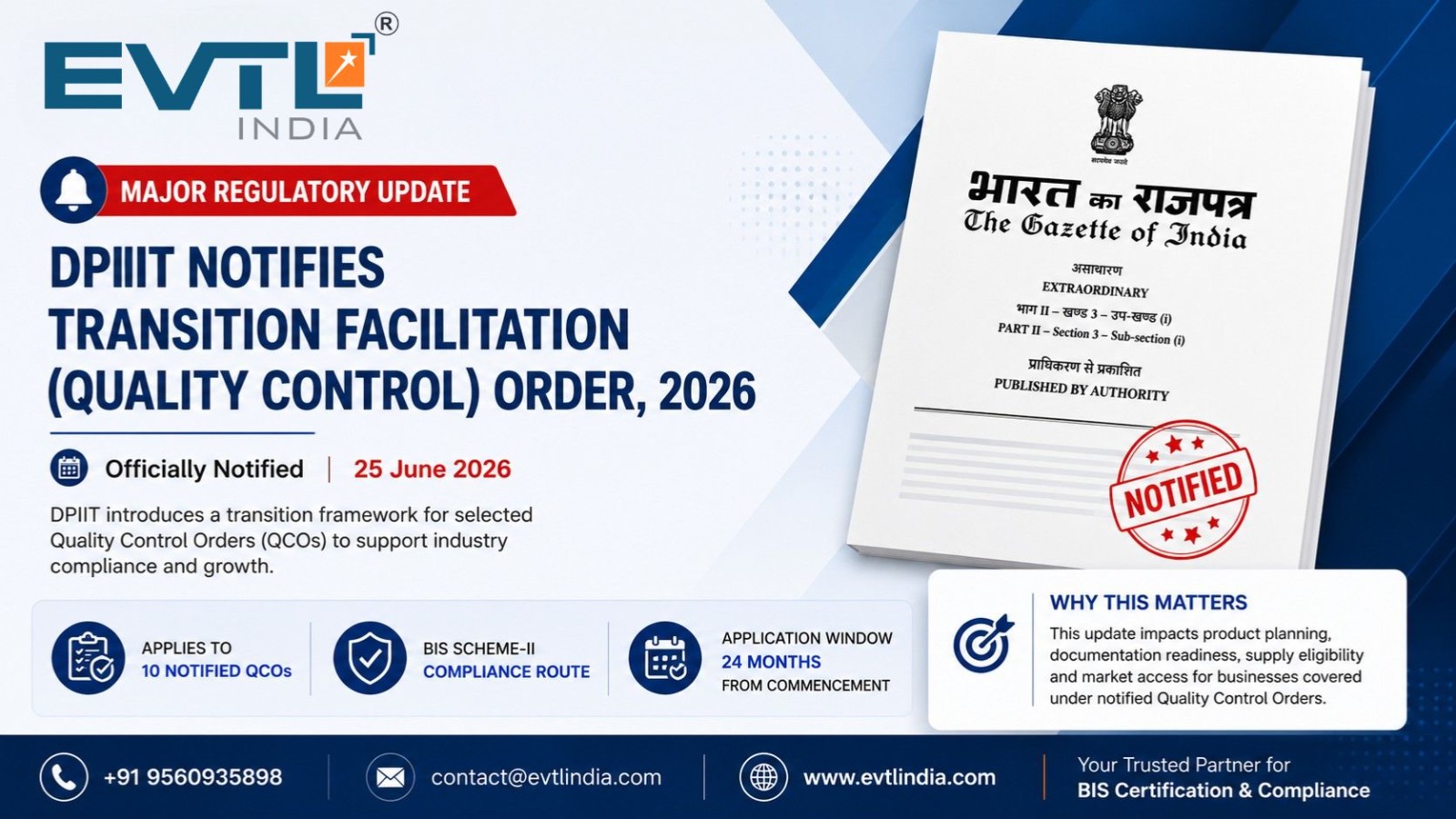
Recognising these industry concerns while preserving India's commitment to quality assurance, the Department for Promotion of Industry and Internal Trade (DPIIT), Ministry of Commerce & Industry, notified the Transition Facilitation (Quality Control) Order, 2026 through Notification S.O. 3417(E) dated 25 June 2026 under the Bureau of Indian Standards Act, 2016. The Order came into force on the date of its publication in the Official Gazette.
The notification has generated considerable discussion across the manufacturing sector, with many businesses assuming that it relaxes BIS Certification requirements. However, this interpretation is incorrect. The Transition Facilitation (Quality Control) Order, 2026 does not remove mandatory BIS Certification or exempt manufacturers from complying with applicable Indian Standards. Instead, it introduces a structured, approval-based, risk-assessed compliance mechanism to facilitate smoother implementation of selected Quality Control Orders while maintaining product quality and consumer protection.
Whether you are a manufacturer, importer, OEM, MSME, startup, brand owner, or foreign manufacturer dealing with products covered under mandatory Quality Control Orders, understanding this latest regulatory framework is essential for maintaining uninterrupted operations and ensuring continued BIS compliance.
What is the Transition Facilitation (Quality Control) Order, 2026?
The Transition Facilitation (Quality Control) Order, 2026 is a new regulatory framework introduced by DPIIT to support industries during the implementation of selected mandatory Quality Control Orders.
The Order establishes an alternative risk-based compliance mechanism that enables eligible companies to continue manufacturing activities while maintaining compliance with applicable Indian Standards and quality requirements. Rather than providing a blanket exemption from existing regulations, the framework creates a structured transition pathway that balances regulatory compliance with industrial growth, innovation, and supply chain resilience.
The Order applies only to goods or articles covered under the Quality Control Orders specified in the Schedule appended to the notification. It does not apply universally to all BIS-certified products or every Quality Control Order currently in force.
One of the most significant features of the Order is that eligible domestic manufacturers may, subject to Government approval and the prescribed conditions, procure supplies from manufacturers holding licences under Scheme II of the Bureau of Indian Standards (Conformity Assessment) Regulations, 2018, instead of relying exclusively on suppliers licensed under Scheme I (ISI Mark Scheme). However, the final product must continue to conform to the applicable Indian Standard, and BIS market surveillance continues to ensure ongoing compliance.
Why Did DPIIT Introduce the Transition Facilitation Order?
Over the past few years, the Government has expanded the number of mandatory Quality Control Orders across several industrial sectors to improve product quality, strengthen consumer protection, promote standardisation, and enhance India's global manufacturing competitiveness.
While these reforms have delivered significant long-term benefits, many manufacturers have experienced implementation challenges, including -
- Limited availability of suppliers licensed under applicable BIS schemes.
- Supply chain disruptions affecting manufacturing continuity.
- Delays in procuring quality-compliant raw materials and components.
- Technology upgrades requiring alternative sourcing arrangements.
- Increased compliance costs during the transition period.
- Production delays despite genuine efforts to comply with regulatory requirements.
To address these practical industry concerns, DPIIT introduced the Transition Facilitation framework as a structured mechanism that supports industry without compromising India's quality ecosystem. The Government has clarified that the framework aims to balance regulatory compliance with innovation, technological advancement, and stronger domestic supply chains while ensuring the continued availability of safe, reliable, and standards-compliant products.
Objectives of the Transition Facilitation (Quality Control) Order, 2026
The Transition Facilitation Order has been introduced with multiple policy objectives that support both industrial development and consumer protection.
Its key objectives include -
- Facilitating the smooth implementation of mandatory Quality Control Orders.
- Promoting Ease of Doing Business without weakening regulatory compliance.
- Encouraging innovation, technology adoption, and research & development.
- Strengthening India's domestic manufacturing ecosystem.
- Improving supply chain resilience and reducing compliance bottlenecks.
- Enhancing the global competitiveness of Indian industry.
- Protecting consumers through continued adherence to Indian Standards.
- Supporting long-term quality assurance under the BIS framework.
The Government has emphasised that the Order should be viewed as a compliance facilitation mechanism rather than a relaxation of mandatory BIS Certification requirements. Its purpose is to assist eligible manufacturers during the transition while preserving India's commitment to quality, safety, and regulatory integrity.
The Transition Facilitation (Quality Control) Order, 2026 introduces a structured regulatory mechanism that helps eligible manufacturers manage compliance challenges while preserving India's quality standards. Unlike a general exemption, the framework is based on Government approval, risk assessment, and continuous regulatory oversight.
The key features of the Order include -
- Risk-Based Compliance Framework: The Order introduces a risk-based compliance mechanism instead of providing blanket exemptions from Quality Control Orders (QCOs). Every application is evaluated individually by an Implementation Committee based on technical capability, manufacturing expertise, supply chain quality assurance, compliance history, commitment to strengthening manufacturing capabilities in India, and other relevant factors.
- Permission-Based Approval: One of the most important aspects of the Order is that manufacturers cannot automatically avail its benefits.
Only companies incorporated under the Companies Act, 2013 may apply for permission under this framework. DPIIT grants approval after the Implementation Committee completes its assessment and is satisfied that the applicant meets the prescribed requirements. Permission may also be subject to additional terms and conditions specified by the Government.
3. Alternative Sourcing Through BIS Scheme II: The Order enables an approved company to procure specified goods from manufacturers holding a valid BIS Scheme II licence, instead of depending exclusively on manufacturers licensed under Scheme I (ISI Mark).
However, this does not replace BIS Certification for regulated products. The final goods supplied under the applicable Quality Control Order must continue to conform to the relevant Indian Standards. The objective is to improve supply chain flexibility while maintaining regulatory compliance and product quality.
- BIS Market Surveillance Continues: The Transition Facilitation framework does not reduce regulatory oversight. The Bureau of Indian Standards (BIS), in consultation with DPIIT, may continue conducting market surveillance directly or through notified agencies to verify that products supplied under the framework continue to comply with applicable Indian Standards. If products fail to meet the prescribed requirements, appropriate regulatory action may be taken.
- Application Window and Validity: The Government has specified a defined timeline for this framework.
- Applications may be submitted within 24 months from the commencement of the Order.
- The Transition Facilitation (Quality Control) Order, 2026 will remain in force for five years, unless extended by the Central Government.
- Permissions granted before the expiry of the Order will continue for the approved period unless suspended, modified, or withdrawn in accordance with the provisions of the Order.
Understanding BIS Scheme I and Scheme II
Following the notification of the Transition Facilitation Order, one of the most frequently asked questions is the difference between Scheme I and Scheme II under the Bureau of Indian Standards (Conformity Assessment) Regulations, 2018.
BIS Scheme I (ISI Mark Scheme): Scheme I is the traditional BIS product certification scheme under which manufacturers obtain a BIS licence after product testing, factory assessment, verification of manufacturing processes, and ongoing surveillance. Products certified under this scheme carry the Standard Mark (ISI Mark) and are permitted to be manufactured or sold where applicable Quality Control Orders mandate Scheme I certification.
BIS Scheme II: Scheme II is another conformity assessment mechanism available under the BIS (Conformity Assessment) Regulations, 2018. Under the Transition Facilitation Order, Scheme II licensing is intended for manufacturers supplying to companies that have received specific permission from DPIIT under this framework.
Unlike Scheme I, Scheme II generally follows a registration-based approach supported by testing from a BIS-recognised laboratory. However, the availability of Scheme II under this Order is restricted to the conditions prescribed in the notification and does not permit unrestricted sale of products in the Indian market.
Eligibility Criteria Under the Transition Facilitation Framework
The Transition Facilitation (Quality Control) Order, 2026 is not a general relaxation available to every manufacturer.
The Order provides that eligible companies incorporated under the Companies Act, 2013 may apply for permission under this framework. Applications are assessed by the Implementation Committee through a comprehensive risk assessment process.
While evaluating an application, the Committee may consider factors such as -
- Technical capability and manufacturing expertise.
- Supply chain quality assurance systems.
- Product design and manufacturing controls.
- Compliance history and regulatory integrity.
- Commitment to establishing manufacturing, design, research & development, or supply chain capabilities in India.
- Continuous compliance with the applicable Quality Control Order for a period of three years, wherever relevant.
- Any other factor considered appropriate by the Committee.
The Committee may also seek supporting documents, declarations, certifications, undertakings, independent assessments, or interact with the applicant before making its recommendation.
Products Covered Under the Transition Facilitation Framework
The Order is not applicable to every Quality Control Order issued by the Government.
It applies only to the Quality Control Orders specifically listed in the Schedule to the notification. These include selected categories such as -
Businesses should verify whether their products are covered under the notified Schedule before assuming that the Transition Facilitation framework applies to them.
Benefits of the Transition Facilitation (Quality Control) Order, 2026
The Transition Facilitation (Quality Control) Order, 2026 has been introduced to help industries manage compliance challenges while preserving India's product quality ecosystem. Rather than reducing regulatory requirements, the framework provides eligible manufacturers with a structured mechanism to maintain production continuity and strengthen long-term manufacturing capabilities.
Some of the key benefits include -
- Improved supply chain resilience for manufacturers covered under notified Quality Control Orders.
- Greater flexibility in procuring specified inputs through the approved transition mechanism.
- Support for innovation, research & development, and advanced manufacturing technologies.
- Reduced risk of production disruptions caused by shortages of compliant suppliers.
- Enhanced Ease of Doing Business while maintaining mandatory quality standards.
- Strengthened domestic manufacturing capabilities under the "Make in India" initiative.
- Continued protection of consumer interests through mandatory compliance with Indian Standards.
- Better long-term competitiveness for Indian manufacturers operating in regulated sectors.
It is important to note that these benefits are available only to eligible companies that receive approval under the Transition Facilitation framework and comply with all applicable conditions prescribed by the Government.
Impact on Manufacturers
For manufacturers operating under mandatory Quality Control Orders (QCOs), the Transition Facilitation framework offers a practical compliance pathway without weakening regulatory obligations.
Eligible manufacturers may experience several operational advantages, including improved sourcing flexibility, reduced dependence on a limited number of suppliers, better production planning, and greater certainty during technology transitions. The framework is particularly valuable for businesses investing in new manufacturing facilities, expanding production capacity, or introducing advanced technologies that require specialised components.
However, manufacturers must understand that approval under this framework does not replace BIS Certification. Final products must continue to comply with the applicable Indian Standards, technical specifications, product testing requirements, and other obligations prescribed under the relevant Quality Control Order.
Impact on Importers and Foreign Manufacturers
Although the Transition Facilitation Order primarily focuses on eligible domestic manufacturers, importers and foreign manufacturers should closely monitor its implementation because it may influence supply chain arrangements for products covered under notified Quality Control Orders.
Importers should continue to -
- Verify whether imported products are covered under mandatory Quality Control Orders.
- Ensure products comply with applicable BIS requirements before import.
- Maintain complete technical documentation and conformity records.
- Monitor future notifications issued by DPIIT and BIS regarding implementation of the Transition Facilitation framework.
Foreign manufacturers supplying products to the Indian market should also continue complying with applicable BIS certification schemes, including the Foreign Manufacturers Certification Scheme (FMCS), wherever required.
Does the Transition Facilitation Order Remove BIS Certification?
No.
This is the most important point every manufacturer and importer should understand.
The Transition Facilitation (Quality Control) Order, 2026 does not remove, suspend, or dilute mandatory BIS Certification requirements.
The Order does not -
- Remove Quality Control Orders.
- Exempt products from applicable Indian Standards.
- Permit unrestricted manufacture or sale of regulated products.
- Allow unrestricted imports of non-compliant products.
- Provide automatic approval to all manufacturers.
- Replace factory assessment, product testing, or BIS surveillance requirements.
Instead, the Order establishes a structured, approval-based compliance mechanism that supports eligible manufacturers while preserving India's quality assurance system and consumer protection objectives.
Businesses should therefore continue complying with all applicable BIS Certification requirements and Quality Control Orders.
How Should Businesses Prepare?
Businesses covered under mandatory Quality Control Orders should proactively evaluate the impact of this regulatory framework on their operations.
Some recommended actions include -
- Identify whether your products are covered under the notified Schedule of the Transition Facilitation Order.
- Review your existing BIS Certification or BIS licence status.
- Evaluate your supply chain and identify potential sourcing challenges.
- Maintain complete technical documentation, testing records, and quality management systems.
- Monitor notifications issued by DPIIT and the Bureau of Indian Standards.
- Assess your eligibility before applying under the Transition Facilitation framework.
- Obtain professional guidance to ensure correct interpretation of regulatory requirements.
Early compliance planning can help businesses reduce operational risks, avoid production delays, and maintain uninterrupted access to the Indian market.
Why Choose EVTL India for BIS Certification & QCO Compliance?
The increasing number of Quality Control Orders and frequent regulatory updates make professional compliance support more important than ever. Understanding whether a product falls under a mandatory QCO, selecting the correct BIS certification scheme, preparing technical documentation, coordinating product testing, and obtaining regulatory approvals require specialised expertise.
EVTL India is a leading BIS Certification Consultant providing end-to-end compliance solutions for manufacturers, importers, exporters, foreign manufacturers, OEMs, startups, and MSMEs across India.
Our services include: BIS Certification Consultancy, ISI Mark Certification, BIS CRS Registration, FMCS Certification for Foreign Manufacturers, Scheme X Certification, Certificate of Conformity (CoC), Quality Control Order (QCO) Compliance, BIS Applicability Assessment, Product Testing Coordination, Documentation Preparation, BIS Application Filing, Factory Audit Support, Licence Approval Assistance, Post-Certification Compliance Support
Our regulatory experts continuously monitor Government notifications, BIS amendments, and Quality Control Orders to help businesses achieve timely approvals while ensuring full regulatory compliance.
Conclusion
The Transition Facilitation (Quality Control) Order, 2026 is an important step towards strengthening India's quality ecosystem while supporting eligible manufacturers through a structured, approval-based compliance framework. The Order does not relax mandatory BIS Certification or Quality Control Orders (QCOs) but helps businesses address supply chain challenges while maintaining compliance with applicable Indian Standards.
Manufacturers, importers, OEMs, MSMEs, and foreign manufacturers should carefully assess the applicability of the Order and continue ensuring compliance with all relevant BIS requirements. Staying updated with the latest regulatory changes will help businesses reduce compliance risks and achieve seamless market access.
Need Expert Assistance with BIS Certification or QCO Compliance?
EVTL India provides end-to-end consultancy for BIS Certification, ISI Mark Certification, BIS CRS Registration, FMCS Certification, Scheme X Certification, CoC, and Quality Control Order (QCO) Compliance. Our experts assist manufacturers, importers, exporters, OEMs, startups, MSMEs, and foreign manufacturers with documentation, product testing, BIS application filing, factory audit support, and regulatory approvals.
Contact EVTL India 📞 +91 9560935898 📧 contact@evtlindia.com 🌐 www.evtlindia.com
Contact EVTL India today for reliable BIS compliance solutions and hassle-free certification support.