DGFT License in India 2026: IEC Registration, Process, Documents, Fees & Benefits Guide
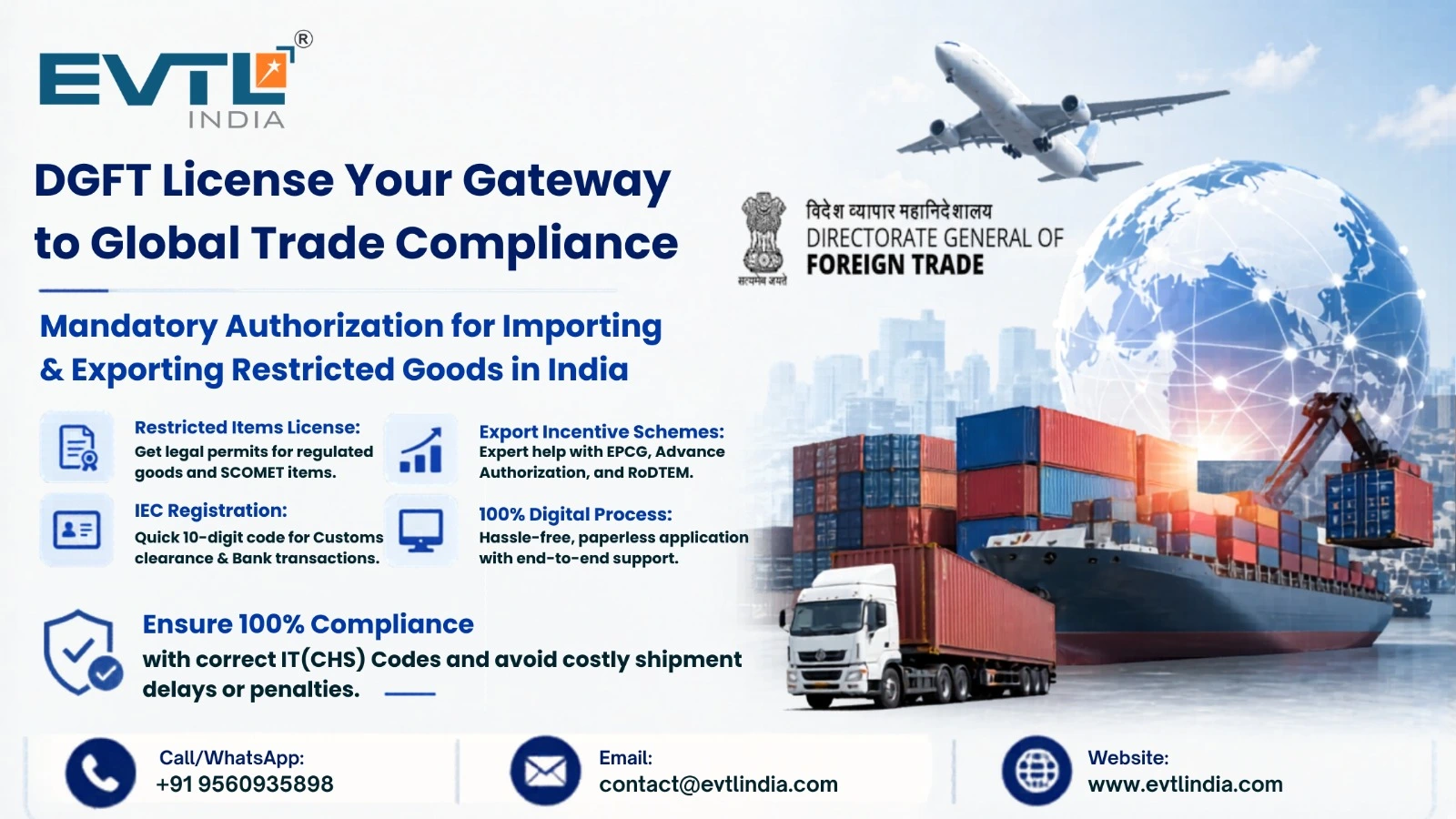
What is the Directorate General of Foreign Trade (DGFT)?
The Directorate General of Foreign Trade (DGFT) is a government body responsible for regulating and promoting India’s international trade. It was established to implement the country’s Foreign Trade Policy (FTP) and ensure smooth import and export operations.
DGFT provides essential services such as issuing the Importer-Exporter Code (IEC), granting licenses for restricted goods, and managing export promotion schemes. In simple terms, DGFT acts as the main authority that controls and supports businesses involved in global trade
Role of DGFT under the Ministry of Commerce and Industry
DGFT works under the Ministry of Commerce and Industry, Government of India. Its key roles include:
- Formulating and implementing foreign trade policies
- Regulating imports and exports through licensing systems
- Promoting exports to boost India’s economy
- Monitoring compliance with trade regulations
- Supporting exporters through various incentive schemes
By handling these responsibilities, DGFT ensures that India’s trade activities remain organized, transparent, and globally competitive
Why DGFT Registration is Essential for Import-Export Businesses in 2026
In 2026, DGFT registration (mainly through IEC) is mandatory for any business that wants to import or export goods from India. Without this registration, international trade is not legally allowed.
Here’s why it is essential:
- Legal Requirement: No import or export can be done without IEC issued by DGFT
- Customs Clearance: Required for shipment processing at ports
- Bank Transactions: Necessary for receiving or sending international payments
- Government Benefits: Access to export promotion schemes like EPCG and Advance Authorization
- Business Growth: Enables companies to expand into global markets
With increasing digitalization and stricter compliance rules, having proper DGFT registration is not just important—it is a basic foundation for doing international business successfully
The Importer-Exporter Code (IEC) .
What is IEC and Why is it Mandatory for Import/Export?
The Importer-Exporter Code (IEC) is a unique 10-digit identification number issued by the Directorate General of Foreign Trade. It is the first and most important requirement for any business or individual planning to start import or export activities in India.
IEC is mandatory because:
- No import or export is allowed without it
- It is required for customs clearance of goods
- Banks ask for IEC to process international payments
- It acts as official proof that your business is registered for global trade
The application process is completely online and usually approved within a few working days.
IEC as a Primary Business Identification Number (No Import/Export without IEC)
IEC works as the main identification number for businesses involved in foreign trade. It is linked to your PAN (Permanent Account Number), which means:
- One PAN = One IEC
- It is valid for lifetime
- No renewal is required, but annual updates are mandatory on the DGFT portal
Every shipment, whether import or export, is tracked using this number. Without IEC, your goods cannot legally move across international borders
Difference Between IEC and Other DGFT Authorizations
Many people confuse IEC with other DGFT licenses, but they serve different purposes:
IEC (Basic Requirement):
- Mandatory for all importers and exporters
- Acts as a registration number
DGFT Authorizations (Additional Licenses):
Required only in specific cases
Examples include:
- Advance Authorization (for duty-free import of raw materials)
- EPCG (for capital goods import at concessional duty)
- SCOMET License (for sensitive or dual-use goods)
In simple terms, IEC is the entry point, while other DGFT authorizations are special permissions based on the nature of goods or trade benefits
3. Types of DGFT Licenses & Authorizations
- Import/export is allowed only after DGFT permission
- Common for sensitive, regulated, or limited-quantity goods
- Application must clearly mention product details, quantity, and purpose
Without this license, customs authorities will not clear the shipment.
B. SCOMET Authorization
SCOMET Authorization is required for exporting items listed under the SCOMET List. These include sensitive or dual-use goods, which can be used for both civilian and military purposes
Key points:
- Mandatory for exporting controlled technologies, chemicals, or equipment
- Requires strict documentation and end-user verification
- Helps ensure compliance with international security regulations
This authorization is critical for businesses dealing in high-tech or strategic products.
C. Export Promotion Schemes
The Directorate General of Foreign Trade offers schemes to promote exports by reducing costs and improving global competitiveness.
Advance Authorization (AA)
- Allows duty-free import of raw materials
- Materials must be used for manufacturing export products
- Export obligation must be fulfilled within a specified time
Export Promotion Capital Goods (EPCG)
- Allows import of capital goods (machinery/equipment) at zero or concessional duty
- Businesses must meet an export obligation over a defined period
- Helps in upgrading technology and increasing production capacity
D. Status Holder Certificate
he Status Holder Certificate is awarded to exporters based on their export performance.
Key benefits:
- Faster customs clearance
- Reduced inspection and paperwork
- Priority treatment in DGFT processes
- Eligibility for additional trade benefits
It recognizes businesses as trusted and high-performing exporters, helping them grow faster in international markets
4. Mandatory Compliance & Regulations
IEC is Required for:
The Importer-Exporter Code (IEC) issued by the Directorate General of Foreign Trade is a mandatory requirement for conducting international trade in India. It is essential in the following areas:
- Customs Clearance: IEC must be provided to customs authorities to process import and export shipments. Without it, goods will not be cleared at ports.
- International Payments via Banks: Banks require IEC to process foreign currency transactions, including receiving export payments and making import payments.
Importance of Correct ITC(HS) Codes for Product Classification
Every product being imported or exported must be classified under the ITC(HS) Codes.
Why correct classification matters:
- Determines whether goods are Free, Restricted, or Prohibited
- Helps identify applicable duties, taxes, and regulations
- Ensures compliance with DGFT and customs rules
- Prevents delays, penalties, or shipment rejection
Incorrect classification can lead to serious legal and financial consequences.
Role of RCMC Issued by Export Promotion Councils
The RCMC is issued by relevant Export Promotion Councils or Commodity Boards.
Key points:
- Required to avail benefits under export promotion schemes
- Confirms that the business is registered with the appropriate council for its product category
- Helps in accessing government incentives, subsidies, and support programs
RCMC is not mandatory for all transactions but becomes essential when a business wants to claim export-related benefits under DGFT schemes.
5. Application Process: Step-by-Step
Here is the DGFT IEC application process presented in a simple table format for better understanding:
Important Notes:
- The process is 100% online and paperless
- IEC is usually generated within 1–3 working days
- No agent is required if documents are correct
6. Validity and Renewal
Lifetime Validity of IEC
The Importer-Exporter Code (IEC) issued by the Directorate General of Foreign Trade has lifetime validity. Once it is generated, there is no need for renewal, making it a one-time registration for businesses engaged in import-export activities.
Mandatory Annual Update
Even though IEC does not expire, the DGFT has made it compulsory to update IEC details every year on its official portal.
Key points:
- Update must be done annually between April and June
- Required even if no changes are made (you must confirm details)
- Helps maintain accurate and active business records
Consequences of Not Updating IEC
Failure to complete the annual update can lead to:
- Deactivation of IEC
- Inability to carry out import/export transactions
- Issues with customs clearance and banking operations
IEC is a lifetime registration, but regular compliance through annual updates is essential to keep it active and valid for business use.
Common Challenges & Mistakes
Falling for Fake or Unauthorized Websites
One of the most common issues businesses face is using fake or unauthorized websites that pretend to be the Directorate General of Foreign Trade.
What to watch out for:
- Websites charging unofficial or high fees
- Fake agents promising “instant IEC approval”
- Non-government domains that look similar to dgft.gov.in
Tip: Always use the official DGFT portal to avoid fraud and data misuse.
Choosing the wrong ITC(HS) Codes is a serious mistake.
Risks include:
- Wrong duty or tax calculation
- Shipment delays or rejection at customs
- Penalties for non-compliance
Accurate classification ensures smooth trade and legal compliance
Not Updating IEC Annually
Although IEC has lifetime validity, failing to update it annually on the DGFT portal can cause:
- Deactivation of IEC
- Disruption in import-export activities
- Issues with banks and customs authorities
Regular updates are mandatory, even if there are no changes
Misuse or Incorrect Declaration
Providing false information or misusing licenses can lead to strict action under the Foreign Trade Policy.
Consequences may include:
- Financial penalties
- Suspension or cancellation of IEC
- Legal action by authorities
Avoiding these common mistakes helps businesses maintain smooth operations, legal compliance, and long-term growth in international trade.
Conclusion
DGFT licensing is the foundation of legal international trade in India. Whether you are a new exporter or an established business, having the right registrations and approvals from the Directorate General of Foreign Trade is essential to operate smoothly in global markets.
Proper compliance not only ensures hassle-free customs clearance and secure banking transactions, but also helps your business avoid penalties and build long-term credibility. From choosing the correct license to maintaining annual updates and following regulations, every step plays a crucial role in your success.
This is where EVTL India adds real value. As an experienced DGFT consultant, EVTL India helps businesses navigate complex procedures with ease—ensuring accurate documentation, faster approvals, and complete compliance.
With the right expert support, you can focus on what truly matters—growing your business and expanding globally—while leaving the legal and technical complexities in safe hands