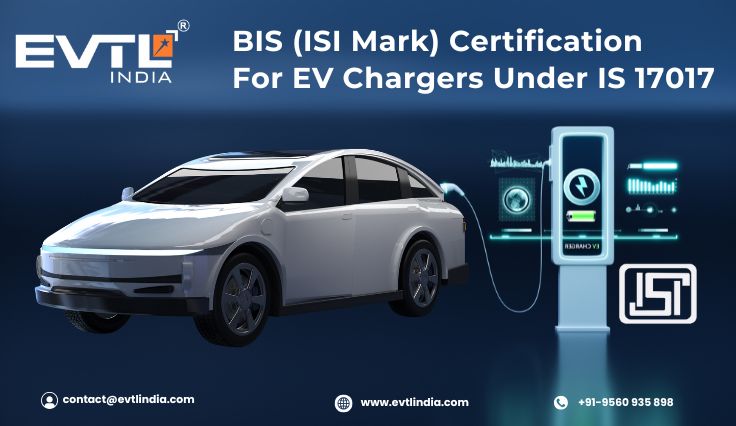
India’s electric vehicle (EV) sector is expanding rapidly, supported by government policies, infrastructure development, and increasing consumer acceptance. As EV adoption grows, the safety and reliability of charging infrastructure become equally critical. To regulate this ecosystem, the Bureau of Indian Standards (BIS) has established defined BIS standards for EV chargers, ensuring safe operation, interoperability, and quality assurance across India.
This blog explains EV charging standards in India, highlights the importance of IS 17017, and outlines why BIS certification for EV chargers is essential under the new safety framework for electrical vehicles.
Role of the Bureau of Indian Standards in EV Charging
The Bureau of Indian Standards is India’s national authority responsible for formulating and enforcing product standards. In the EV domain, BIS plays a key role in setting technical benchmarks for charging equipment to protect users, vehicles, and the power grid.
BIS standards help:- Reduce electrical and fire hazards
- Ensure uniform charging compatibility
- Maintain product quality and performance
- Support safe deployment of public and private charging stations
Without standardized requirements, EV chargers could pose serious safety and operational risks.
EV Charging Standards in India: Why They Matter
EV charging standards in India define how electric vehicle supply equipment (EVSE) should be designed, tested, installed, and operated. These standards consider Indian electrical conditions, environmental factors, and user safety expectations.
Key objectives of Indian EV charging standards include:- Protection against electric shock and overheating
- Safe handling of high voltage and current loads
- Standardized connectors and interfaces
- Reliable communication between charger and vehicle
- Compatibility with different EV models
These requirements are particularly important for public charging infrastructure, where chargers are used continuously by different vehicles.
IS 17017: The Backbone of EV Charger Standards
IS 17017 is the principal Indian Standard governing conductive charging systems for electric vehicles. It is aligned with international best practices while being adapted to Indian grid and climatic conditions.
The IS 17017 series addresses multiple aspects of EV charging, including:- General safety and performance requirements
- AC and DC charging systems
- Plug, socket, and connector specifications
- Control and communication protocols
- Electromagnetic compatibility (EMC)
- Protection during fault and abnormal conditions
By covering both low-power and high-power charging systems, IS 17017 ensures consistency across home chargers, workplace chargers, and fast public charging stations.
BIS Certification for EV Chargers: Compliance Requirement
To legally manufacture, import, or sell EV chargers in India, BIS certification for EV chargers is mandatory for applicable categories. Certification confirms that the charger complies with IS 17017 and other relevant Indian Standards.
Why BIS certification is important:
- It is a regulatory requirement for market entry.
- It validates product safety and quality.
- It builds trust with EV OEMs, operators, and users.
- It reduces legal and operational risks.
- It enables participation in government and PSU projects
Both Indian and foreign manufacturers must follow the BIS conformity assessment process before supplying EV chargers to the Indian market.
Testing and Evaluation under BIS Standards
Before certification, EV chargers must undergo testing at BIS-recognized laboratories. These tests verify whether the product meets the technical and safety parameters defined under IS 17017.
Testing typically includes:
- Electrical safety and insulation checks
- Temperature rise and thermal stability tests
- Short circuit and overload protection evaluation
- Mechanical strength and environmental resistance
- Communication and control system verification
Only after successful testing and documentation review does BIS grant certification approval.
New Safety Standards for Electrical Vehicles and Charging Equipment
With technological advancements and increasing charging demand, BIS continues to strengthen new safety standards for electrical vehicles and associated infrastructure. Updated requirements emphasize:
- Improved fire and shock protection.
- Safer DC fast charging systems
- Enhanced communication safety between EV and charger
- Performance stability under Indian weather conditions
- Grid-friendly charging behavior
These updated safety measures help ensure that EV chargers operate reliably, even under heavy usage and challenging conditions.
Importance of Compliance for EV Industry Stakeholders
Compliance with BIS standards for EV chargers is not just a legal obligation—it is a strategic advantage. Manufacturers, charging station operators, and infrastructure developers benefit from:
- Faster approvals and smoother deployment
- Higher acceptance by OEMs and authorities
- Reduced maintenance and safety incidents
- Long-term sustainability of charging networks
As India moves toward mass EV adoption, standardized and certified charging equipment will be the foundation of a safe and efficient ecosystem.
Conclusion
The future of electric mobility in India depends heavily on reliable and safe charging infrastructure. Through IS 17017, EV charging standards in India, and mandatory BIS certification for EV chargers, the Bureau of Indian Standards ensures that EV charging systems meet stringent safety and performance benchmarks.Adhering to these standards supports consumer safety, regulatory compliance, and the long-term growth of India’s electric vehicle ecosystem—making BIS compliance an essential step for every EV charger manufacturer and supplier.