
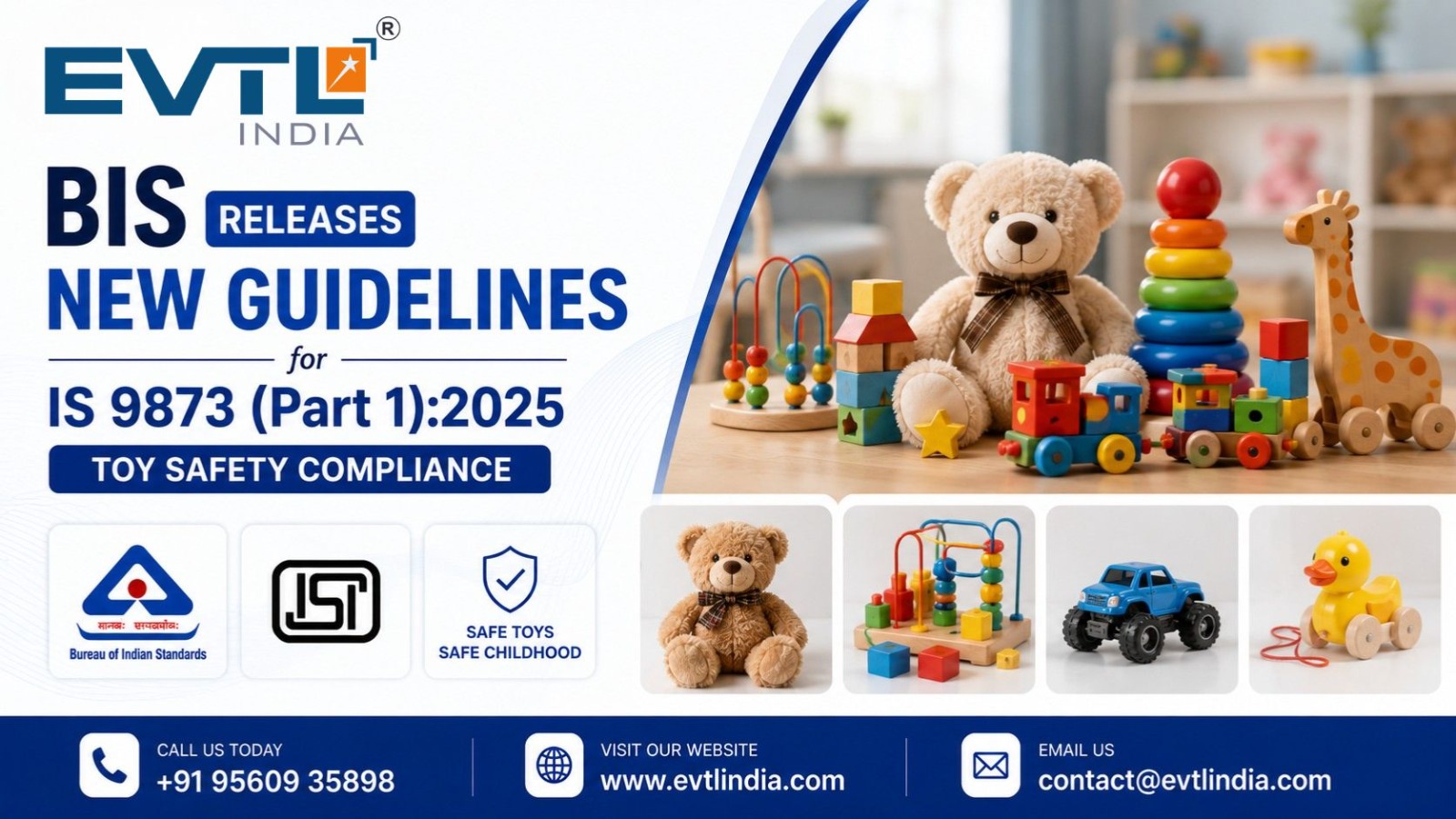
BIS Releases New Guidelines for IS 9873 (Part 1):2025 Toy Safety Compliance
Introduction
The Bureau of Indian Standards (BIS) has issued implementation guidelines for the revised IS 9873 (Part 1):2025, which specifies the safety requirements for toys related to mechanical and physical properties. The revised standard replaces IS 9873 (Part 1):2019 and introduces several important changes aimed at improving toy safety and aligning Indian regulations with the latest international requirements. The new guidelines provide clear directions for existing BIS license holders, new applicants, manufacturers, importers, and testing laboratories to ensure a smooth transition to the updated standard.
As toy safety remains a critical concern for regulators and consumers alike, manufacturers must understand the revised requirements and take proactive measures to ensure compliance. Failure to comply with the applicable BIS standards may result in regulatory issues, market restrictions, and delays in obtaining or maintaining BIS certification.
Overview of IS 9873 (Part 1):2025
IS 9873 (Part 1):2025 covers the mechanical and physical safety aspects of toys intended for children below 14 years of age. The standard establishes requirements to minimize risks associated with choking hazards, sharp edges, moving parts, structural failures, entanglement, and other physical hazards that may arise during normal use or reasonably foreseeable misuse of toys. The revised version has been updated in line with the latest ISO 8124-1 requirements to strengthen safety provisions and improve international harmonization.
The standard applies to a wide range of toys, including educational toys, activity toys, ride-on toys, plush toys, construction sets, and many other categories intended for children's use.
Key Changes Introduced in IS 9873 (Part 1):2025
The revised standard introduces several significant updates that manufacturers must consider during product design, testing, and certification processes.
- Updated Labelling and Warning Requirements: The new standard includes revised warning and labeling provisions for various toy categories. BIS has clarified the placement and visibility of warning labels to ensure that safety information is communicated effectively to consumers. Certain labeling requirements related to fixed loops and nooses have also been relaxed where appropriate.
- Expanded Coverage for Suspended and Attached Toys: The revised requirements broaden the scope of toys attached to or suspended over cots, cradles, and similar infant environments. Manufacturers producing such products must evaluate compliance with the updated safety provisions and testing criteria.
- Enhanced Testing Requirements: Additional testing requirements have been introduced for folding toys and toys containing movable structures. The updated standard places greater emphasis on durability and reasonably foreseeable abuse testing to ensure that products remain safe throughout their intended lifecycle.
- New Provisions for Ride-On Toys: Electrically driven ride-on toys are now subject to revised speed-related safety requirements. Manufacturers of battery-operated ride-on vehicles must verify compliance with the newly established limits and testing procedures before seeking BIS certification.
- Revised Sound Level Requirements: The standard revises permissible sound levels for certain toy categories, including pull and push toys. These changes reflect updated safety considerations while maintaining adequate protection against excessive noise exposure for children.
BIS Transition Guidelines for Existing Licensees
To facilitate implementation, BIS has issued transition guidelines for existing license holders. Manufacturers currently certified under IS 9873 (Part 1):2019 are permitted to continue operations during the transition period; however, they must adopt the revised requirements within the specified timeline.
In many cases, where revisions are editorial or involve relaxed requirements, BIS may not require fresh testing reports. Instead, manufacturers may submit declarations confirming compliance with the revised provisions. Additional testing may be required only for products affected by new technical requirements. BIS has also specified that all licensees must complete the transition to IS 9873 (Part 1):2025 before the withdrawal of the previous standard.
Impact on New Applicants
Manufacturers applying for BIS certification for toys must carefully review the revised standard before initiating certification activities. New applicants should ensure that product design, technical documentation, labeling, and testing reports comply with IS 9873 (Part 1):2025 requirements.
BIS has provided guidance on handling applications submitted during the transition phase. Applicants should coordinate with BIS-recognized laboratories and certification experts to avoid delays and ensure successful certification under the updated requirements.
Importance of BIS Compliance for Toy Manufacturers
Compliance with IS 9873 (Part 1):2025 offers several advantages for manufacturers and importers:
- Demonstrates conformity with Indian toy safety regulations.
- Improves consumer confidence and product credibility.
- Reduces risks associated with recalls and safety incidents.
- Facilitates smooth market access and regulatory approvals.
- Supports long-term business growth through enhanced product quality.
Since toy safety certification remains mandatory under the applicable Quality Control Order (QCO), manufacturers must ensure that their products meet all relevant BIS standards before being introduced into the Indian market. BIS-certified toys bearing the ISI Mark assure consumers that the products have undergone rigorous safety evaluation and comply with prescribed standards.
Conclusion
The release of BIS implementation guidelines for IS 9873 (Part 1):2025 marks an important step toward strengthening toy safety standards in India. The revised standard introduces updated testing procedures, improved warning requirements, expanded product coverage, and enhanced safety provisions that align with international best practices. Manufacturers, importers, and brand owners should carefully assess the impact of these changes on their products and initiate compliance activities well in advance. Early adoption of the revised requirements will help businesses maintain uninterrupted market access, avoid regulatory challenges, and ensure the highest level of safety for children using their products. EVTL India assists manufacturers and importers throughout the BIS certification process by providing support with documentation, testing coordination, compliance assessment, and regulatory approvals to help achieve seamless compliance with IS 9873 (Part 1):2025.