BIS Registration for solar inverters and power inverters IS 16221 (Part 2): 2015
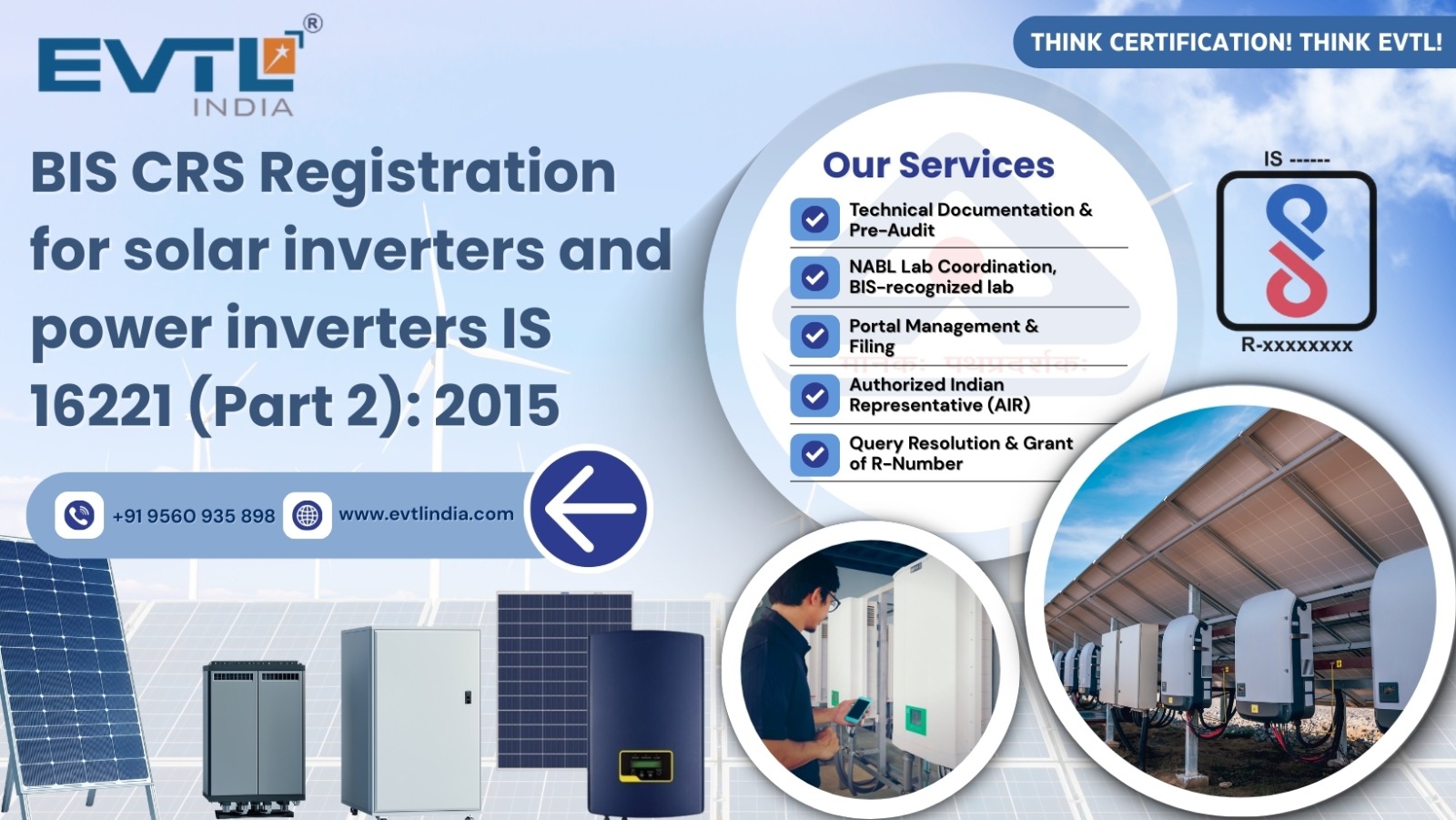
With India’s strong push toward renewable energy and the growing need for reliable power backup, solar inverters and power inverters have become an essential part of everyday electrical systems. These products operate continuously, often under fluctuating loads and challenging environmental conditions, and are directly connected to household, commercial, and industrial power networks. Because of this close interaction with electrical systems, safety, durability, and reliability are critical.
To ensure that inverter products meet defined safety and performance standards, the Bureau of Indian Standards (BIS) has made certification mandatory for Solar Inverters and Power Inverters under Indian Standard IS 16221 (Part 2): 2015. This requirement ensures that only tested, safe, and quality-compliant inverter products are manufactured, imported, and sold in the Indian market.
What is IS 16221 (Part 2): 2015?
IS 16221 (Part 2): 2015 is the Indian Standard that lays down safety requirements for power converters used in photovoltaic (PV) power systems. The standard is designed to protect users, installers, and connected equipment from potential electrical, mechanical, and thermal hazards that may arise during normal operation or fault conditions.
It covers critical safety aspects such as electrical insulation, protection against electric shock, temperature rise, abnormal operating behavior, and overall construction safety. The standard applies to both solar inverters and power inverters, including grid-connected and off-grid systems, within specified voltage limits.
By complying with IS 16221 (Part 2): 2015, manufacturers ensure uniform safety standards while significantly reducing risks associated with inverter use across residential, commercial, and industrial installations.
Legal Importance of BIS Certification for Solar and Power Inverters
BIS Certification for Solar Inverter and Power Inverter is a mandatory legal requirement in India under the Compulsory Registration Scheme (CRS) notified by the Ministry of Electronics and Information Technology (MeitY). Manufacturers and importers must obtain BIS registration before placing inverter products in the Indian market.
Manufacturing, importing, or selling uncertified inverter products is considered a violation of the BIS Act, 2016 and can result in strict regulatory action.
Key Legal Highlights:
- Mandatory BIS registration under IS 16221 (Part 2): 2015
- Applicable to both domestic and foreign manufacturers
- Required for manufacturing, importing, selling, and distribution
- Non-compliance attracts penalties under the BIS Act, 2016
- Risk of product seizure and market withdrawal
- Customs authorities may detain uncertified imports
- Ensures lawful market access and regulatory protection
Testing Requirements under IS 16221 (Part 2): 2015
To obtain BIS certification, solar and power inverters must be tested at a BIS-recognized laboratory. These tests confirm whether the product meets prescribed safety and performance criteria.
Key testing parameters include:
- Protection against electric shock
- Insulation resistance and dielectric strength
- Temperature rise and thermal stability
- Performance under abnormal and fault conditions
- Mechanical strength and construction safety
- Verification of marking and labelling
Only inverter models that successfully pass all applicable tests are approved for registration under IS 16221 (Part 2): 2015.
BIS Registration Process for Solar and Power Inverters:
Tests Performed
Before obtaining BIS registration for Solar Panel, the products undergo rigorous testing in BIS-recognized laboratories. The key tests include:
Documents Required for BIS CRS Registration
General Documents:
- BIS application form.
- GST Certificate
- MSME certificate
- Authorized person Aadhaar
- Company PAN Card
- Contact Details
- Trademark Certificate (Class 9,11)
Additional Documents for Foreign Manufacturers:
- AIR (All India Representative) Details
- Trademark Certificate (Class 9,11)
- Application form 1.
- Authorized representative's photo ID.
- Business license (original + English translation).
Technical Documents:
- CCL (Critical Component List)
- CDF Form
- Product Marking Plate
- Product Manual
- Product Diagram
Validity and Renewal of BIS Registration
BIS registration for solar and power inverters is generally valid for two years. Renewal is granted upon demonstrating continued compliance with IS 16221 (Part 2): 2015 and submitting updated declarations and documents.
Any changes in product design, components, or manufacturing location must be reported to BIS for prior approval
Support Services Offered by BIS Consultants and Agents
Given the technical requirements and regulatory procedures involved, many manufacturers rely on professional support:
- BIS Consultant for Solar Inverter and Power Inverter – Complete compliance management
- CRS Consultant for Inverters – Guidance on testing and registration procedures
- BIS Agent for Inverters – Application filing and coordination with BIS
- BIS QCO Compliance Support – Ensures adherence to applicable Quality Control Orders
These services help reduce delays, prevent errors, and ensure smoother approvals.
Legal and Commercial Benefits for Manufacturers
- Ensures mandatory compliance with IS 16221 (Part 2): 2015
- Protects against penalties and enforcement actions
- Enhances product safety and market credibility
- Enables participation in government and institutional projects
- Builds consumer trust and brand reputation
- Supports long-term business growth in the energy sector
Conclusion
BIS Certification for Solar Inverter and Power Inverter under IS 16221 (Part 2): 2015 is a vital requirement for ensuring electrical safety, regulatory compliance, and consumer protection in India. It not only shields manufacturers from legal risks but also confirms that inverter products meet nationally accepted safety standards. With proper certification and expert guidance, businesses can confidently enter the Indian market, strengthen brand reliability, and contribute to a safer and more sustainable energy ecosystem.