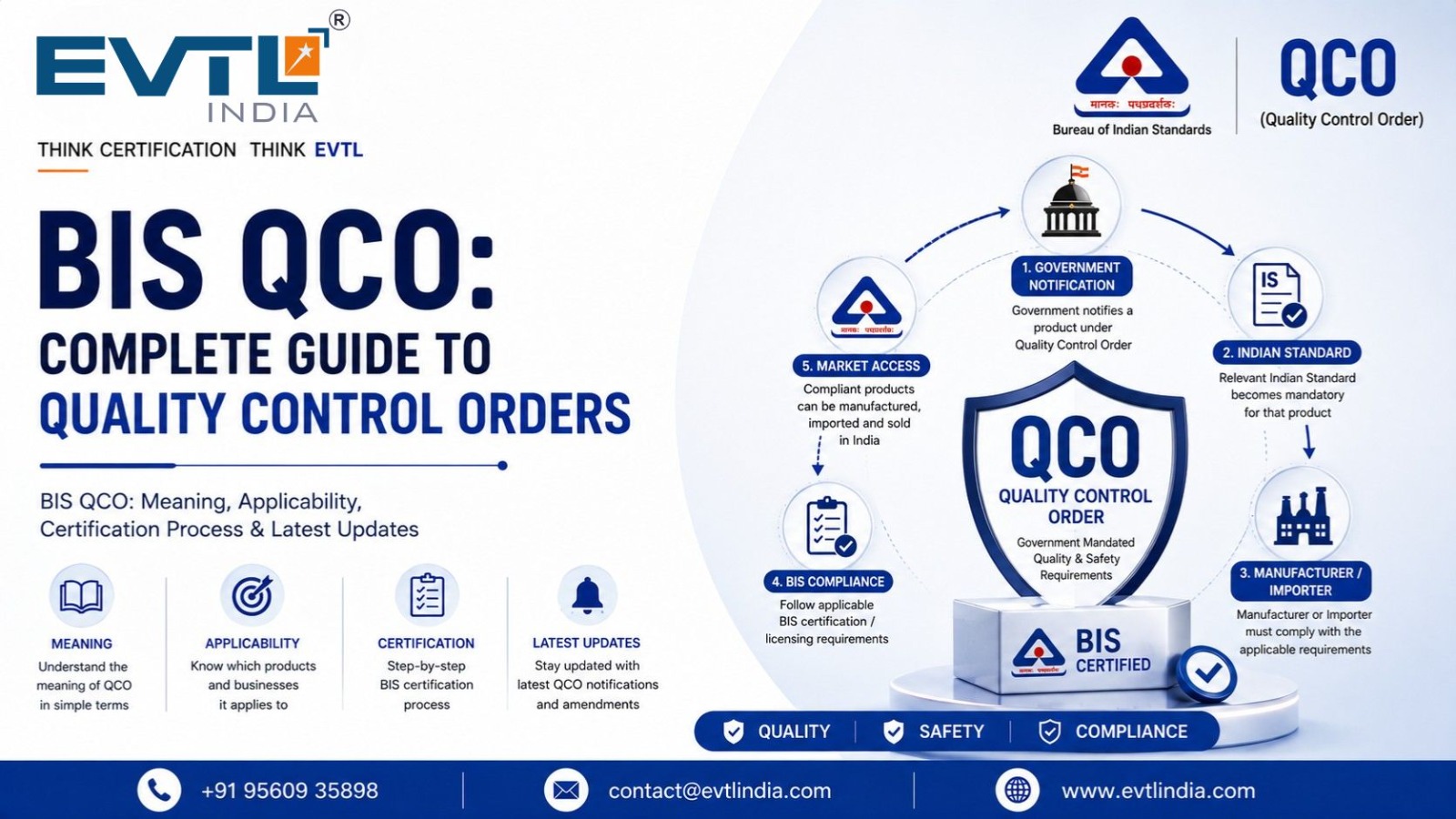
BIS QCO: Meaning, Applicability, Certification Process & Latest Updates

 19 August 2026
BIS QCO: Meaning, Applicability, Certification Process & Latest Updates

What is BIS QCO?

BIS QCO stands for Bureau of Indian Standards Quality Control Order. A Quality Control Order (QCO) is an order issued by the Government of India that makes compliance with specified Indian Standards (IS) mandatory for the products covered under that particular order.

When a product is covered by a QCO, the manufacturer or importer must comply with the requirements specified in the applicable QCO. Depending on the product and the applicable conformity assessment scheme, this may require BIS certification, a BIS licence or Certificate of Conformity (CoC), and use of the BIS Standard Mark.

It is important to understand that QCO, Indian Standard and BIS Certification are not the same thing -

TermMeaning
QCOA Government order that makes specified standards mandatory for covered products.
Indian Standard (IS)The technical requirements and specifications applicable to a particular product.
BIS CertificationA conformity assessment process through which compliance with the applicable standard is assessed, where certification is required.

Why is BIS QCO Important?

QCOs are introduced to ensure that specified products available in the Indian market meet prescribed quality, safety, performance and other applicable requirements.

For manufacturers and importers, understanding QCO applicability is important because non-compliance can create regulatory and business risks.

Before starting the BIS certification process, it is important to determine -

  • Whether the product is covered under a QCO
  • Which Indian Standard (IS) applies
  • When the QCO becomes effective
  • Which BIS conformity assessment scheme applies
  • Whether any exemption or special provision is available
  • What certification and marking requirements must be followed

How Does BIS QCO Work?

The basic compliance process can be understood as -

QCO Notification → Product Identification → Applicable Indian Standard → QCO Applicability → BIS/Conformity Assessment Requirements → Compliance

For example, if a Government QCO makes a particular Indian Standard mandatory for a specific product, the manufacturer must first verify whether its product falls within the scope of that QCO. If BIS certification is prescribed, the manufacturer must then follow the applicable BIS certification process before the relevant compliance deadline.

Important: QCO requirements are product-specific. The certification process, effective date, exemptions and other requirements may differ from one QCO to another. Therefore, the relevant QCO notification and its latest amendments should always be checked before making a compliance decision.


Need Help With BIS QCO Compliance?

If you are a manufacturer, importer or foreign manufacturer, EVTL India can help you understand the applicable QCO, Indian Standard, certification requirements, documentation and compliance process for your product.

What Does a Quality Control Order Mean?

A Quality Control Order (QCO) is an order issued by the Government of India that makes specified Indian Standards (IS) mandatory for the products covered under that order.

In simple terms, a QCO means that covered products must meet the requirements specified in the applicable order. Depending on the QCO, requirements may apply to the manufacture, import, sale, storage or distribution of the product.

Where BIS certification is prescribed, the manufacturer must obtain the applicable BIS licence, Certificate of Conformity (CoC), or other prescribed conformity assessment before the relevant compliance requirement becomes applicable.

Simple Example

QCO → Product → Applicable IS → BIS/Conformity Assessment → Compliance

The exact requirements can vary between QCOs, so the relevant notification, effective date, amendments and exemptions should always be checked.

Why Does the Government Issue QCOs?

The Government issues QCOs to make specified standards mandatory for products where quality, safety, performance and consumer protection are important.

Key objectives include -

  • Consumer Safety: Help ensure products meet specified safety requirements.
  • Product Quality: Maintain defined quality and performance standards.
  • Prevent Substandard Products: Restrict products that do not meet mandatory requirements.
  • Consumer Protection: Help ensure conformity with applicable Indian Standards.
  • Fair Competition: Create common compliance requirements for manufacturers and importers.

Important: A QCO does not mean that every product follows the same BIS certification process. The applicable QCO, IS standard, effective date, BIS scheme and exemptions must be checked for the specific product.

Which Products Are Covered Under BIS QCO?

There is no single universal list of "BIS QCO products." The Government issues separate QCOs for specific products and product categories.

QCOs may cover areas such as -

  • Electrical and electronic products
  • Steel and iron products
  • Chemicals and petrochemicals
  • Cement and construction materials
  • Machinery and engineering products
  • Household and consumer products
  • Automotive components
  • Cables and electrical equipment
  • Industrial and safety-related products

However, being part of a particular industry does not automatically mean that a product is covered by a QCO. The exact product scope and applicable notification must be verified.

How to Check Whether a Product Is Covered?

Check the following -

  1. Product name and description
  2. Applicable Indian Standard (IS)
  3. Product specifications and scope
  4. Relevant QCO notification
  5. Effective/implementation date
  6. Exemptions or special provisions
  7. Applicable BIS conformity assessment requirements

In short: Don't determine QCO applicability only from the product category. Always match the exact product with the applicable IS and QCO notification.

How to Check QCO Applicability for Your Product

Before applying for BIS certification, first confirm whether your product is covered under a QCO and what requirements apply to it.

  • Identify Your Product - Collect the basic product details: Product name and model, Technical specifications, Intended use, Material/composition, where applicable, Product variants
  • Identify the Applicable Indian Standard - Check whether an Indian Standard (IS) applies to your product. Don't rely only on the IS number; review its scope and requirements to confirm that your product is covered.
  • Check the Relevant QCO - Verify whether the Government has issued a QCO making the applicable IS mandatory. Check: Product scope, Applicable IS, Effective date,BIS/conformity assessment requirements, Exemptions and special provisions, Latest amendments
  • Check the Effective Date - Check the commencement/effective date mentioned in the QCO. The notification date and compliance date may not always be the same.
  • Check Exemptions - Some QCOs may provide specific exemptions based on the product, end use, manufacturer, quantity or other conditions. Never assume an exemption without checking the applicable notification.
  • Identify the BIS Requirement - If BIS certification is required, identify the applicable BIS conformity assessment scheme, testing, documentation, inspection and marking requirements.

Quick QCO Applicability Check

Product → Applicable IS → QCO → Product Scope → Effective Date → Exemptions → BIS Requirement
Important: QCO applicability should not be decided only by product name or a general QCO list. The product's technical specifications should be matched with the scope of the applicable IS and the relevant QCO notification. This helps manufacturers, importers and foreign manufacturers avoid unnecessary certification costs and compliance risks.

Is BIS Certification Mandatory Under QCO?

BIS certification is mandatory when the applicable QCO specifically requires it for the covered product. The exact requirement depends on the product, applicable Indian Standard (IS), QCO and conformity assessment scheme.

Before applying, check -

  • Exact product and scope
  • Applicable Indian Standard (IS)
  • Relevant QCO and amendments
  • QCO commencement date
  • Applicable BIS certification/conformity assessment scheme
  • Exemptions or special provisions

Important: A QCO and a BIS licence are not the same thing. A QCO is a Government order that makes specified requirements mandatory, while BIS certification is the conformity assessment mechanism where it is prescribed.

For imported products, the importer should also verify that the foreign manufacturing unit has the required valid BIS certification, where applicable.

BIS Certification Process for QCO Products

The certification process depends on the product and applicable BIS scheme. A typical process can be understood as follows -

  1. Check QCO & Applicable IS: Identify the exact product, applicable Indian Standard (IS) and relevant QCO.
  2. Check BIS Requirements: Determine the applicable certification/conformity assessment scheme and requirements for the product.
  3. Prepare Documents & Factory: Prepare the required technical documents and ensure that the manufacturing, quality-control and testing facilities meet applicable requirements.
  4. Product Testing: Complete the testing required under the applicable BIS scheme, using the prescribed testing facility or method.
  5. Submit BIS Application: Submit the application and required documents through the applicable BIS process.
  6. Factory Assessment: Where required, BIS assesses the manufacturing facilities, production process, quality-control system and testing arrangements.
  7. Grant of Certification: After successful evaluation and fulfilment of applicable requirements, BIS may grant the relevant licence or Certificate of Conformity (CoC).
  8. Maintain Compliance: After certification, the manufacturer must continue to meet applicable requirements, including surveillance, testing, marking and other conditions prescribed under the relevant scheme.

BIS QCO Certification Process

Product → IS & QCO Check → BIS Scheme → Documents & Testing → Application → Assessment → Certification → Ongoing Compliance
Important: There is no single BIS process applicable to every QCO product. The exact QCO notification, IS, certification scheme, effective date and exemptions should be verified before starting the certification process.

Documents Required for BIS Certification

The documents required for BIS certification depend on the product, applicable Indian Standard (IS), and BIS conformity assessment scheme. Therefore, the same document list does not apply to every product.

Generally, the required information may include -

  • Manufacturer and company details
  • Factory/manufacturing unit details
  • Applicable Indian Standard (IS)
  • Product specifications and technical details
  • Manufacturing process/flow chart
  • Manufacturing machinery details
  • Testing equipment and laboratory details
  • Quality control and inspection arrangements
  • Test reports, where applicable
  • Raw material/component details
  • Product models and variants
  • Undertakings and declarations
  • Brand/trademark documents, where applicable

Important: Exact documentation requirements are product-specific. Before applying, the applicable BIS scheme, product manual, and application checklist should be verified.

QCO Requirements for Indian Manufacturers

If a product is covered under a QCO, the Indian manufacturer must comply with the applicable QCO, Indian Standard, and BIS conformity assessment requirements.

  1. Check QCO Applicability: Confirm whether the exact product falls within the scope of the applicable QCO.
  2. Identify the Applicable IS: Identify the Indian Standard (IS) specified in the QCO and ensure that the product meets its requirements.
  3. Prepare Manufacturing Facilities: Maintain the required manufacturing infrastructure, machinery, production processes, and quality controls as applicable to the product and BIS scheme.
  4. Ensure Testing Facilities: Maintain the required testing equipment, laboratory facilities, and competent personnel, wherever applicable.
  5. Obtain Applicable Certification: Complete the required BIS licence, Certificate of Conformity (CoC), or applicable conformity assessment process specified for the product.
  6. Maintain Ongoing Compliance: After certification, continue to follow applicable BIS marking, testing, surveillance, quality control, and other compliance requirements.

Simple Compliance Process

QCO Check → IS Identification → Factory & Testing Readiness → BIS Certification/Conformity Assessment → Marking → Ongoing Compliance
Important: Simply submitting a BIS application does not mean that the QCO requirements have been fulfilled. The manufacturer must meet all applicable requirements specified under the relevant QCO and BIS certification scheme.

QCO Requirements for Importers

QCO requirements can also apply to imported products. Importers should verify whether the product is covered under a QCO and whether the applicable BIS certification or conformity assessment requirements have been fulfilled.

What Should an Importer Check?

  1. QCO Applicability: Check whether the imported product is covered under the applicable QCO.
  2. Applicable Indian Standard: Identify the relevant Indian Standard (IS) and confirm that the product falls within its scope.
  3. Foreign Manufacturer's BIS Certification: Where BIS certification is required, verify that the foreign manufacturing unit holds the appropriate valid BIS licence or certification.
  4. Licence Details: Check the licence scope, manufacturing location, product varieties/models and validity.
  5. Exemptions: If an exemption is being claimed, verify the specific provision and conditions mentioned in the applicable QCO.

Does an Importer Need a BIS Licence?

Generally, BIS product certification licences are issued to the manufacturing unit, rather than to importers, dealers or distributors. Therefore, where certification is mandatory, the importer should source the product from a manufacturer holding the required valid BIS certification.

Import Compliance Flow

QCO Check → IS Check → Foreign Manufacturer Check → BIS Licence/CoC Verification → Product Scope Verification → Import Compliance

QCO Requirements for Foreign Manufacturers

Foreign manufacturers supplying products to India may need to comply with the applicable QCO, Indian Standard and BIS certification requirements.

Where the applicable certification route is Foreign Manufacturers Certification Scheme (FMCS), the foreign manufacturer can apply for a BIS licence for products manufactured at its overseas facility, subject to the applicable requirements.

Major Requirements for Foreign Manufacturers

  1. Meet the Applicable Indian Standard The product must conform to the requirements of the applicable Indian Standard (IS).
  2. Maintain Manufacturing Facilities The manufacturing unit should have the required machinery, production facilities and process controls applicable to the product.
  3. Maintain Testing Facilities Required testing equipment, laboratory facilities and competent personnel should be available as specified by the applicable standard and certification scheme.
  4. Appoint an Authorized Indian Representative (AIR) Under FMCS, the foreign manufacturer is required to appoint an Authorized Indian Representative (AIR) who meets the applicable BIS requirements.
  5. Prepare Application & Technical Documents The manufacturer must submit the prescribed application and supporting documents. Depending on the product, these may include: Manufacturing process flow chart, Quality assurance details, Raw material and production information, Manufacturing machinery details, Testing equipment details, Product and technical information, Other documents specified by BIS
  6. BIS Assessment & Certification BIS assesses the manufacturing facilities, quality-control arrangements, testing capabilities and product conformity according to the applicable requirements. If the requirements are successfully fulfilled, the applicable BIS certification/licence may be granted.

Foreign Manufacturer Compliance Flow

QCO Applicability → Applicable IS → BIS Scheme → Factory & Testing Readiness → AIR → Documents → BIS Application → Assessment/Testing → Certification → Ongoing Compliance
Important: Foreign manufacturers should not assume that every QCO product follows FMCS. The applicable QCO, Indian Standard and BIS conformity assessment scheme must first be verified.
How Can a BIS QCO Consultant Help?

For foreign manufacturers, a consultant can assist with QCO applicability, IS identification, BIS scheme selection, documentation, AIR requirements, testing, application preparation and certification support.

Product → QCO → IS → BIS Scheme → Factory → Testing → AIR → Certification

QCO Exemptions and Special Cases

QCO exemptions are not universal. An exemption applies only when it is specifically provided in the relevant QCO, amendment, notification, or applicable legal provision.

A product should not be considered exempt simply because it is manufactured in a small quantity, intended for export, or produced by a small-scale manufacturer.

Special Provisions May Include

Depending on the specific QCO, provisions may relate to -

  • Specific products or product categories
  • Particular end uses
  • Export-related supplies
  • Specified manufacturers or entities
  • Quantities or conditions
  • Transitional arrangements
  • Products manufactured before a specified date
  • Other conditions stated in the notification

Before Claiming an Exemption

Manufacturers and importers should -

  1. Identify the applicable QCO.
  2. Review the complete notification.
  3. Check the latest amendments.
  4. Confirm that the product falls within the relevant scope.
  5. Verify all exemption conditions.
  6. Maintain required supporting records and documents.

Important: The fact that a QCO contains an exemption does not automatically mean that your product qualifies for it. The specific notification and applicable conditions should always be verified.

QCO Effective Date and Implementation

The effective or commencement date determines when the requirements of a particular QCO become applicable, subject to the provisions of that notification.

The publication date and compliance date may be different, so the publication date alone should not be used to determine the compliance deadline.

How to Check the QCO Effective Date

QCO Notification → Publication Date → Commencement Provision → Product & IS Scope → Amendments/Extensions → Applicable Compliance Date
Why Is the Effective Date Important?

Manufacturers and importers need to know the effective date to determine when compliance becomes mandatory and plan certification or other requirements accordingly.

If a QCO is amended, extended or supplemented by a later notification, the latest applicable notification should be checked before making a compliance decision.

Information to Check on a QCO

For a product-specific QCO, verify -

  • QCO notification number
  • Notification date
  • Applicable Indian Standard (IS)
  • Product scope
  • Original commencement date
  • Amendments or extensions
  • Current applicable date
  • Exemptions or special provisions

Consultant Tip: Avoid publishing a fixed QCO compliance date without verifying the latest official notification. QCO implementation dates and conditions can be changed or supplemented through subsequent Government notifications.

What Happens if QCO Requirements Are Not Followed?

If a product is covered under a mandatory QCO and the applicable requirements are not followed, the manufacturer or importer may face regulatory and legal consequences.

The exact action depends on the specific QCO, applicable BIS requirements and other relevant laws. Therefore, there is no single penalty applicable to every QCO product.

Possible Consequences

Depending on the applicable provisions, non-compliance may lead to -

  • Restrictions on manufacture, import, sale or distribution
  • Regulatory action relating to BIS certification/licensing
  • Product seizure or withdrawal from the market
  • Action against non-conforming products
  • Financial penalties, where prescribed
  • Prosecution or other legal proceedings, where applicable
  • Business delays and additional compliance costs

For BIS Licence Holders

If a manufacturer already holds a BIS licence but fails to maintain certification requirements, BIS may take applicable regulatory action, which can include surveillance, testing, corrective measures, suspension, cancellation or other measures, depending on the circumstances.

Risks for Importers

Importers dealing with QCO-covered products should verify compliance before placing an order or importing the shipment.

QCO Applicability → Applicable IS → Foreign Manufacturer → BIS Certification → Product Scope → Models/Varieties → Certificate Validity
Important – QCO non-compliance should not be assessed simply as "BIS certificate missing." The applicable QCO, IS, certification scheme, commencement date, exemptions and enforcement provisions should all be reviewed.
Consultant Tip: If a client asks, "What is the penalty for QCO non-compliance?", do not quote a fixed amount without first identifying the specific product, QCO notification and applicable legal provisions.

BIS QCO Consultant: How We Can Help

BIS QCO compliance depends on the product, applicable Indian Standard, QCO notification, effective date and conformity assessment scheme. EVTL India helps manufacturers, importers and foreign manufacturers understand these requirements and prepare for BIS compliance.

How Can a BIS QCO Consultant Help?

  1. QCO Applicability Assessment: We check whether the specific product is covered under a QCO based on its description, specifications, applicable IS and notification.
  2. Indian Standard Identification: We identify the applicable Indian Standard (IS) and verify whether the product falls within its scope.
  3. QCO Notification Review: We review the relevant QCO, amendments, effective date, exemptions and special provisions.
  4. BIS Scheme Identification: Where BIS certification is required, we help identify the applicable BIS conformity assessment scheme.
  5. Documentation Support: We assist with the technical and supporting documents required for the applicable certification process.
  6. Testing Guidance: We provide guidance on applicable testing requirements, test reports and testing facilities.
  7. Factory Readiness Support: We help manufacturers understand requirements related to manufacturing facilities, quality control, machinery and testing arrangements.
  8. Foreign Manufacturer Support: For eligible foreign manufacturers, we provide guidance on FMCS, AIR requirements, documentation and BIS certification.
  9. BIS Application Support: We assist with application preparation, documentation and coordination throughout the certification process.
  10. Ongoing Compliance Support: We provide guidance on applicable testing, surveillance, marking, renewal and continuing compliance requirements.

Why Choose Professional QCO Assistance?

Incorrect QCO interpretation can lead to: Wrong certification route, Unnecessary testing costs, Certification delays, Import-related issues, Documentation problems, Non-compliance risks

Our Approach: We recommend starting with a QCO applicability assessment before beginning the BIS certification process. This helps determine the correct QCO, IS, BIS scheme, requirements and compliance route for your product.

Need Help With BIS QCO Compliance? If you are a manufacturer, importer or foreign manufacturer, share your:

Product Name + Technical Specifications + Country of Manufacturing + Intended Use

EVTL India can help assess the QCO applicability, applicable IS, certification route, documentation and compliance requirements before you proceed with testing or certification.

FAQ ?

Call EVTL India for BIS, CDSCO and TEC Certification Services
Email EVTL India for regulatory certification assistance in India
WhatsApp EVTL India for quick certification consultation
QUICK ENQUIRY