
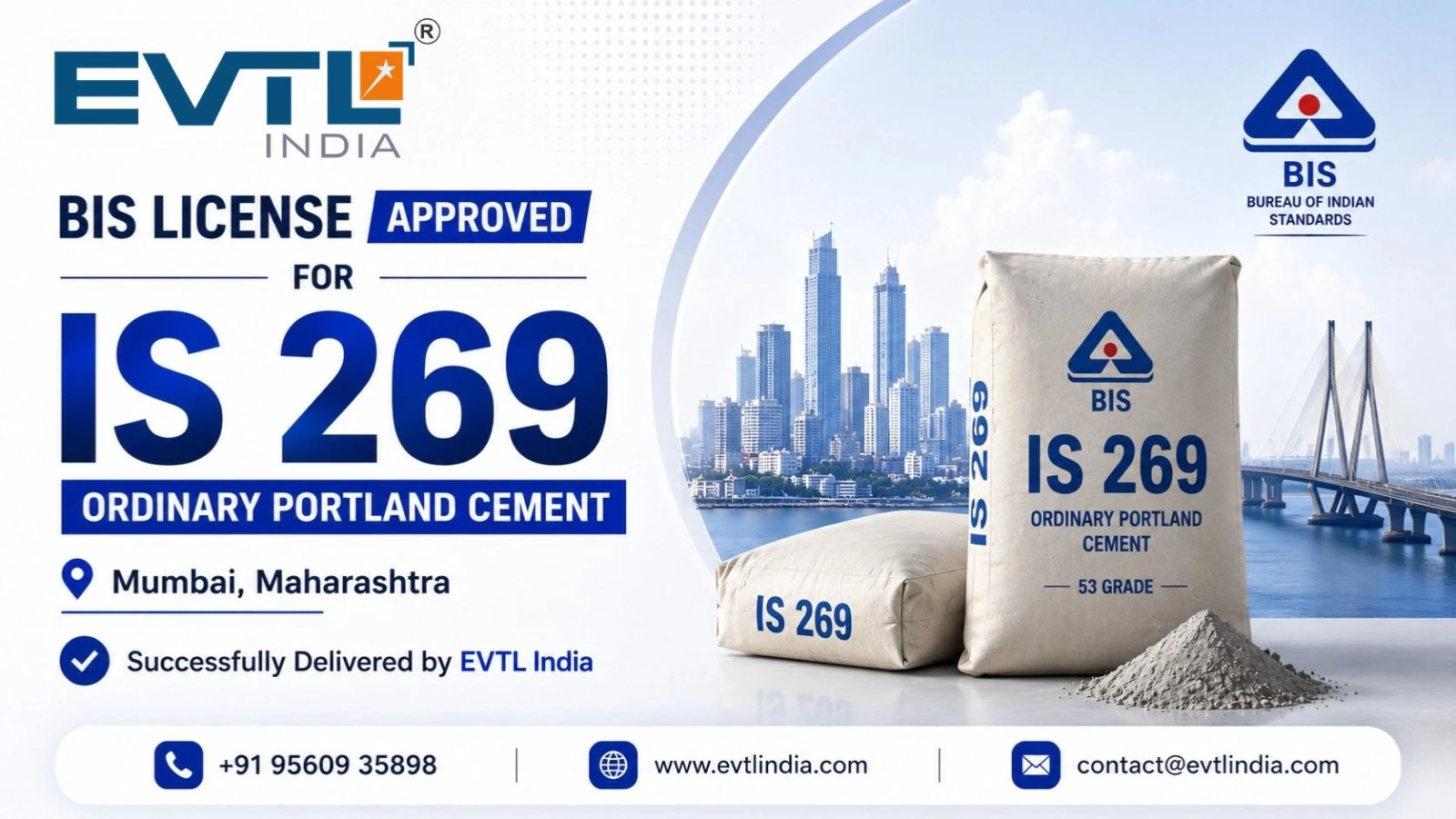
BIS License for IS 269 Cement in Mumbai, Maharashtra – Successfully Delivered by EVTL India
Mumbai, Maharashtra, is one of India's leading construction and infrastructure centers, with a significant demand for high-quality cement products used in residential, commercial, industrial, and public infrastructure projects. Manufacturers producing Ordinary Portland Cement (OPC) for the Indian market must comply with the requirements of BIS certification under IS 269. This Indian Standard specifies the quality, physical properties, chemical requirements, testing methods, and performance criteria for Ordinary Portland Cement to ensure product reliability, strength, and consistency.
To demonstrate compliance with Indian quality standards, manufacturers are required to obtain a BIS License and use the ISI Mark under the applicable certification scheme of the Bureau of Indian Standards (BIS). EVTL India successfully assisted a cement manufacturer in Mumbai, Maharashtra, in obtaining the BIS License for IS 269 Cement. Our team provided end-to-end support, including documentation preparation, product testing coordination, application filing, compliance assessment, and certification guidance. The successful grant of the BIS License enabled the manufacturer to demonstrate conformity with Indian standards and strengthen its position in the competitive construction materials market.
Product Scope and Applicable Standards for IS 269
The scope of this BIS audit included a comprehensive assessment of the manufacturing, quality control, testing, storage, packing, and dispatch processes for Ordinary Portland Cement (OPC) 33 Grade. This cement is widely used in residential construction, commercial buildings, infrastructure projects, masonry work, concrete production, plastering, flooring applications, and various civil engineering works. As cement serves as a critical binding material in construction, maintaining consistent quality, strength, durability, and performance is essential to ensure structural safety and long-term reliability.
The audit was conducted in strict accordance with the following requirements:
- IS 269:2015: The Indian Standard specifying the requirements, chemical composition, physical properties, performance criteria, and testing methods for Ordinary Portland Cement (OPC) 33 Grade.
- Raw Material and Manufacturing Controls: Verification of the quality and suitability of limestone, clay, gypsum, clinker, and other approved materials used in the cement manufacturing process to ensure compliance with prescribed specifications.
- Chemical Composition Requirements: Assessment of chemical parameters such as lime saturation factor, magnesia content, sulphuric anhydride, insoluble residue, and loss on ignition to verify conformity with the requirements of the standard.
- Physical Performance Evaluation: Evaluation of fineness, setting time, soundness, and compressive strength to ensure the cement delivers the required performance characteristics for construction applications.
- Process and Production Controls: Inspection of kiln operations, clinker production, grinding processes, blending controls, storage systems, and production monitoring procedures to ensure consistent product quality.
- Testing and Quality Assurance Procedures: Review of laboratory testing facilities, calibration records, testing equipment, inspection procedures, sampling methods, and quality management systems used to maintain compliance with applicable requirements.
- Packing, Marking, and Traceability Requirements: Verification of packaging controls, batch identification systems, product marking requirements, storage practices, and traceability procedures to ensure product integrity throughout the supply chain.
- Applicable BIS FMCS Requirements: Compliance with Bureau of Indian Standards Foreign Manufacturers Certification Scheme (FMCS) requirements, including product testing, factory quality assurance systems, surveillance obligations, conformity assessment procedures, marking requirements, sampling protocols, and ongoing compliance measures for supplying Ordinary Portland Cement (OPC) 33 Grade to the Indian market.
Applicable Standards and References
Compliance with IS 269 and the associated testing standards is mandatory for manufacturers seeking BIS certification and the use of the ISI Mark for Ordinary Portland Cement (OPC) 33 Grade in India.
BIS Certificate Application Procedure in Mumbai, Maharashtra
Obtaining a BIS Certificate is an important step for manufacturers and importers who want to ensure that their products comply with Indian quality and safety standards. At EVTL India, we simplify the certification process by providing complete guidance and support at every stage, making the procedure smooth, efficient, and hassle-free.
- Product Identification and Standard Selection: The first step is to identify the product category and determine the applicable Indian Standard (IS) and certification scheme. Selecting the correct standard is essential to ensure compliance and avoid delays during the application process.
- Documentation Preparation: Once the product standard is identified, our experts assist in preparing all required documents, including business registration certificates, manufacturing details, product specifications, quality management documents, and other compliance-related records. Proper documentation helps ensure a smooth application process.
- Product Testing: The product must be tested in a BIS-recognized laboratory to verify compliance with the applicable Indian Standard. EVTL India coordinates the testing process and helps manufacturers obtain accurate test reports required for certification.
- BIS Application Submission: After successful product testing, the BIS application is submitted through the designated BIS portal. Our team carefully reviews all information and supporting documents before submission to minimize errors and processing delays.
- Factory Inspection and Assessment: For products requiring factory evaluation, BIS officials conduct an inspection of the manufacturing facility. The audit includes verification of production processes, quality control systems, testing facilities, and compliance procedures. EVTL India assists clients in preparing for the inspection and addressing any observations.
- Grant of BIS Certification: After successful verification of documents, test reports, and inspection findings, BIS grants the certification or licence. The manufacturer is then authorized to use the BIS Standard Mark as per the applicable certification scheme and legally market the product in India.
With EVTL India's professional support, businesses in Mumbai, Maharashtra can complete the BIS certification process efficiently while ensuring full compliance with BIS regulations and quality requirements.
Services Offered by EVTL India in Mumbai, Maharashtra
Documents Required for BIS Certification in Mumbai, Maharashtra
To apply for BIS Certification, manufacturers must submit specific documents to demonstrate compliance with applicable Indian Standards. The documentation requirements may vary depending on the certification scheme and product category. Commonly required documents include:
- Business Registration Certificate
- GST Registration and PAN Details
- Product Specifications and Technical Documents
- Product Test Reports from BIS-Recognized Laboratories
- Manufacturing Process Flow Chart
- Quality Control and Quality Assurance Documents
- Factory Layout and Production Details
- Trademark Registration Certificate (if applicable)
- Authorized Indian Representative (AIR) Authorization Letter (for foreign manufacturers)
- Brand Authorization Letter (if applicable)
At EVTL India, our experts assist in preparing and reviewing all required documents to ensure accuracy, reduce compliance risks, and help avoid unnecessary delays during the BIS approval process.
BIS Certification Cost in Mumbai
The cost of obtaining a BIS Certificate depends on factors such as product category, testing requirements, factory inspection, and applicable BIS fees. Below is an indicative cost structure:
*Testing charges vary depending on the product type, applicable standard, and testing requirements.
BIS Licence Renewal and Compliance Requirements
Obtaining a BIS licence is not the final step. Manufacturers must continue to comply with BIS requirements and renew their licences within the prescribed validity period to maintain certification.
Validity of BIS Licences
Renewal and Ongoing Compliance
To ensure uninterrupted market access and continued use of the BIS certification mark, manufacturers should:
- Apply for licence renewal before expiry
- Maintain product quality and compliance with applicable Indian Standards
- Conduct periodic product testing as required
- Maintain quality control records and production documentation
- Comply with BIS surveillance and inspection requirements
Timely renewal and continuous compliance help businesses avoid penalties, licence suspension, and disruptions in product sales within the Indian market.
Conclusion
Obtaining a BIS License for IS 269 Cement is essential for manufacturers seeking to supply Ordinary Portland Cement (OPC) 33 Grade in the Indian market while meeting the required quality, safety, and performance standards. BIS certification not only permits the use of the ISI Mark but also enhances product credibility, strengthens customer confidence, and improves market competitiveness in the construction industry.
The successful certification of IS 269 Cement in Mumbai, Maharashtra, demonstrates the importance of proper documentation, product testing, compliance management, and adherence to BIS requirements. With the right guidance and a structured approach, manufacturers can complete the certification process efficiently and avoid unnecessary delays.
EVTL India provides comprehensive support throughout the BIS certification journey, helping manufacturers achieve regulatory compliance, obtain BIS licences smoothly, and maintain ongoing conformity with applicable Indian Standards and BIS regulations.