
BIS Certification vs CRS Registration in India: Key Differences, Process, and Compliance Guide
The Bureau of Indian Standards (BIS) plays a vital role in protecting consumers and regulating product quality in India. It ensures that products manufactured, imported, or sold in the Indian market meet prescribed safety, quality, and performance standards through various conformity assessment schemes. Among these, BIS Certification (ISI Mark Certification) and CRS Certification (Compulsory Registration Scheme) are two major compliance frameworks that often create confusion for manufacturers and importers.
Although both certifications are issued by BIS, they are not interchangeable. Each scheme applies to different product categories, regulatory objectives, and compliance requirements. Understanding the difference between BIS vs CRS Certification is essential to avoid regulatory delays, customs issues, and non-compliance penalties.
This guide explains the key distinctions between BIS ISI Certification and BIS CRS Registration, helping manufacturers select the correct certification route for smooth and lawful market entry in India.
What Is BIS Certification (ISI Mark Certification)?
BIS Certification, commonly known as ISI Mark Certification, is a mandatory product conformity scheme for goods notified under BIS Quality Control Orders (QCOs) issued by the Government of India.
Under this scheme, manufacturers must demonstrate compliance with the applicable Indian Standard (IS) through product testing, factory inspection, and evaluation of quality control systems. Once approved, BIS grants a manufacturing licence, allowing the use of the ISI Mark, a widely trusted symbol of quality and safety in the Indian market.
Key Features of BIS ISI Certification:
- Applicable to domestic manufacturers and foreign manufacturers (through BIS FMCS)
- Mandatory for products covered under BIS QCOs
- Includes product testing, factory audit, and ongoing surveillance
- Products carry the ISI Mark with a BIS licence number
- Ensures long-term manufacturing and quality compliance
Products commonly covered under BIS Certification in India include electrical appliances, cement, steel products, cables, chemicals, rubber products, household goods, and construction materials.
What Is CRS Certification (Compulsory Registration Scheme)?
CRS Certification, also referred to as BIS CRS Registration, is a compulsory product registration scheme introduced by BIS in collaboration with the Ministry of Electronics and Information Technology (MeitY). This scheme mainly applies to electronics and IT products notified under the Compulsory Registration Order (CRO).
Under CRS, manufacturers must get their products tested in BIS-recognized laboratories and register each product model with BIS. After approval, BIS issues a CRS Registration Number (R-Number), which must be displayed on the product and its packaging.
Unlike ISI certification, CRS certification does not involve factory inspection and focuses only on product-level compliance based on laboratory testing.
Key Features of CRS Certification:
- Applicable to Indian and foreign manufacturers
- Mandatory for electronics and IT products under CRS
- Requires testing in BIS-approved laboratories
- No factory audit or manufacturing licence required
- Products carry the CRS Standard Mark with R-Number
- Faster and simpler than BIS ISI Certification
Products commonly requiring BIS CRS Certification include mobile phones, laptops, tablets, LED lights, power adapters, CCTV cameras, routers, smart devices, and other notified electronic goods.
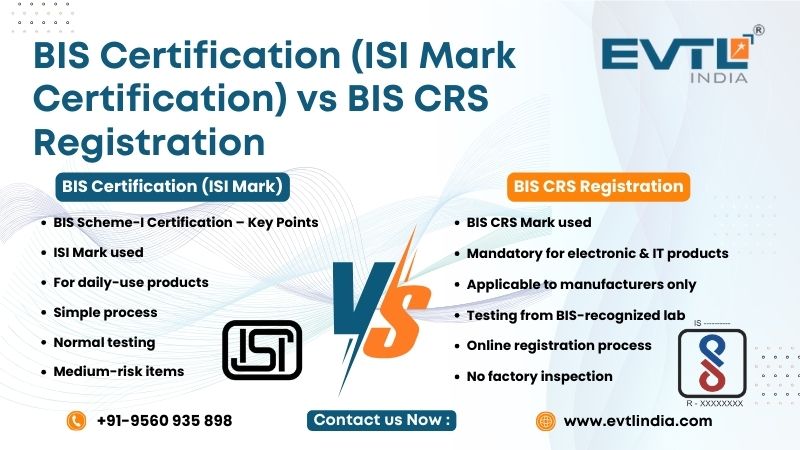
BIS vs CRS Certification: Key Differences
Which Certification Should You Choose?
The requirement for BIS Certification or CRS Certification depends on several regulatory factors, including:
- Product category notified under BIS QCO or CRS Order
- Safety and risk profile of the product
- Whether the product is electronic/IT or industrial
- Manufacturing location (domestic or foreign)
- Applicable Indian Standards (IS)
If a product is listed under the BIS CRS product list, ISI certification alone will not meet compliance requirements. Similarly, if a product is notified under a BIS QCO, CRS registration will not be sufficient.
Choosing the wrong certification route can result in customs clearance delays, penalties, cancellation of approval, or restrictions on sale in India.
Why BIS and CRS Consultants Matter
Both BIS ISI Certification and CRS Registration involve technical documentation, standard interpretation, coordination with BIS-recognized laboratories, and regulatory communication. An experienced BIS Consultant or CRS Consultant supports manufacturers by:
- Identifying applicable BIS or CRS standards
- Managing product testing and compliance reports
- Preparing accurate applications and declarations
- Coordinating factory inspections (for BIS certification)
- Reducing rejection risks and approval timelines
Professional consultancy ensures regulatory clarity, faster certification, and hassle-free compliance, especially for foreign manufacturers and first-time applicants.
Conclusion
Although BIS Certification (ISI Mark Certification) and CRS Certification (Compulsory Registration Scheme) are both issued by the Bureau of Indian Standards, they differ significantly in scope, compliance depth, and approval process. BIS certification focuses on continuous manufacturing quality through licensing and surveillance, while CRS certification offers a streamlined registration pathway for electronics and IT products based on laboratory testing.
Understanding BIS vs CRS Certification in India is essential for manufacturers seeking legal market access, regulatory compliance, and long-term business success. Selecting the correct certification not only ensures compliance but also strengthens brand credibility, customer trust, and market acceptance.