
BIS Certification for Self-aligning roller bearings as per IS 6454:2026
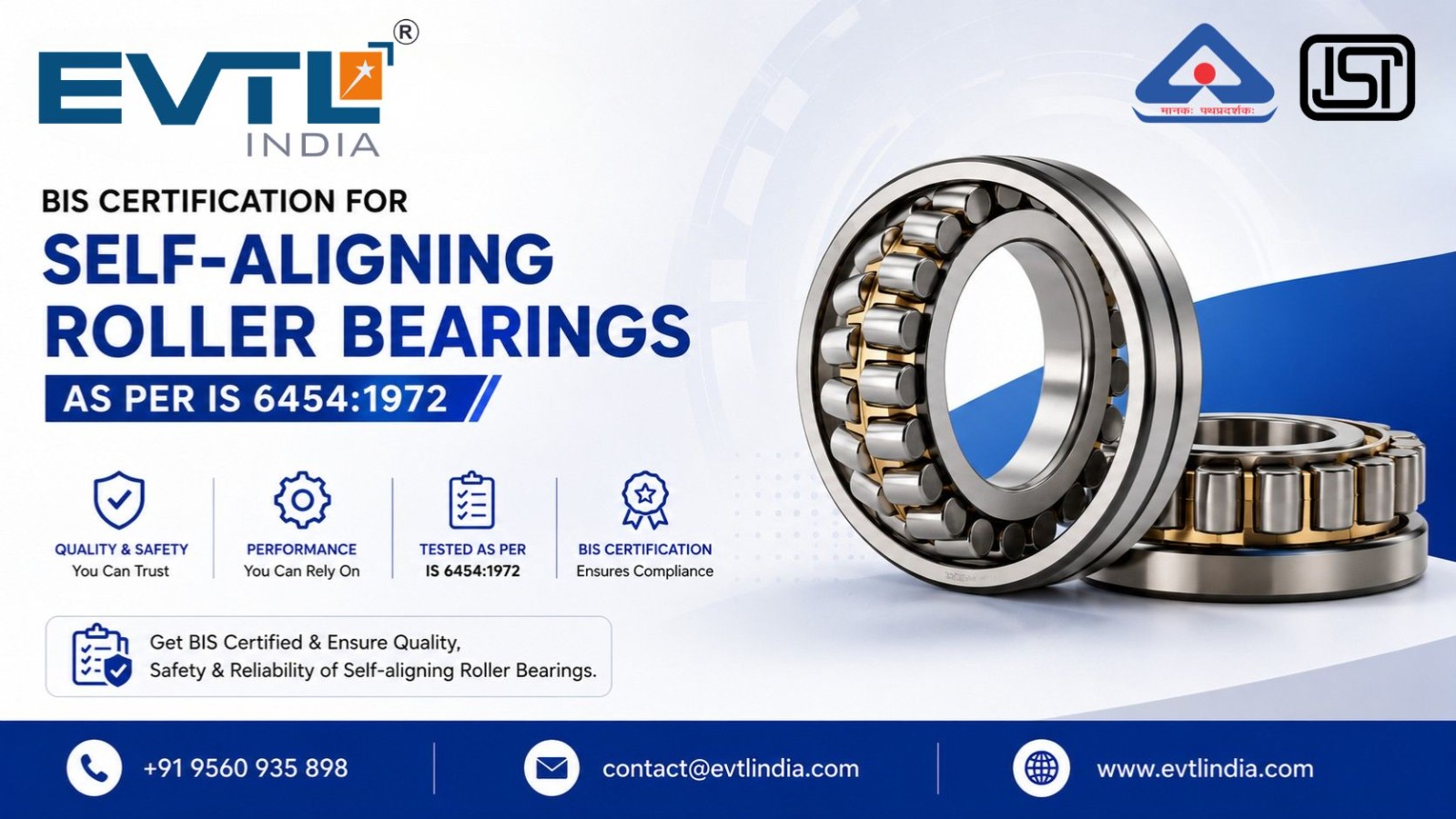
Self-Aligning Roller Bearings are widely used in automobiles, industrial machinery, agricultural equipment, construction machinery, and other heavy engineering applications. These bearings are designed to accommodate shaft misalignment while supporting rotating shafts and reducing friction during operation. Because they are used in demanding applications, they need to provide reliable performance, proper dimensional accuracy, and durability.
BIS Certification for Self-Aligning Roller Bearings under IS 6454:2026 ensures that these bearings meet the applicable quality, dimensional, material, and performance requirements specified by the Bureau of Indian Standards (BIS). It helps manufacturers maintain consistent product quality and comply with the relevant Indian Standard requirements. The ISI Mark on certified bearings indicates conformity with the applicable BIS requirements, giving greater confidence to manufacturers, buyers, and end users.
Overview of IS 6454:2026
IS 6454:2026 specifies the requirements for self-aligning roller bearings, particularly their boundary dimensions, tolerances, radial clearances, general requirements, and designation. The standard is intended for bearings designed to accommodate shaft deflection or misalignment while maintaining proper operation and fit in mechanical assemblies.
The standard covers key requirements related to -
- Boundary Dimensions: Requirements for the principal dimensions of self-aligning roller bearings.
- Tolerances: Dimensional tolerances to support accuracy, interchangeability, and proper fitment.
- Radial Clearances: Requirements for radial internal clearance of the bearings.
- General Requirements: Technical requirements that the bearing and its components need to meet.
- Designation: Requirements for identifying and specifying the bearings according to their characteristics.
What is BIS Certification for Self-Aligning Roller Bearings?
The Bureau of Indian Standards (BIS) is India’s national authority responsible for formulating and enforcing product quality and safety standards. BIS Certification for Self-Aligning Roller Bearings confirms that the product complies with the applicable Indian Standard, which specifies requirements related to dimensions, design, performance, and quality of self-aligning roller bearings.
Manufacturers who obtain ISI Certification for Self-Aligning Roller Bearings are authorized to display the ISI Mark on their products, subject to the applicable BIS requirements. This mark serves as a trusted indication that the bearings have been assessed for conformity with the relevant Indian Standard through testing and quality evaluation. A valid BIS License for Self-Aligning Roller Bearings demonstrates compliance with applicable Indian regulatory and quality requirements.
Why Does BIS Certification Matter?
- Safety and Reliability : Self-aligning roller bearings are used in heavy-duty machinery, making dimensional accuracy, material strength, and reliable load-bearing capacity essential. BIS-certified bearings are assessed to support safe and dependable operation.
- Consistent Performance and Quality : Certified bearings are evaluated for dimensions, tolerances, construction, and other specified quality requirements. BIS Registration for Self-Aligning Roller Bearings helps ensure consistent performance and longer service life.
- Compliance with IS 6454:2026 : IS 6454:2026 specifies the required dimensions, tolerances, and technical requirements for self-aligning roller bearings. Certification confirms that the bearings conform to the applicable requirements of the standard.
- Market Trust and Brand Credibility : Bearings manufactured according to recognized BIS requirements provide greater confidence to OEMs, industrial buyers, distributors, and other customers. BIS certification strengthens product credibility in the Indian market.
- Legal Compliance under BIS QCO : Where self-aligning roller bearings are covered under a mandatory BIS Quality Control Order, manufacturers and importers must obtain the required BIS certification before manufacturing, importing, or selling them in India.
ISI Mark Certification Process Requirement for Self-Aligning Roller Bearings
The ISI Mark Certification process generally includes the following steps -
- Identify the Applicable Standard – Confirm that the Self-Aligning Roller Bearings fall under the applicable Indian Standard and relevant BIS certification scheme.
- Prepare the Required Documents – Gather all necessary documents, including company registration details, manufacturing information, quality control documents, product specifications, and factory details.
- Product Testing – Get the bearings tested at a BIS-recognized laboratory to verify compliance with the applicable Indian Standard.
- Submit the BIS Application – File the application online through the BIS portal along with the required documents, test reports, and prescribed fees.
- Factory Inspection – BIS officials may inspect the manufacturing facility to assess production processes, testing facilities, quality control systems, and manufacturing capabilities.
- Grant of BIS License – After successful verification of documents, test results, and factory assessment, BIS grants the license, allowing the manufacturer to use the ISI Mark on the certified Self-Aligning Roller Bearings.
How BIS Consultant and Agents Help
The BIS certification process for Self-Aligning Roller Bearings can be complex and documentation-heavy. Professional support simplifies the journey -
- BIS Consultant for Self-Aligning Roller Bearings: Handles documentation, product testing coordination, and compliance with the applicable Indian Standard.
- ISI Consultant for Self-Aligning Roller Bearings: Guides manufacturers through the ISI Mark certification requirements, factory inspection, and BIS procedures.
- BIS Agent for Self-Aligning Roller Bearings: Manages communication with BIS authorities, application follow-ups, query resolution, and inspection scheduling.
With expert assistance, manufacturers can avoid common errors, reduce delays, ensure compliance, and obtain BIS Certification more efficiently.
Why EVTL India is a Trusted BIS Certification Consultant
EVTL India is a trusted BIS consultant providing BIS Certification, ISI Mark Certification, BIS CRS Registration, FMCS Certification, and other regulatory approvals across India.
- Expert BIS Guidance: In-depth knowledge of BIS standards, QCOs, and product compliance requirements.
- Complete Documentation Support: Assistance with accurate documentation, application preparation, and submission.
- End-to-End Certification Support: Support from product testing and factory inspection to final BIS approval.
- Faster Certification Process: Streamlined coordination to help reduce delays and simplify the certification process.
- Support for Indian & Foreign Manufacturers: Assistance for both domestic manufacturers and overseas manufacturers seeking BIS approval.
- Reliable Compliance Assistance: Transparent communication and dedicated support throughout the BIS certification process.
Conclusion
Obtaining BIS Certification for Self-Aligning Roller Bearings under the applicable Indian Standard is more than a regulatory requirement—it demonstrates a manufacturer’s commitment to product quality, dimensional accuracy, durability, and reliable performance. With the support of experienced BIS consultants and agents, manufacturers can simplify the certification process and ensure compliance with all applicable BIS requirements.
The ISI Mark assures manufacturers, industrial buyers, and end users that the bearings have been tested and assessed for conformity with the relevant Indian Standards. It serves as a mark of quality and reliability, strengthens customer confidence, and supports the legal manufacture, import, and sale of Self-Aligning Roller Bearings in the Indian market.