
BIS Certification for Pumps in India: Meaning, IS Standards, Process, Cost & Requirements
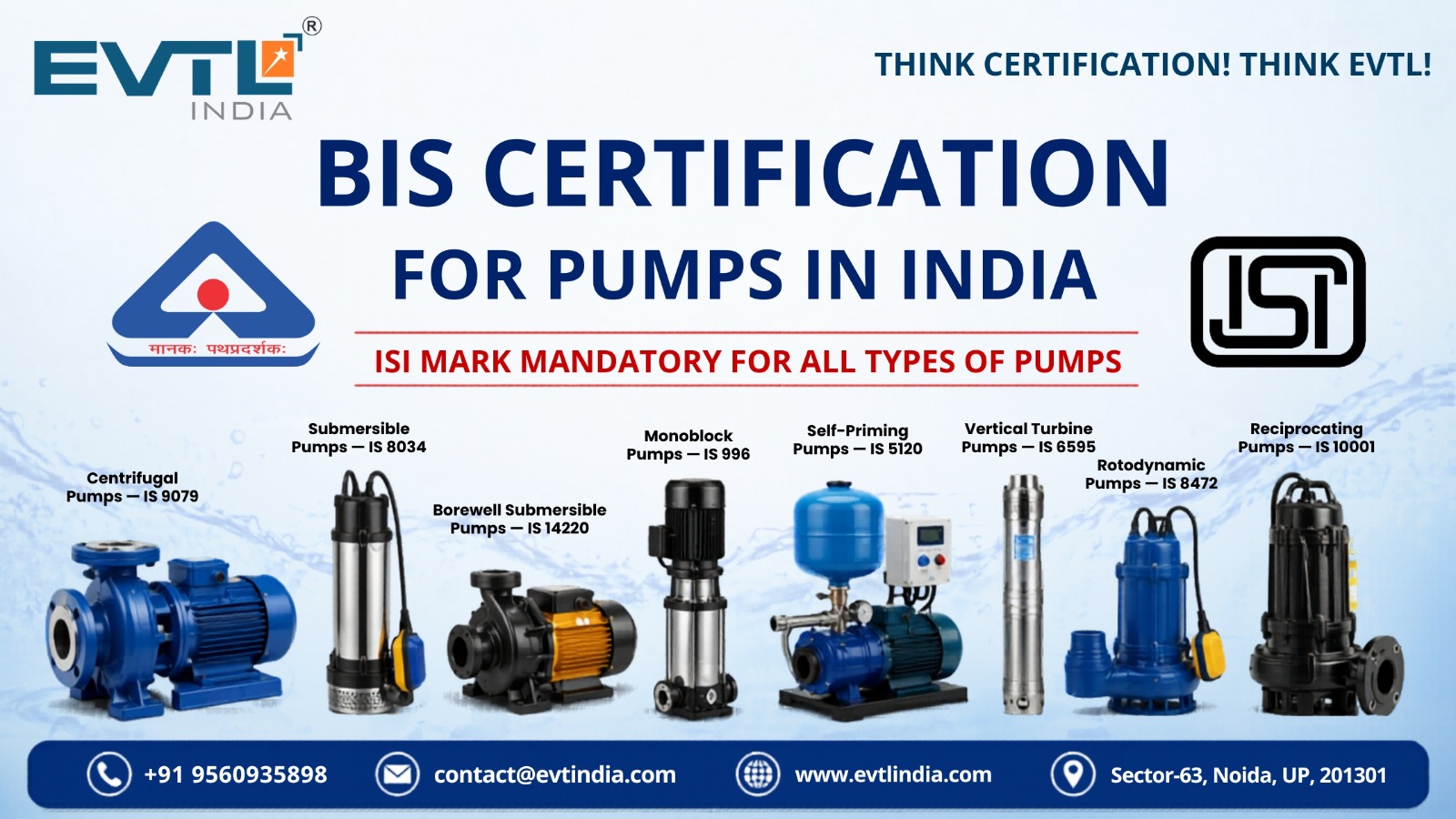
Pumps are essential mechanical devices used to move liquids from one place to another by creating pressure or suction. These pumps are especially useful in areas where water needs to be lifted from underground sources or transported over long distances. They are built to deliver consistent water flow while operating under different environmental and load conditions.
The Bureau of Indian Standards has established various Indian Standards to define the specifications for different types of pumps. These standards outline requirements related to design, performance, efficiency, and material quality to ensure safety and durability. Manufacturers are required to obtain BIS certification (ISI Mark) to sell these pumps in the Indian market and ensure compliance with quality regulations.
Bis certification for pumps: meaning ,requirements,and who needs it
BIS Certification for pumps is a mark of quality given by the Bureau of Indian Standards that confirms a pump meets the required safety, performance, and durability standards in India. Once certified, manufacturers can use the ISI Mark, which assures buyers that the pump is reliable and approved for sale in the Indian market.
Requirements
BIS certification for pumps is required for businesses involved in manufacturing, importing, or supplying pumps in India to ensure compliance with applicable Indian Standards and Quality Control Orders.
Applicable to:
- Manufacturers (India): Must obtain BIS certification if the pumps fall under mandatory QCO requirements before selling in the Indian market.
- Foreign Manufacturers: Need BIS certification under the Foreign Manufacturers Certification Scheme (FMCS) to export pumps to India.
- Importers/Brand Owners: Must ensure that all imported or branded pumps are BIS certified before distribution or sale.
- Sellers/Distributors: Should only deal in BIS-certified pumps to ensure legal compliance and product quality.
BIS-Approved Pump Products as per Indian Standards
The Bureau of Indian Standards has defined multiple Indian Standards (IS) covering different categories of pumps used in domestic, agricultural, and industrial applications.
Key products include:
How to Get BIS Certification for Pumps
The BIS certification process ensures that pumps meet the required Indian Standards for proper functioning and consistent quality. This process is defined by the Bureau of Indian Standards and includes the following steps:
- Online Registration: Manufacturers register on the BIS Manak portal by providing company details, manufacturing unit information, and product specifications. Foreign manufacturers are required to appoint an Authorized Indian Representative (AIR).
- Testing at BIS-Approved Laboratory: Pump samples are tested in BIS-recognized laboratories to check parameters such as efficiency, material quality, and durability.
- Application Submission: The application is submitted along with test reports, product details, and necessary technical documents. Foreign manufacturers must also include AIR-related documentation.
- Factory Inspection: BIS officials conduct an inspection of the manufacturing facility to evaluate the production process, testing capabilities, and quality control measures.
- Grant of BIS License: Once all requirements are fulfilled successfully, BIS grants the certification license under the applicable scheme.
- Use of ISI Mark: After certification, the manufacturer can affix the ISI Mark along with the CM/L number on the pumps, indicating compliance with BIS standards and approval for sale in the Indian market.
BIS Documents Checklist For Pumps
The following documents are typically required for obtaining BIS certification:
Marking Requirements and ISI Labeling
Once a manufacturer is granted a BIS licence, the ISI Mark for pumps must be affixed in a clear and lasting manner on the product or its packaging. In addition to the mark, specific information must also be provided in line with the applicable Indian Standard. These details make it easier to identify the product and indicate that it meets the prescribed BIS requirements.
Note: Marking is generally done through durable methods such as metal plates, engraving, stamping, or permanent printing. This ensures that the details remain visible during handling, storage, and use, in accordance with BIS marking guidelines.
BIS License Validity for Pumps
After obtaining BIS certification for pumps, the license remains valid for a fixed period. To keep it active, manufacturers must continue complying with BIS standards.
BIS Approval Cost for Pumps
The BIS certification cost for pumps includes different types of charges such as application fees, inspection charges, license fees, marking fees, testing costs, and consultancy support fees. These charges are applicable as per BIS Scheme I guidelines and may vary depending on the manufacturer and product category.
Note:
- For foreign manufacturers, the application fee is usually paid through SWIFT transfer. In SAARC countries, payment in INR with applicable GST may also be allowed.
- Audit charges for foreign units depend on the location of the factory and inspection requirements.
- Marking fees vary based on the type of pump and production volume. Some MSME benefits may also be applicable.
- Testing charges are directly paid to BIS-approved laboratories for product evaluation.
- Consultancy fees depend on the complexity of documentation, product type, and factory location support required.
Conclusion
In India, BIS certification ensures that pumps meet the required quality, safety, and durability standards. The ISI mark on a pump indicates that it has been tested and approved as safe, reliable product, and are suitable for daily use.For manufacturers, importers, and distributors, obtaining BIS certification is mandatory to legally sell pumps in the Indian market. It helps ensure that products comply with Indian Standard (IS) requirements and maintain consistent performance. With the support of EVTL India, manufacturers can complete the certification process more easily and ensure their products meet all regulatory requirements without hassle.