
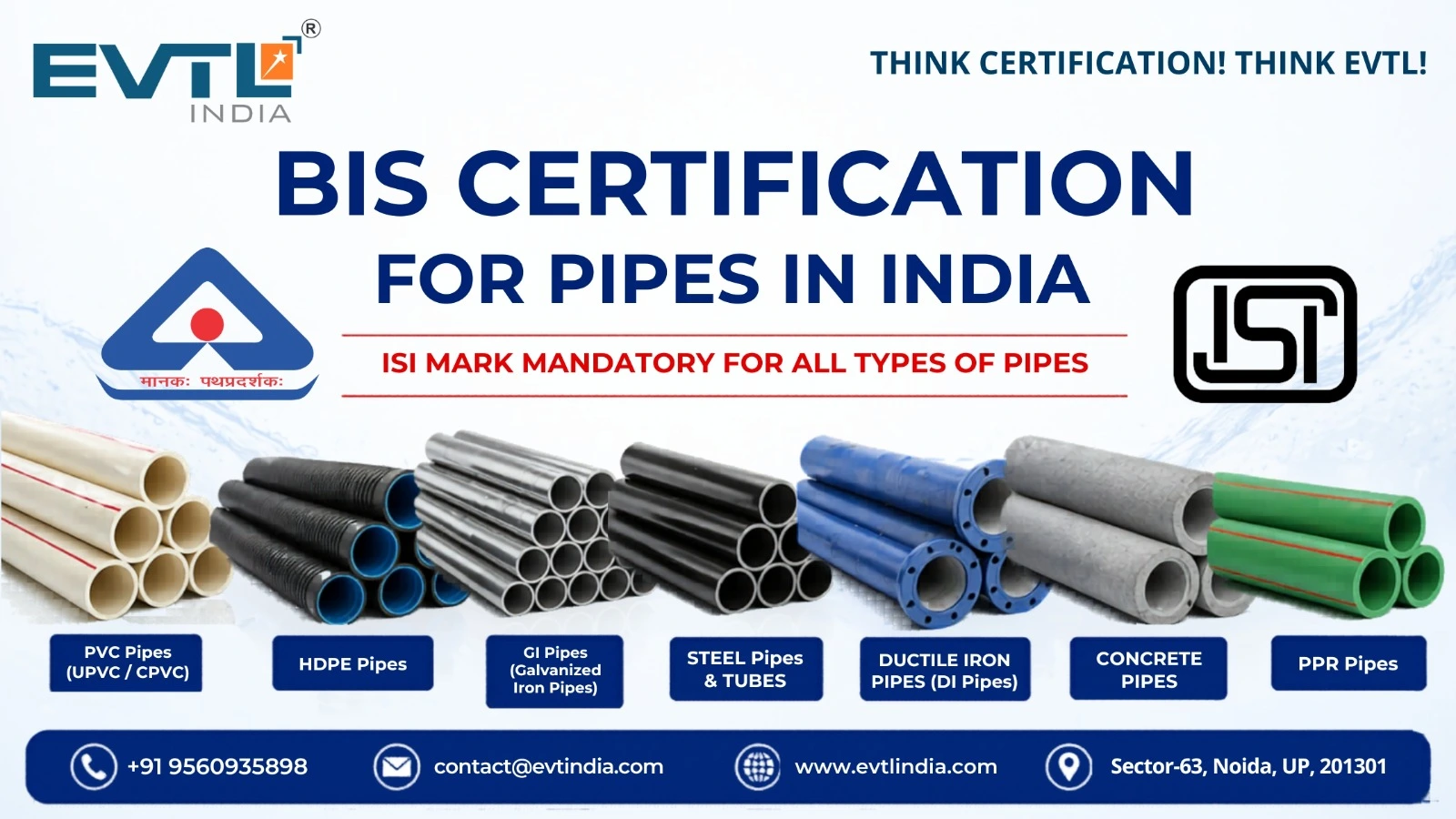
BIS Certification For Pipes in India
Pipes are essential components used for the transportation and distribution of liquids, gases, and other materials in residential, commercial, industrial, agricultural, and infrastructure applications. They are widely used in water supply systems, sewage networks, irrigation projects, oil and gas industries, plumbing systems, chemical plants, and various construction activities where safe and efficient flow management is required.
To ensure the quality, safety, and performance of these products, the Bureau of Indian Standards (BIS) provides certification for pipes under the applicable Indian Standards. This certification ensures that pipes are properly tested for strength, durability, pressure resistance, dimensional accuracy, material quality, leakage prevention, and overall reliability, making them suitable for long-term use while reducing the risks of pipe failure, contamination, and operational inefficiency.
Industrial Safety Pipes Quality Control Order (QCO)
The Industrial Safety Pipes Quality Control Order (QCO) is a statutory order issued by the Government of India to ensure that industrial safety pipes manufactured, imported, or sold in India meet the prescribed quality and safety standards. This order has been introduced to maintain product reliability, operational safety, and durability in industries where pipes are used for the transportation of water, gas, chemicals, oil, and other industrial applications. Industrial safety pipes are widely used in sectors such as construction, manufacturing, fire protection systems, oil and gas, chemical plants, and infrastructure projects. As per the QCO, industrial safety pipes must comply with the relevant Indian Standard prescribed by the Bureau of Indian Standards and must bear the BIS Standard Mark (ISI Mark) before being manufactured, imported, distributed, or sold in the Indian market.
Products Covered Under Indian Standard for Industrial Safety Pipes
Industrial safety pipes are widely used in various industries for the safe transportation of liquids, gases, chemicals, steam, and other hazardous substances. To ensure quality, durability, and operational safety, the Bureau of Indian Standards (BIS) has established Indian Standards for different categories of industrial pipes. These standards help manufacturers maintain uniformity and ensure that the pipes are suitable for industrial applications.
BIS Certification Process for Industrial Safety Pipes
The BIS certification process for Industrial Safety Pipes ensures that the pipes meet the required quality, safety, and performance standards set by the Bureau of Indian Standards (BIS). These pipes are used in industries for the safe transportation of water, chemicals, gases, and other materials where strong and durable pipes are important. The process includes the following steps:
- Online Registration: Manufacturers must register on the BIS Manak Online Portal by submitting company details, factory information, and product details. Foreign manufacturers also need to appoint an Authorized Indian Representative (AIR) in India for BIS-related work.
- Testing at BIS-Approved Laboratory: Samples of Industrial Safety Pipes are tested in BIS-approved laboratories to check whether they meet the required Indian Standards. The testing includes pressure strength, size accuracy, leakage resistance, impact strength, durability, and overall product performance.
- Application Submission: After successful testing, the manufacturer submits the BIS application along with test reports, technical documents, manufacturing details, quality control documents, and factory information. Foreign manufacturers must also submit AIR authorization documents.
- Factory Inspection: BIS officers visit the manufacturing unit to inspect the production process, raw materials, testing facilities, and quality control system. The inspection ensures that the manufacturer can produce quality products consistently.
- Grant of BIS License: If the product and factory meet all BIS requirements, BIS grants the certification license under the applicable scheme. This license allows the manufacturer to sell the product in the Indian market.
- Use of ISI Mark: After getting the BIS license, the manufacturer can use the ISI mark along with the CM/L number on the Industrial Safety Pipes. The ISI mark shows that the product is BIS-certified and meets Indian safety and quality standards.
Required BIS Documents Checklist for Pipes
Foreign manufacturers are required to appoint an Authorized Indian Representative (AIR) in India to coordinate with the Bureau of Indian Standards (BIS) and handle all compliance-related activities in India.
Marking Requirements & License Validity
Marking Requirements :
Note: The marking should be clear, long-lasting, and easy to read on the product or packaging. It is usually done through embossing, printing, engraving, or labeling so that it remains visible during storage, transport, and use as per BIS guidelines.
Validity of BIS License for Pipes
Note: The marking should be durable, legible, and clearly visible. It is generally applied through embossing, engraving, printing, labeling, or other permanent marking methods so that it remains intact during handling, storage, transportation, and usage as per BIS requirements.
BIS Approval Cost for Pipes
The cost of BIS certification for pipes includes different types of charges such as the application fee, factory inspection fee, license fee, product testing charges, and marking fee. These charges are collected by BIS according to the applicable certification requirements under Scheme I.
Note:
- Application fee for foreign manufacturers is payable via SWIFT (SAARC countries may pay in INR with applicable GST).
- Audit charges for foreign manufacturers vary based on country/location.
- Marking fee depends on the product category and production volume (MSME benefits may apply).
- Testing charges are paid directly to BIS-approved laboratories.
- Consultancy fees depend on product type and factory location.