Laboratory
glassware plays a vital role in scientific research, experiments, and industrial
applications. The accuracy, safety, and reliability of laboratory results often
depend on the quality of glassware used, making it essential to maintain strict
standards for these products. In India, the Bureau of Indian Standards (BIS) is
the national body responsible for formulating and enforcing standards that
ensure the safety, quality, and reliability of products, including laboratory
glassware.
The BIS, through
its regulatory framework, ensures that laboratory glassware meets established
quality benchmarks. With the introduction of mandatory BIS certification for
specific laboratory glassware items, manufacturers and suppliers are required
to adhere to these standards. This certification not only assures the safety
and quality of products but also helps establish credibility and trust among
consumers, researchers, and institutions.In this article,
we will explore the importance of BIS certification for laboratory glassware,
the regulatory framework under which it operates, and the process for obtaining
certification.The Importance of Quality in Laboratory Glassware
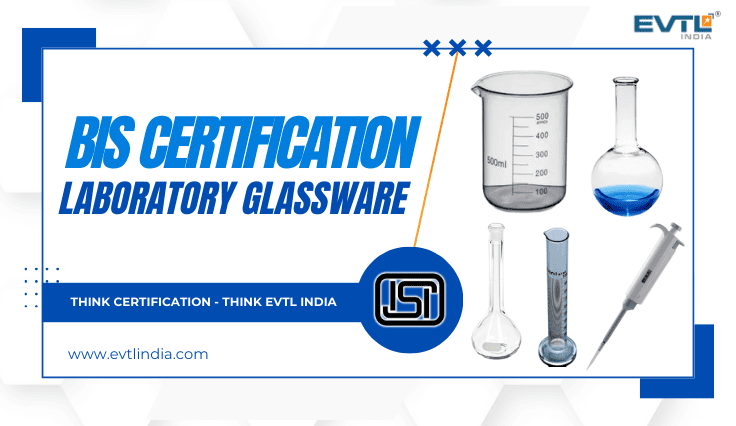
Laboratory
glassware encompasses a wide range of products used in scientific and medical
research, industrial laboratories, and educational institutions. These products
include beakers, flasks, test tubes, petri dishes, burettes, pipettes, and
more. The accuracy and safety of laboratory processes largely depend on the
quality of glassware being used.
The primary
concerns with laboratory glassware are:- Precision and accuracy: Scientific
experiments require glassware that is dimensionally accurate and chemically
inert.
- Durability: Glassware must withstand
temperature changes, chemical reactions, and mechanical forces without breaking
or deteriorating.
- Safety: Poor-quality glassware may pose
risks such as contamination, inaccurate results, and breakage, which can lead
to injuries or damage to laboratory equipment.
Given these
critical factors, it is essential for laboratory glassware to be manufactured
to the highest quality standards. BIS certification plays a key role in
assuring that the glassware used in laboratories meets these stringent
requirements.
Bureau of Indian Standards (BIS) and Its Role
The Bureau of
Indian Standards (BIS) is the national standard-setting body of India,
established under the BIS Act, 2016. Its mission is to formulate and enforce
standards for various products to ensure their quality, safety, and
reliability. BIS sets standards for laboratory glassware under its broader
objective of consumer protection and quality assurance.
BIS
certification helps ensure that products meet the specific standards outlined
for laboratory glassware. In certain cases, products are subject to mandatory
certification under the Quality Control Orders (QCO), making it illegal to sell
or distribute non-compliant products in India.Quality Control Orders (QCO) for Laboratory Glassware
The Ministry of
Commerce and Industry (Department for Promotion of Industry and Internal Trade,
DPIIT) issued a Quality Control Order (QCO) on January 1, 2024, for laboratory
glassware. The "Laboratory
Glassware (Quality Control) Order, 2023" mandates that all
manufacturers and importers of specific laboratory glassware items must obtain
BIS certification to sell their products in the Indian market.
QCOs are
regulations set by the government to ensure adherence to specific quality and
safety standards for certain products. For laboratory glassware, this means
that manufacturers must meet BIS standards before their products can be
distributed or sold. Compulsory Use of Standard Mark (ISI Mark)
Under the QCO
for laboratory glassware, it is mandatory for manufacturers, importers, and
distributors to obtain BIS certification. Once certified, products can bear the
ISI Mark, signifying compliance with stringent quality and safety standards.
This certification is crucial for ensuring product reliability and maintaining
market credibility.
Products lacking
BIS certification or failing to meet required standards are prohibited from
being sold in India. Violations of this regulation can result in penalties
under the Bureau of Indian Standards Act, 2016. This enforcement safeguards
consumers and promotes the use of high-quality laboratory glassware in
scientific and industrial settings.Benefits of BIS Certification for Laboratory Glassware
The BIS
certification process ensures that laboratory glassware products adhere to
stringent standards, providing several benefits for manufacturers, suppliers,
and users:
- Quality Assurance: BIS
certification ensures laboratory glassware meets high standards, vital for
accurate and reliable scientific research.
- Regulatory Compliance: Certified
products adhere to government regulations, reducing legal risks and assuring
users of safety and efficiency.
- Credibility: BIS
certification enhances manufacturers' reputation by demonstrating a commitment
to quality, offering a competitive advantage.
- Market Acceptance: Products
with the ISI Mark are preferred in domestic and global markets, especially by
research institutions.
- Consumer Trust: BIS
certification builds trust, ensuring consistent and reliable results in
scientific work.
Process for BIS Certification for Laboratory Glassware
The BIS certification process for laboratory glassware involves multiple steps, designed to thoroughly evaluate a product's compliance with the required standards. Here is a general overview of the certification process
- Application Submission: Manufacturers
must submit an application form along with required documentation to BIS.
- Documentation Review: BIS reviews the
submitted documents to ensure completeness and correctness.
- Factory Inspection: BIS officials
conduct an on-site inspection of the manufacturing facility to assess the
production process and quality control measures.
- Sample Testing: Product samples are
taken and tested in BIS-approved laboratories to verify compliance with Indian
standards.
- Certification Grant: Upon successful
completion of the inspection and testing, BIS grants certification, allowing
the manufacturer to use the BIS mark on their products.
Documents
Required for BIS Certification
To apply for BIS
certification for Laboratory Glassware, manufacturers need to submit the
following documents:
- Application form
- Manufacturing process details
- Quality control plan
- Test reports from BIS-approved
laboratories
- Factory layout and equipment
details
- Proof of business registration
- Product specifications and
technical details
- Declaration of conformity to
Indian standards
Additionally,
manufacturers may be required to provide proof of compliance with environmental
and safety regulations, depending on the specific type of product being
certified.
Conclusion
BIS
certification for laboratory glassware is crucial in maintaining high standards
of quality, safety, and reliability in scientific research and industrial
applications. With the implementation of the Quality Control Order (QCO) for
laboratory glassware, manufacturers must now comply with BIS regulations to
sell their products in the Indian market. This not only assures quality but
also enhances the credibility and market acceptance of laboratory glassware
products.
Navigating the
BIS certification process can be complex and time-consuming. Manufacturers of
laboratory glassware can benefit from the services of EVTL India, which
specializes in assisting companies in obtaining BIS certification hassle-free.
With expertise in handling documentation, application submission, sample
testing, and factory audits, EVTL India ensures a smooth and efficient
certification process, allowing manufacturers to focus on their core
operations.