
BIS Certification Consultant for All Glass Products in India
BIS Certification for Glass Products is mandatory for manufacturers and foreign exporters who want to manufacture, import, or sell glass products in the Indian market. The Bureau of Indian Standards (BIS) ensures that glass products meet the required quality, safety, and performance standards before they are made available to consumers.
Several glass products, including Transparent Float Glass, Flat Transparent Sheet Glass, Safety Glass, and Laboratory Glassware, are covered under different Indian Standards (IS) and applicable Quality Control Orders (QCOs). Manufacturers must obtain a valid BIS licence to comply with these regulations and legally use the ISI Mark on their products.
Whether you are an Indian manufacturer, foreign manufacturer, importer, or brand owner, understanding the BIS certification requirements is essential for entering the Indian market. In this guide, we explain the applicable BIS standards, certification process, required documents, product testing, factory inspection, and the role of a BIS Certification Consultant in obtaining approval for glass products.
What is BIS Certification for Glass Products?
BIS Certification for Glass Products is a certification issued by the Bureau of Indian Standards (BIS) to ensure that glass products meet the required Indian quality and safety standards. Products covered under the applicable Quality Control Orders (QCOs) must comply with their respective Indian Standards (IS) before they can be manufactured, imported, sold, or distributed in India. Once certified, manufacturers are permitted to use the ISI Mark, which indicates that the product complies with BIS requirements.
Why is BIS Certification Mandatory for Glass Products?
The Government of India has made BIS Certification for Glass Products mandatory to ensure that only safe, high-quality, and standard-compliant products are available in the market. It helps protect consumers, maintains product quality, and prevents the sale of substandard glass products. Manufacturers and foreign exporters must obtain BIS Certification to comply with the applicable Indian Standards (IS) and Quality Control Orders (QCOs). Without a valid BIS licence, covered glass products cannot be legally manufactured, imported, sold, or distributed in India.
Glass Products Covered Under BIS Certification
The Bureau of Indian Standards (BIS) has made certification mandatory for several glass products to ensure they meet the required quality, safety, and performance standards. Below are the major glass products covered under the applicable Indian Standards and Quality Control Orders (QCOs).
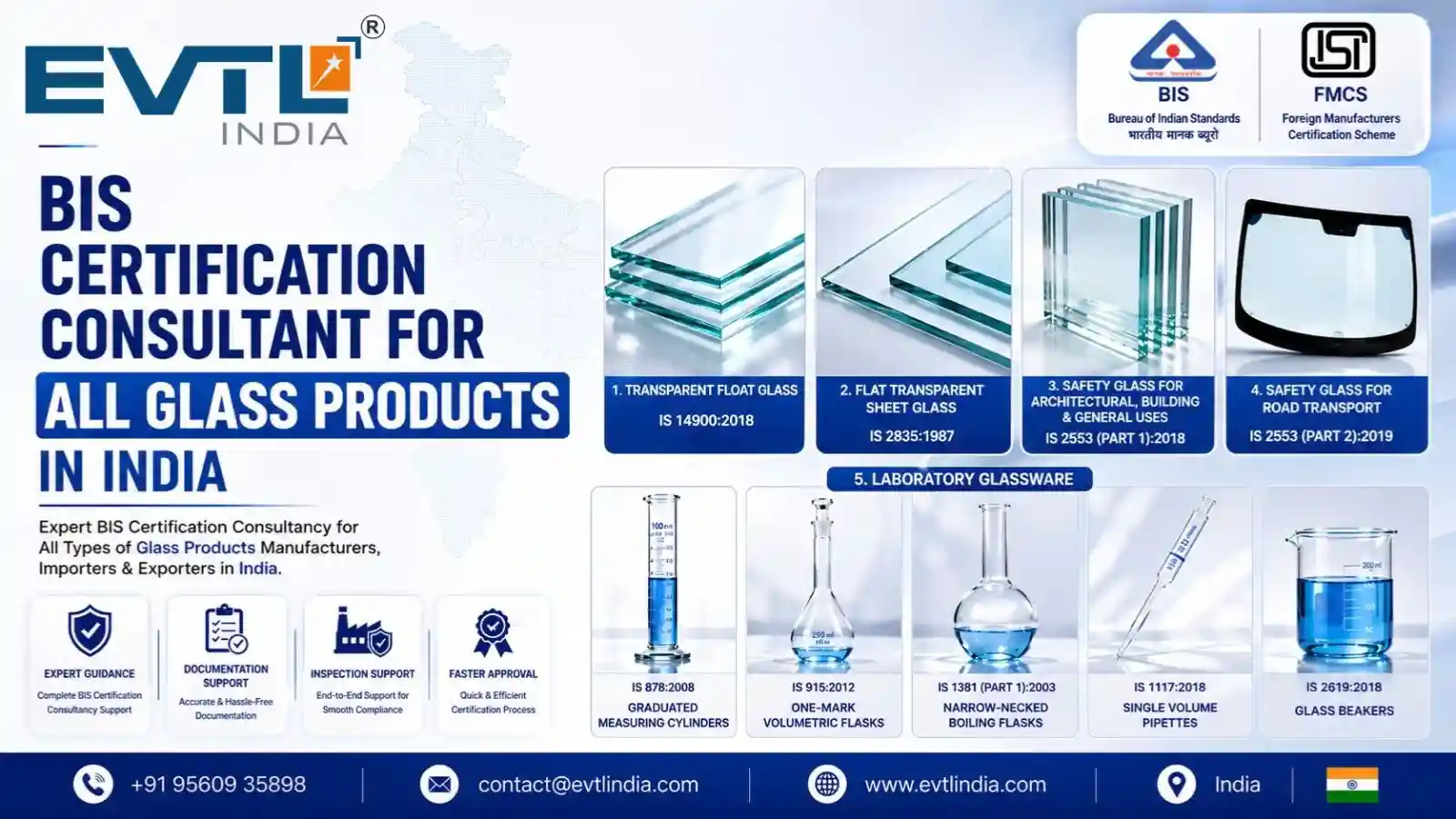
- Transparent Float Glass – IS 14900:2018: Transparent Float Glass is a high-quality flat glass with a smooth and clear surface. It is widely used in windows, doors, facades, partitions, furniture, and other architectural applications. Manufacturers must comply with IS 14900:2018 and obtain BIS Certification before manufacturing, importing, or selling this product in India.
- Flat Transparent Sheet Glass – IS 2835:1987: Flat Transparent Sheet Glass is commonly used in residential and commercial buildings for glazing applications. To ensure consistent quality and safety, this product must conform to IS 2835:1987. BIS Certification is mandatory under the applicable Quality Control Order before it can be supplied in the Indian market.
- Safety Glass for Architectural, Building & General Uses – IS 2553 (Part 1):2018: Safety Glass used in buildings and architectural projects is covered under IS 2553 (Part 1):2018. This standard specifies the requirements for strength, durability, and safety performance. Manufacturers must obtain BIS Certification to comply with the applicable regulations and legally market the product in India.
- Safety Glass for Road Transport – IS 2553 (Part 2):2019: Safety Glass used in vehicles, including windscreens and window glass, must comply with IS 2553 (Part 2):2019. BIS Certification ensures that the product meets the required safety and quality standards for use in road transport vehicles.
Laboratory Glassware
Various laboratory glassware products are also covered under BIS Certification to ensure accuracy, durability, and safe use in laboratories. The applicable Indian Standards include:
- IS 878:2008 – Graduated Measuring Cylinders
- IS 915:2012 – One-Mark Volumetric Flasks
- IS 1381 (Part 1):2003 – Narrow-Necked Boiling Flasks
- IS 1117:2018 – Single Volume Pipettes
- IS 2619:2018 – Glass Beakers
Manufacturers of these laboratory glassware products must comply with the relevant Indian Standards and obtain BIS Certification before manufacturing or supplying them in the Indian market.
Applicable Indian Standards for Glass Products
Different types of glass products are covered under different Indian Standards (IS) issued by the Bureau of Indian Standards (BIS). Manufacturers must ensure that their products comply with the applicable standard before obtaining BIS Certification. Some of the major Indian Standards for glass products are -
Quality Control Orders (QCOs) for Glass Products
The Government of India has issued Quality Control Orders (QCOs) to make BIS Certification mandatory for specified glass products. These orders ensure that only products meeting the prescribed Indian Standards are manufactured, imported, sold, or distributed in India. Manufacturers covered under these QCOs must obtain a valid BIS licence before placing their products on the Indian market. Failure to comply with the applicable QCO may result in regulatory action under the BIS Act, 2016.
Applications of Glass Products
Glass products are widely used across residential, commercial, industrial, automotive, and laboratory sectors. Depending on the type of glass, they serve different purposes in everyday life and specialized industries. Some common applications include -
- Windows, doors, and building facades
- Residential and commercial glazing
- Office partitions and interior decoration
- Furniture, mirrors, and display panels
- Automotive windscreens and vehicle windows
- Hospitals, research laboratories, and educational institutions
- Chemical and pharmaceutical laboratories
- Industrial equipment and scientific testing
- Construction and infrastructure projects
These applications highlight the importance of maintaining high quality and safety standards, making BIS Certification for Glass Products essential for manufacturers and suppliers operating in the Indian market.
Who Needs BIS Certification for Glass Products?
BIS Certification for Glass Products is mandatory for businesses involved in the manufacturing, import, and supply of glass products covered under the applicable Indian Standards (IS) and Quality Control Orders (QCOs). The following entities are required to ensure BIS compliance before offering these products in the Indian market.
- Indian Manufacturers: Indian manufacturers producing Glass Products such as Transparent Float Glass, Flat Transparent Sheet Glass, Safety Glass, and Laboratory Glassware must obtain a BIS licence under the ISI Certification Scheme. Their products must comply with the applicable Indian Standard before they can be manufactured and sold in India.
- Foreign Manufacturers (FMCS): Foreign manufacturers exporting Glass Products to India must obtain BIS Certification under the Foreign Manufacturers Certification Scheme (FMCS). Manufacturers from China, Japan, South Korea, Taiwan, Vietnam, Thailand, Malaysia, Indonesia, Singapore, the UAE, Turkey, and other countries must obtain BIS approval before exporting products covered under the applicable QCOs to India.
- Importers: Importers must ensure that all imported Glass Products are manufactured by a BIS-certified manufacturer and comply with the applicable Indian Standards (IS) and Quality Control Orders (QCOs). Importing or selling non-certified products covered under mandatory BIS certification is prohibited under the BIS Act, 2016.
BIS Certification for Foreign Manufacturers Exporting Glass Products to India
Foreign manufacturers who intend to export Glass Products to India must obtain BIS Certification under the Foreign Manufacturers Certification Scheme (FMCS). This requirement applies to glass products covered under the applicable Indian Standards (IS) and Quality Control Orders (QCOs). Without a valid BIS licence, these products cannot be legally imported, sold, or distributed in the Indian market.
Under the FMCS, manufacturers are required to submit an application to BIS, provide the necessary documents, get their products tested in a BIS-recognized laboratory, and undergo a factory inspection. After successful evaluation and compliance with the applicable Indian Standard, BIS grants the licence, allowing manufacturers to use the ISI Mark and export their certified glass products to India.
Documents Required for BIS Certification
Manufacturers applying for BIS Certification for Glass Products must submit the required documents to the Bureau of Indian Standards (BIS). The exact requirements may vary depending on the type of product and the applicant. However, the commonly required documents include -
- Completed BIS application form
- Manufacturing unit registration certificate
- Product specifications and manufacturing process details
- Factory layout and list of manufacturing machinery
- Details of in-house testing facilities and quality control system
- Product test reports from a BIS-recognized laboratory (where applicable)
- Trademark or brand authorization letter, if applicable
- Identity and address proof of the applicant
- Authorized Indian Representative (AIR) details for foreign manufacturers
- Any additional documents requested by BIS during the certification process
BIS Certification Process for Glass Products
Manufacturers must follow the prescribed BIS Certification process to obtain approval for glass products covered under the applicable Indian Standards (IS) and Quality Control Orders (QCOs). The process generally includes the following steps -
- Application Submission: Submit the BIS application along with the required documents and prescribed fees.
- Document Verification: BIS reviews the application and verifies all submitted documents.
- Product Testing: Product samples are tested in a BIS-recognized laboratory to ensure compliance with the applicable Indian Standard.
- Factory Inspection: BIS officials inspect the manufacturing facility to verify the production process, quality control system, and testing capabilities.
- Evaluation: BIS evaluates the test reports, inspection findings, and supporting documents.
- Grant of BIS Licence: If all requirements are fulfilled, BIS issues the licence, allowing the manufacturer to use the ISI Mark on the certified glass products.
- Surveillance: After certification, BIS may conduct periodic inspections and product testing to ensure continued compliance with the applicable standards and Quality Control Orders (QCOs).
BIS Factory Inspection & Audit Process
The BIS Factory Inspection & Audit Process is an important step in obtaining BIS Certification. BIS officials inspect the manufacturing facility to verify compliance with the applicable Indian Standard (IS), quality control systems, testing facilities, production processes, raw materials, and product quality.
The inspection typically includes the following steps -
- Application Review: Verification of the submitted documents and manufacturing details.
- Factory Visit: BIS officers inspect the manufacturing unit and production processes.
- Quality Control Assessment: Evaluation of the in-house quality management system and testing capabilities.
- Sample Collection: Product samples are collected and sent to a BIS-recognized laboratory for independent testing.
- Compliance Verification: BIS verifies whether the product meets the relevant Indian Standard (IS) requirements.
- Audit Report & Approval: Based on the inspection and test results, BIS processes the application and grants the certification if all requirements are fulfilled.
Proper preparation for the BIS factory inspection helps manufacturers avoid delays, address non-conformities quickly, and improve the chances of obtaining BIS Certification without unnecessary complications.
Timeline for BIS Certification
The timeline for obtaining BIS Certification depends on the product category, testing requirements, document readiness, and factory inspection. On average, the certification process takes 30 to 90 days to complete. The typical timeline is -
- Document Preparation: 3–7 days
- Product Testing: 15–30 days
- Application Submission & Review: 7–15 days
- Factory Inspection (if applicable): 7–15 days
- Grant of BIS License: 7–15 days after successful verification
Total Estimated Timeline: 30–90 days (subject to BIS requirements and product type).
BIS Certification Fees & Cost Structure
The cost of BIS Certification depends on several factors, including the product category, applicable Indian Standard (IS), certification scheme (ISI, CRS, or FMCS), product testing requirements, factory inspection, and annual marking fees. There is no fixed cost for every product, as the total expense varies based on the scope of certification.
The overall BIS Certification cost generally includes -
- BIS Application Fee
- Product Testing Charges
- Factory Inspection & Audit Fees (if applicable)
- Licence Grant Fee
- Annual Licence Renewal Fee
- Minimum Marking Fee / Marking Charges
- Consultancy & Documentation Charges (optional)
Benefits of BIS Certification
Obtaining BIS Certification for Glass Products offers several benefits to manufacturers, importers, and foreign exporters. It ensures compliance with Indian regulations while improving product quality and market credibility. Some of the key benefits include -
- Ensures compliance with the applicable Indian Standards (IS) and Quality Control Orders (QCOs).
- Authorizes manufacturers to use the ISI Mark on certified glass products.
- Enables the legal manufacture, import, sale, and distribution of glass products in India.
- Improves product quality, safety, and reliability.
- Increases customer trust and brand reputation.
- Helps manufacturers expand their business in the Indian market.
- Reduces the risk of penalties and regulatory actions for non-compliance.
- Provides easier market access for foreign manufacturers through the Foreign Manufacturers Certification Scheme (FMCS).
Common Challenges Faced by Manufacturers
Manufacturers may face several challenges while obtaining BIS Certification for Glass Products. Proper planning and expert guidance can help overcome these issues and ensure a smooth certification process.
- Identifying the correct Indian Standard (IS) for the product.
- Understanding the applicable Quality Control Order (QCO) requirements.
- Preparing complete and accurate documentation.
- Meeting product testing requirements in a BIS-recognized laboratory.
- Maintaining adequate quality control and testing facilities.
- Successfully completing the BIS factory inspection and audit.
- Addressing non-conformities identified during testing or inspection.
- Managing the certification timeline and regulatory requirements.
- Appointing an Authorized Indian Representative (AIR) for foreign manufacturers under the FMCS scheme.
With the support of an experienced BIS Certification Consultant, manufacturers can simplify the certification process, avoid common compliance issues, and obtain BIS approval more efficiently.
Why Choose EVTL India as Your BIS Certification Consultant?
EVTL India is a trusted BIS Certification Consultant providing complete support for BIS Certification for Glass Products. We assist both Indian and foreign manufacturers in obtaining BIS approval for products covered under the applicable Indian Standards (IS) and Quality Control Orders (QCOs). Our experienced team ensures a smooth, hassle-free, and timely certification process.
Our services include -
- Complete assistance for BIS Certification under the ISI Scheme and FMCS.
- Support with application preparation and documentation.
- Guidance for product testing in BIS-recognized laboratories.
- Assistance during factory inspection and audit.
- Support for appointing an Authorized Indian Representative (AIR) for foreign manufacturers.
- Quick resolution of BIS queries and compliance issues.
- End-to-end assistance until the BIS licence is granted.
Conclusion
BIS Certification for Glass Products is essential for manufacturers and foreign exporters who want to manufacture, import, or sell glass products in the Indian market. Compliance with the applicable Indian Standards (IS) and Quality Control Orders (QCOs) ensures product quality, regulatory compliance, and legal market access. Whether you are an Indian manufacturer, foreign manufacturer, importer, or brand owner, obtaining BIS Certification helps build customer trust and ensures smooth business operations. With the expert guidance of EVTL India, businesses can complete the certification process efficiently and achieve full BIS compliance for their glass products.
EVTL India offers complete assistance for BIS Certification under both the ISI Scheme and the Foreign Manufacturers Certification Scheme (FMCS). Our experts provide end-to-end support, including documentation, product testing coordination, factory inspection assistance, compliance management, and licence approval.
Looking for a reliable BIS Certification Consultant for Glass Products? Contact EVTL India today for expert guidance and hassle-free BIS certification. Our team is ready to help you achieve compliance quickly and expand your business in the Indian market.
📞 Contact EVTL India Today
Phone: +919560935898
Email: [email protected]
Website: www.evtlindia.com
Get in touch with our experts today and start your BIS Certification journey with confidence.