
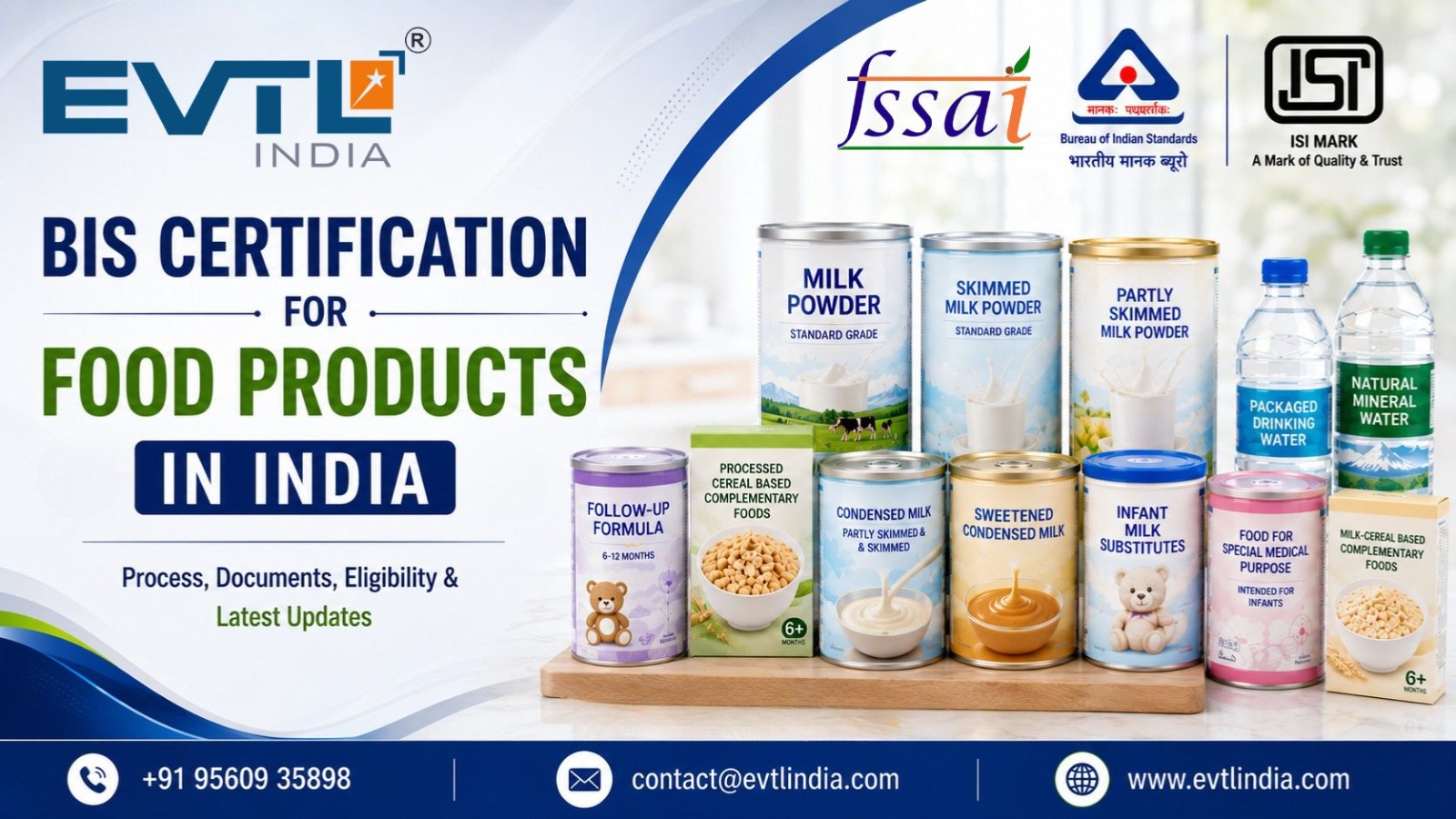
BIS Certification for Food Products in India | Process, Documents, Eligibility & Latest Updates
Whether you are a food manufacturer, dairy manufacturer, beverage producer, packaged food company, importer, exporter, OEM manufacturer, private label brand, or foreign manufacturer, understanding whether your product requires BIS Certification, ISI Mark Certification, or only FSSAI compliance is essential before manufacturing, importing, or selling products in India.
This comprehensive guide explains everything you need to know about BIS Certification for Food Products, including the latest regulatory updates, de-notified food products, the difference between BIS and FSSAI, eligibility, required documents, the BIS Certification process, benefits, and compliance requirements. If your product falls under an applicable BIS scheme, EVTL India, a trusted BIS Certification Consultant in India, provides end-to-end assistance with documentation, application filing, testing coordination, FMCS support for foreign manufacturers, and overall regulatory compliance.
What is BIS Certification for Food Products?
BIS Certification for Food Products is a conformity assessment process established by the Bureau of Indian Standards (BIS) to verify that products comply with the applicable Indian Standards (IS) for quality, safety, hygiene, packaging, and performance. Where applicable, certified manufacturers are permitted to use the ISI Mark, demonstrating that their products meet the prescribed BIS requirements before being supplied to the Indian market.
For food manufacturers, importers, exporters, brand owners, and foreign manufacturers, understanding the current BIS regulatory framework is essential. While BIS certification continues to play an important role in India's quality infrastructure, most food products are no longer covered under mandatory BIS certification. Instead, they are primarily regulated under the Food Safety and Standards Act, 2006 and the regulations issued by the Food Safety and Standards Authority of India (FSSAI). Businesses should therefore determine whether their product is subject to any mandatory BIS requirement or is governed exclusively by FSSAI before planning market entry or production.
EVTL India assists businesses in understanding applicable regulatory requirements, identifying whether BIS certification is required, selecting the relevant Indian Standard, preparing documentation, coordinating testing, and providing end-to-end compliance support for manufacturers operating in India and overseas.
Is BIS Certification Mandatory for Food Products in India?
One of the most common questions asked by food manufacturers is whether BIS Certification is mandatory for all food products. The answer is No.
BIS Certification is generally a voluntary quality certification unless the Government of India makes compliance mandatory through a specific Quality Control Order (QCO) or other statutory notification. Over the years, several food products that previously required compulsory BIS certification have been de-notified, and manufacturers are now primarily required to comply with the Food Safety and Standards Act, 2006 and the applicable FSSAI Regulations.
As a result, businesses should not assume that every food product requires an ISI Mark. Instead, manufacturers should verify the latest regulatory status of their product before manufacturing, importing, or selling it in India. This helps avoid unnecessary certification costs while ensuring compliance with the applicable legal requirements.
Manufacturers of dairy products, packaged foods, infant nutrition products, beverages, health foods, processed food products, food ingredients, and other food categories should always confirm whether BIS certification is currently applicable or whether compliance is governed exclusively under the FSSAI framework.
Food Products De-notified from Compulsory BIS Certification
The regulatory framework for food products in India has undergone significant changes in recent years. Although several food products were previously covered under mandatory BIS Certification (ISI Mark Scheme), the Government of India has de-notified these products from compulsory BIS certification. As a result, manufacturers are no longer required to obtain a mandatory BIS licence for these products before manufacturing, importing, or selling them in India. The current position is reflected in the BIS Scheme-I product list, where these food categories are specifically identified as "De-notified from compulsory BIS certification."
The de-notified food products include:
Following these regulatory changes, the above products are primarily governed under the Food Safety and Standards Act, 2006 and the applicable Food Safety and Standards (Prohibition and Restrictions on Sales) Regulations, 2011, along with subsequent amendments notified through GSR 759(E), GSR 760(E), the First Amendment Regulations, 2022, and the First Amendment Regulations, 2024. Manufacturers must therefore ensure full compliance with the applicable FSSAI requirements relating to product composition, food safety, hygiene, packaging, labeling, and quality before placing these products on the Indian market.
BIS Certification vs FSSAI Licence for Food Products
Many businesses assume that a Food Business Operator (FBO) only requires an FSSAI Licence or that obtaining BIS Certification automatically satisfies all regulatory requirements. In reality, BIS and FSSAI serve different regulatory purposes and should not be considered interchangeable.
The Food Safety and Standards Authority of India (FSSAI) regulates food safety, manufacturing practices, hygiene, labeling, storage, distribution, and licensing of food businesses under the Food Safety and Standards Act, 2006. Every eligible food manufacturer, processor, importer, distributor, retailer, or food business operator must obtain the applicable FSSAI Registration or Licence before commencing operations.
The Bureau of Indian Standards (BIS), on the other hand, develops Indian Standards (IS) and operates product certification schemes. BIS Certification becomes mandatory only when the Central Government issues a specific Quality Control Order (QCO) or statutory notification making compliance compulsory for a particular product category. Otherwise, BIS certification generally remains voluntary.
Therefore, before applying for BIS Certification, manufacturers should first determine whether their product is currently covered under a mandatory BIS requirement or is regulated exclusively under the FSSAI framework. Taking the correct compliance approach helps businesses avoid unnecessary certification costs, regulatory delays, and market-entry challenges.
This distinction is particularly important for food manufacturers, dairy companies, beverage manufacturers, packaged food producers, health food manufacturers, importers, exporters, OEM manufacturers, private label brands, and foreign manufacturers planning to supply food products in the Indian market.
Who Needs BIS Certification for Food Products?
Determining whether BIS Certification is required depends on the specific food product and the latest regulatory notifications issued by the Government of India. Businesses should not assume that every food product requires an ISI Mark. Instead, they should verify whether their product is covered under a mandatory BIS Quality Control Order (QCO), falls under a voluntary BIS certification scheme, or is regulated exclusively by the Food Safety and Standards Authority of India (FSSAI).
If a food product is notified for compulsory BIS certification, the licence is granted only to the actual manufacturing unit. Traders, distributors, wholesalers, retailers, and marketing companies cannot obtain a BIS licence unless they are the manufacturer of the product.
Businesses that may need to assess BIS applicability include -
- Food Manufacturers
- Food Processing Companies
- Dairy Manufacturers
- Beverage Manufacturers
- Packaged Food Manufacturers
- Infant Nutrition Manufacturers
- Health Food Manufacturers
- Food Ingredient Manufacturers
- Food Importers
- Food Exporters
- Brand Owners
- Private Label Manufacturers
- OEM Manufacturers
- Contract Manufacturers
- Foreign Manufacturers exporting food products to India
For foreign manufacturers, BIS certification—where applicable—is processed under the Foreign Manufacturers Certification Scheme (FMCS). Companies must appoint an Authorized Indian Representative (AIR) and comply with BIS requirements before exporting regulated products to the Indian market.
Eligibility Criteria for BIS Certification for Food Products
Manufacturers seeking BIS Certification must satisfy the applicable eligibility requirements prescribed under the relevant BIS certification scheme. While the exact requirements vary depending on the product category and the applicable Indian Standard (IS), manufacturers are generally expected to demonstrate their capability to consistently produce products that comply with the specified quality and safety requirements.
The basic eligibility requirements generally include -
- Manufacturing Facility: The applicant must be the actual manufacturer of the product. BIS issues licences only to manufacturing units and not to traders, importers, distributors, or dealers unless permitted under the applicable certification scheme.
- Product Compliance with Applicable Indian Standard: The product should conform to the relevant Indian Standard (IS), where BIS certification is applicable. Manufacturers must ensure that raw materials, production processes, finished products, packaging, and quality control procedures comply with the prescribed requirements.
- Quality Control System: The manufacturing facility should maintain an effective quality management and production control system to ensure consistent product quality. Proper inspection procedures, testing practices, calibration records, and production documentation should be maintained.
- Testing Facilities: Depending on the applicable Indian Standard and certification requirements, manufacturers may need access to suitable testing facilities for routine quality checks. Product samples may also be tested in BIS-recognized laboratories as part of the certification process.
- Factory Inspection: BIS may conduct a factory inspection to verify the manufacturing process, quality control measures, testing arrangements, production capability, and overall compliance with the applicable certification requirements before granting the licence.
- Compliance with Applicable Regulations: Manufacturers must also comply with other applicable Indian regulations, including the Food Safety and Standards Act, 2006, FSSAI requirements, labeling provisions, and any relevant statutory notifications applicable to their products.
At EVTL India, we assist manufacturers, importers, exporters, brand owners, private label companies, OEM manufacturers, and foreign manufacturers in determining whether BIS Certification is applicable to their products and provide end-to-end support throughout the compliance process.
Documents Required for BIS Certification for Food Products
The documents required for BIS Certification depend on the applicable certification scheme, product category, and the relevant Indian Standard (IS). Manufacturers should ensure that all technical, legal, and quality-related documents are complete before submitting the application to avoid delays during evaluation.
Some of the commonly required documents include:
- Manufacturing unit registration and business incorporation documents
- Factory address proof and manufacturing licence
- Product specifications and technical details
- Manufacturing process flow chart
- List of manufacturing and testing equipment
- Details of raw materials used in production
- In-house quality control and testing procedures
- Calibration certificates for testing equipment, where applicable
- Product drawings, labels, and packaging artwork, if required
- Product test reports from BIS-recognized laboratories (where applicable)
- Quality management system documents, if available
- Trademark authorization letter, where applicable
- Authorized Indian Representative (AIR) documents for foreign manufacturers
- Import-related documents for overseas manufacturers, where applicable
- Any additional documents required by BIS under the applicable certification scheme
Proper documentation helps reduce processing delays and improves the efficiency of the BIS certification process. EVTL India assists businesses in preparing, reviewing, and submitting complete documentation to ensure smooth compliance with BIS requirements.
BIS Certification Process for Food Products
Where BIS Certification is applicable, manufacturers must follow the prescribed certification procedure before obtaining permission to use the ISI Mark. Although the exact process may vary depending on the certification scheme and product category, the overall procedure generally includes the following steps -
- Identify the Applicable Standard -The first step is to determine whether the food product is covered under a mandatory BIS requirement, voluntary certification scheme, or is regulated solely under the FSSAI framework. Identifying the correct Indian Standard (IS) is essential before initiating the application.
- Documentation Preparation - The applicant prepares the required technical documents, manufacturing details, product specifications, quality control records, and supporting compliance documents for submission.
- Application Submission - The BIS application is submitted through the prescribed online portal along with the applicable documents, declarations, and prescribed fees.
- Product Testing - Where required, product samples are tested in BIS-recognized laboratories to verify compliance with the applicable Indian Standard.
- Factory Inspection - BIS officials may conduct an inspection of the manufacturing facility to evaluate the production process, quality management system, testing facilities, and overall manufacturing capability.
- Evaluation by BIS - BIS reviews the application, inspection findings, laboratory test reports, and supporting documents before making the certification decision.
- Grant of BIS Licence - If all applicable requirements are successfully fulfilled, BIS grants the licence, allowing the manufacturer to use the ISI Mark in accordance with the licence conditions and applicable regulations.
- Ongoing Compliance - After certification, manufacturers are required to maintain consistent product quality, comply with applicable BIS requirements, and cooperate with surveillance activities, periodic inspections, or testing, where applicable, to ensure continued compliance.
EVTL India provides end-to-end assistance throughout the BIS Certification process, including product applicability assessment, documentation support, application filing, coordination with laboratories, inspection assistance, regulatory guidance, and post-certification compliance support for manufacturers in India and abroad.
Benefits of BIS Certification for Food Products
Although BIS Certification is mandatory only for specific product categories notified by the Government of India, obtaining certification where applicable offers several advantages for manufacturers, importers, exporters, and brand owners. It demonstrates compliance with recognized Indian Standards and helps businesses strengthen product quality, regulatory compliance, and market credibility.
Some of the key benefits include -
- Compliance with Indian Regulatory Requirements: BIS Certification helps manufacturers comply with applicable Indian Standards and mandatory Quality Control Orders (QCOs), enabling the legal manufacture, import, and sale of regulated products in India.
- Improves Product Quality and Consistency: The certification process encourages manufacturers to maintain standardized production practices, quality control systems, and testing procedures, resulting in consistent product quality.
- Enhances Consumer Confidence: Products certified under the applicable BIS scheme demonstrate conformity with prescribed quality and safety requirements, helping build greater confidence among consumers, distributors, and institutional buyers.
- Supports Market Access: Where BIS Certification is mandatory, obtaining the licence is essential for supplying products in the Indian market. Compliance also helps businesses avoid regulatory hurdles and unnecessary delays during product launches.
- Strengthens Brand Reputation: Meeting recognized quality standards enhances the credibility of manufacturers and supports long-term business growth by reinforcing customer trust and brand reliability.
- Facilitates Business Expansion: Regulatory compliance enables manufacturers to expand into new markets, participate in government procurement opportunities where applicable, and strengthen relationships with distributors, retailers, and commercial buyers.
Why Choose EVTL India for BIS Certification for Food Products?
Obtaining BIS Certification requires a clear understanding of the applicable regulatory framework, product standards, documentation requirements, and certification procedures. EVTL India provides end-to-end consultancy services to help manufacturers determine whether BIS Certification is applicable to their products and assists them throughout the compliance process.
Our services include:
- Product applicability assessment and regulatory guidance
- Identification of the applicable Indian Standard (IS)
- BIS Certification eligibility evaluation
- Documentation preparation and review
- BIS application filing support
- Coordination with BIS-recognized laboratories
- Assistance during factory inspections
- Support for domestic manufacturers and foreign manufacturers under the FMCS scheme
- Authorized Indian Representative (AIR) support for overseas manufacturers
- Guidance on licence renewal and ongoing compliance requirements
With extensive experience across multiple industries, EVTL India supports food manufacturers, dairy companies, beverage manufacturers, packaged food producers, health food manufacturers, importers, exporters, private label brands, OEM manufacturers, and foreign manufacturers in navigating the BIS certification process efficiently and in accordance with the latest regulatory requirements.
Conclusion
Understanding the latest regulatory framework for BIS Certification for Food Products is essential for every food business operating in India. Although BIS Certification remains an important quality assurance mechanism, it is not mandatory for all food products. Several food categories have been de-notified from compulsory BIS Certification and are now primarily regulated under the Food Safety and Standards Act, 2006 and the applicable FSSAI Regulations. Therefore, businesses should always verify the current regulatory status of their products before initiating the certification process.
Whether you are a food manufacturer, importer, exporter, dairy company, beverage manufacturer, startup, MSME, OEM, private label brand, or foreign manufacturer, choosing the correct compliance pathway helps ensure smooth market access while avoiding unnecessary delays and regulatory issues.
If your product requires BIS Certification, ISI Mark Certification, FMCS Certification, or expert guidance on regulatory applicability, EVTL India offers reliable end-to-end consultancy services. From product applicability assessment and documentation to application filing, testing coordination, factory inspection assistance, licence approval, renewal, and ongoing compliance support, our experienced team manages every stage of the certification process with professionalism and transparency.
If you are looking for a trusted BIS Certification Consultant for Food Products or a reliable BIS Consultant in India, EVTL India is ready to help you achieve fast, hassle-free, and fully compliant certification.
Contact EVTL India 📞 Phone: +91 9560935898 📧 Email: contact@evtlindia.com 🌐 Website: www.evtlindia.com