
BIS Certification for Feeding Bottles in India (Plastic & Glass) | IS 14625 & IS 5168 | ISI Mark Guide
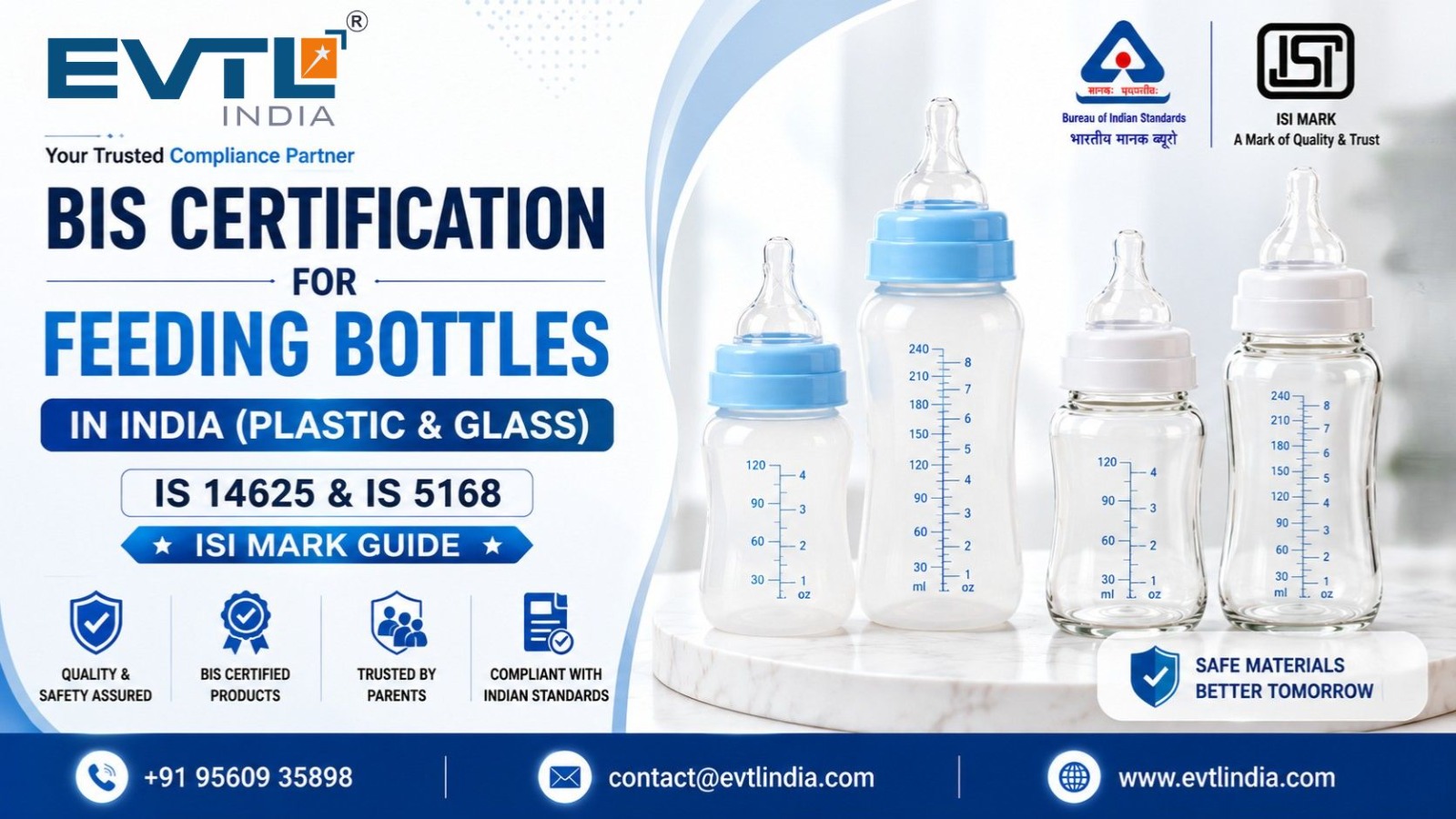
BIS Certification for Feeding Bottles is a mandatory requirement for manufacturers, importers, and brand owners who intend to manufacture, import, or sell Baby Feeding Bottles in the Indian market. Whether you are applying for BIS Certification for Plastic Feeding Bottles (IS 14625) or BIS Certification for Glass Feeding Bottles (IS 5168), obtaining the required BIS Licence and ISI Mark Certification for Feeding Bottles is essential to comply with the regulations prescribed by the Bureau of Indian Standards (BIS).
Feeding bottles are among the most important Infant Care Products, as they come into direct contact with babies during feeding. To ensure product quality, hygiene, material safety, and performance, the Government of India has made Mandatory BIS Certification applicable to these products under the relevant legislation. Before a product can be manufactured, imported, distributed, or sold in India, it must successfully complete the BIS Certification Process, including Product Testing in a BIS Approved Laboratory, compliance verification, and fulfilment of all applicable regulatory requirements.
Both Plastic Feeding Bottles (IS 14625) and Glass Feeding Bottles (IS 5168) must comply with their respective Indian Standards to obtain BIS Certification for Feeding Bottles. The certification verifies that the product meets the prescribed quality, safety, and performance requirements and authorizes manufacturers to use the ISI Mark, demonstrating compliance with Indian Standards.
What is BIS Certification for Feeding Bottles?
BIS Certification for Feeding Bottles is a mandatory product certification issued by the Bureau of Indian Standards (BIS) to ensure that Plastic Feeding Bottles (IS 14625) and Glass Feeding Bottles (IS 5168) meet the prescribed Indian quality and safety requirements before they are manufactured, imported, distributed, or sold in India. Whether you are looking for BIS Certification for Plastic Feeding Bottles, BIS Certification for Glass Feeding Bottles, ISI Mark Certification for Feeding Bottles, or a trusted BIS Consultant for Feeding Bottles, understanding the applicable standards and certification process is the first step toward regulatory compliance.
Feeding bottles are among the most sensitive baby care products because they come into direct contact with infant food and are used by newborns and young children every day. Even a minor defect in the material, design, or manufacturing quality can affect an infant's health and safety. To protect consumers and ensure consistent product quality, the Government of India has made BIS Certification for Feeding Bottles mandatory under the provisions of The Infant Milk Substitutes, Feeding Bottles and Infant Foods (Regulation of Production, Supply and Distribution) Act, 1992.
The certification confirms that feeding bottles comply with the applicable Indian Standards, including requirements related to raw materials, construction, dimensions, mechanical strength, hygiene, chemical safety, performance, marking, and quality control. Once the product successfully meets these requirements and the manufacturer obtains a BIS Licence, the product is permitted to carry the ISI Mark, demonstrating compliance with the relevant Indian Standard.
The applicable standards are -
- IS 14625 – Plastic Feeding Bottles
- IS 5168 – Glass Feeding Bottles
Manufacturers of both plastic and glass feeding bottles must ensure that their products are tested in a BIS-approved laboratory and comply with all applicable technical requirements before applying for certification. Depending on the type of manufacturer, the certification process may also include documentation review, product testing, factory inspection, and assessment of the quality management system.
BIS Certification for Feeding Bottles is applicable to a wide range of businesses, including -
- Indian Manufacturers
- Foreign Manufacturers
- Importers
- Brand Owners
- OEM Manufacturers
- Private Label Manufacturers
- Startups
- MSMEs
- Baby Care Product Manufacturers
Without a valid BIS ISI Certification for Feeding Bottles, regulated products cannot be legally manufactured, imported, supplied, or sold in the Indian market. Non-compliance may result in regulatory action, product recalls, penalties, or restrictions on market access.
For businesses, obtaining BIS Certification for Plastic Feeding Bottles or BIS Certification for Glass Feeding Bottles is more than a legal requirement. It helps demonstrate product quality, strengthens consumer confidence, enhances brand reputation, and ensures compliance with India's product safety regulations. Working with an experienced BIS Certification Consultant can simplify the entire process, from identifying the correct standard and preparing technical documentation to coordinating product testing, submitting the application, supporting factory inspections, and obtaining the BIS licence with minimal delays.
Whether you are planning to launch a new feeding bottle brand, import baby feeding products into India, or expand your manufacturing operations, obtaining the correct BIS Certification for Feeding Bottles is an essential step to ensure full regulatory compliance and long-term business success.
Is BIS Certification Mandatory for Feeding Bottles in India?
Yes, BIS Certification for Feeding Bottles is mandatory in India. Every manufacturer intending to manufacture, import, distribute, or sell Plastic Feeding Bottles (IS 14625) or Glass Feeding Bottles (IS 5168) must obtain the required BIS Licence and use the ISI Mark before placing these products on the Indian market.
The mandatory requirement is governed by The Infant Milk Substitutes, Feeding Bottles and Infant Foods (Regulation of Production, Supply and Distribution) Act, 1992, which aims to protect infant health by ensuring that feeding bottles comply with prescribed Indian quality and safety standards.
Since feeding bottles come into direct contact with infant food and are used by newborns and young children, they must be manufactured using safe materials and undergo strict product testing, quality control, and regulatory compliance before being sold. A valid BIS Certification for Feeding Bottles confirms that the product has successfully met all applicable requirements under IS 14625 or IS 5168.
Manufacturing, importing, or selling regulated feeding bottles without the required ISI Mark Certification for Feeding Bottles may lead to regulatory action, product seizure, penalties, or other legal consequences. Therefore, businesses should obtain BIS Certification for Plastic Feeding Bottles or BIS Certification for Glass Feeding Bottles before commercial production or import.
Applicable Indian Standards
The Bureau of Indian Standards (BIS) has specified separate Indian Standards for plastic and glass feeding bottles. Manufacturers must comply with the relevant standard depending on the product they manufacture.
IS 14625 – Plastic Feeding Bottles
IS 14625 specifies the quality, safety, construction, material, performance, testing, and marking requirements for Plastic Feeding Bottles. Products manufactured under this standard must undergo testing in a BIS-approved laboratory before obtaining BIS ISI Certification.
IS 5168 – Glass Feeding Bottles
IS 5168 specifies the technical and safety requirements for Glass Feeding Bottles, including material quality, dimensional requirements, durability, performance testing, marking, packaging, and quality control procedures.
Manufacturers must identify the correct Indian Standard before filing their BIS Certification application to avoid unnecessary delays.
Products Covered Under BIS Certification for Feeding Bottles
The mandatory certification requirements generally apply to feeding bottles covered under the applicable Indian Standards, including -
- Plastic Feeding Bottles
- Glass Feeding Bottles
- Standard Baby Feeding Bottles
- Printed Feeding Bottles
- Wide Neck Feeding Bottles
- Narrow Neck Feeding Bottles
- BPA-Free Plastic Feeding Bottles (where applicable)
- Baby Milk Feeding Bottles
Manufacturers should verify the applicable product category before applying for BIS Certification for Feeding Bottles.
Who Needs BIS Certification for Feeding Bottles?
BIS Certification for Feeding Bottles is required by businesses involved in manufacturing, importing, branding, or supplying regulated feeding bottles in India.
This includes -
- Indian Manufacturers
- Foreign Manufacturers
- Importers
- Brand Owners
- OEM Manufacturers
- Contract Manufacturers
- Private Label Manufacturers
- Startups
- MSMEs
- Baby Care Product Manufacturers
- Infant Product Companies
- Export-Oriented Manufacturers supplying products to India
If your product falls under IS 14625 or IS 5168, obtaining BIS Certification is mandatory before commercial sale.
Benefits of BIS Certification and ISI Mark for Feeding Bottles
Obtaining BIS Certification for Plastic Feeding Bottles and Glass Feeding Bottles offers significant advantages beyond regulatory compliance.
Some key benefits include -
- Legal authorization to manufacture, import, and sell feeding bottles in India.
- Permission to use the ISI Mark on certified products.
- Compliance with Indian quality and safety regulations.
- Improved consumer trust and brand reputation.
- Assurance of product quality and infant safety.
- Reduced risk of regulatory action.
- Better acceptance in retail and institutional markets.
- Increased confidence among distributors and dealers.
- Stronger market competitiveness.
- Long-term regulatory compliance with BIS requirements.
For manufacturers and importers, BIS Certification serves as both a legal requirement and a mark of quality that enhances credibility in the Indian market.
BIS Certification Process for Plastic and Glass Feeding Bottles
The BIS Certification Process for Feeding Bottles involves several technical and regulatory steps designed to verify product conformity with the applicable Indian Standard.
The general process includes -
- Identifying the applicable Indian Standard (IS 14625 or IS 5168).
- Reviewing product specifications.
- Preparing technical documentation.
- Conducting product testing in a BIS-recognized laboratory.
- Submitting the BIS application.
- Scrutiny of documents by BIS.
- Factory inspection (where applicable).
- Assessment of manufacturing facilities and quality control systems.
- Verification of test reports.
- Grant of BIS Licence.
- Authorization to use the ISI Mark.
- Ongoing surveillance and compliance monitoring after licence approval.
Working with an experienced BIS Consultant for Feeding Bottles can help businesses complete these stages efficiently while minimizing documentation errors and approval delays.
Documents Required for BIS Certification
Preparing complete and accurate documentation is one of the most important steps in obtaining BIS Certification for Feeding Bottles. Whether you are applying for BIS Certification for Plastic Feeding Bottles (IS 14625) or BIS Certification for Glass Feeding Bottles (IS 5168), BIS verifies the legal status of the manufacturer, manufacturing capabilities, product specifications, and quality control system before granting a BIS Licence.
Although the exact documentation may vary depending on the product and manufacturer, the following documents are generally required -
- Company Registration Certificate
- Factory Registration or Manufacturing Licence
- Business Licence
- GST Registration (for Indian manufacturers)
- Manufacturing Process Flow Chart
- Product Technical Specifications
- Product Drawings (if applicable)
- List of Manufacturing Machinery
- List of Testing Equipment
- Calibration Certificates
- In-house Testing Facility Details
- Quality Control Plan
- Raw Material Details
- Product Test Reports from a BIS-recognized Laboratory
- Trademark Authorization Letter (if applicable)
- Authorized Signatory Documents
- Factory Layout
- Packaging and Product Marking Details
- Declaration and Undertaking as required by BIS
Submitting complete documentation helps avoid unnecessary objections and speeds up the BIS Certification Process for Feeding Bottles.
Product Testing Requirements and BIS Approved Laboratories
- Material quality
- Construction and workmanship
- Dimensional accuracy
- Mechanical strength
- Leak resistance
- Durability
- Hygiene requirements
- Safety requirements
- Marking and labeling
- Packaging requirements
- Performance requirements
Only products that successfully meet the prescribed test requirements are eligible for BIS Certification and permission to use the ISI Mark.
Factory Inspection and Quality Control Requirements
As part of the BIS Certification Process, BIS may conduct a factory inspection to assess whether the manufacturing facility has the capability to consistently produce products that comply with IS 14625 or IS 5168.
During the inspection, BIS officials may review -
- Manufacturing process
- Production facilities
- Quality management system
- Testing equipment
- Calibration records
- Raw material control
- Finished product inspection
- In-process quality control
- Storage facilities
- Production records
- Quality documentation
- Product traceability
The objective of the inspection is to ensure that every certified feeding bottle maintains consistent quality even after the BIS Licence has been granted.
Validity, Renewal, and Surveillance of BIS Licence
Once approved, the BIS Licence for Feeding Bottles remains valid for the period specified by BIS, provided the manufacturer continues to comply with all applicable requirements.
To maintain certification, manufacturers must -
- Continue producing products in accordance with IS 14625 or IS 5168.
- Maintain proper quality control procedures.
- Keep testing equipment calibrated.
- Maintain production and testing records.
- Cooperate during BIS surveillance inspections.
- Apply for licence renewal before expiry.
- Continue complying with all BIS regulations.
Failure to maintain compliance may result in suspension or cancellation of the BIS Licence.
BIS Certification Cost and Timeline for Feeding Bottles
The BIS Certification Cost for Feeding Bottles depends on several factors and cannot be fixed for every applicant. The overall cost may vary based on -
- Product category
- Applicable Indian Standard
- Number of product variants
- Laboratory testing charges
- Factory inspection requirements
- Documentation complexity
- Manufacturer location
- Indian or Foreign Manufacturer
- Consultancy requirements
Similarly, the BIS Certification Timeline depends on -
- Product testing duration
- Completion of documentation
- BIS application review
- Factory inspection schedule
- Response to technical queries
- Overall compliance readiness
Businesses that prepare documentation correctly and coordinate efficiently with BIS generally experience a faster approval process.
Why Choose EVTL India as Your BIS Certification Consultant?
Getting BIS Certification for Feeding Bottles requires in-depth technical knowledge, accurate documentation, product testing, coordination with BIS-approved laboratories, factory inspection support, and continuous regulatory compliance. Whether you require BIS Certification for Plastic Feeding Bottles (IS 14625) or BIS Certification for Glass Feeding Bottles (IS 5168), partnering with an experienced BIS Certification Consultant can help streamline the entire certification process and minimize approval delays.
EVTL India is a trusted BIS Consultant in India, offering comprehensive BIS Certification Services for manufacturers, importers, and brand owners across various industries. Our team provides end-to-end support to ensure your products comply with all applicable Bureau of Indian Standards (BIS) requirements and obtain the required BIS Licence and ISI Mark Certification efficiently.
Our End-to-End BIS Certification Services Include
- Identification of the applicable Indian Standard
- Complete documentation preparation and verification
- BIS application filing and submission
- Product testing coordination with BIS-recognized laboratories
- Assistance with BIS-approved laboratory requirements
- Factory inspection and audit support
- Technical compliance guidance
- Coordination and query handling with BIS authorities
- BIS Licence approval assistance
- Licence renewal support
- Post-certification compliance and surveillance assistance
With extensive expertise in BIS Certification, ISI Mark Certification, and BIS Regulatory Compliance, EVTL India helps businesses navigate the certification process with confidence. Our experienced consultants work closely with clients at every stage—from documentation and product testing to licence approval and ongoing compliance—ensuring a smooth, transparent, and hassle-free certification experience.
If you are looking for a reliable BIS Consultant for Feeding Bottles, BIS Registration Consultant, or BIS Certification Consultant in India, EVTL India is your trusted partner for fast, compliant, and end-to-end BIS certification solutions.
Conclusion
BIS Certification for Feeding Bottles is a mandatory requirement for manufacturers, importers, and brand owners intending to manufacture, import, distribute, or sell Plastic Feeding Bottles (IS 14625) and Glass Feeding Bottles (IS 5168) in India. Obtaining a valid BIS Licence and ISI Mark Certification not only ensures compliance with the Bureau of Indian Standards (BIS) but also demonstrates that the products meet the prescribed quality, safety, hygiene, and performance requirements for infant care products.
Whether you are an Indian Manufacturer, Foreign Manufacturer, Importer, OEM Manufacturer, Brand Owner, Startup, MSME, or Private Label Manufacturer, complying with the applicable Indian Standards is essential for legal market access and long-term business success. Since the BIS Certification Process involves technical documentation, product testing, factory inspection, and regulatory compliance, working with an experienced BIS Consultant for Feeding Bottles can help simplify the certification journey and avoid unnecessary delays.
EVTL India is a trusted BIS Certification Consultant in India, providing complete end-to-end consultancy for BIS Certification for Plastic Feeding Bottles (IS 14625) and Glass Feeding Bottles (IS 5168). Our experts assist with standard identification, documentation, product testing, BIS application filing, coordination with BIS-approved laboratories, factory inspection support, licence approval, renewal, and post-certification compliance, ensuring a smooth, transparent, and hassle-free certification process.
Contact EVTL India 📞 Phone: +91 9560935898 📧 Email: contact@evtlindia.com 🌐 Website: www.evtlindia.com