
BIS Certification for Chinese Manufacturers
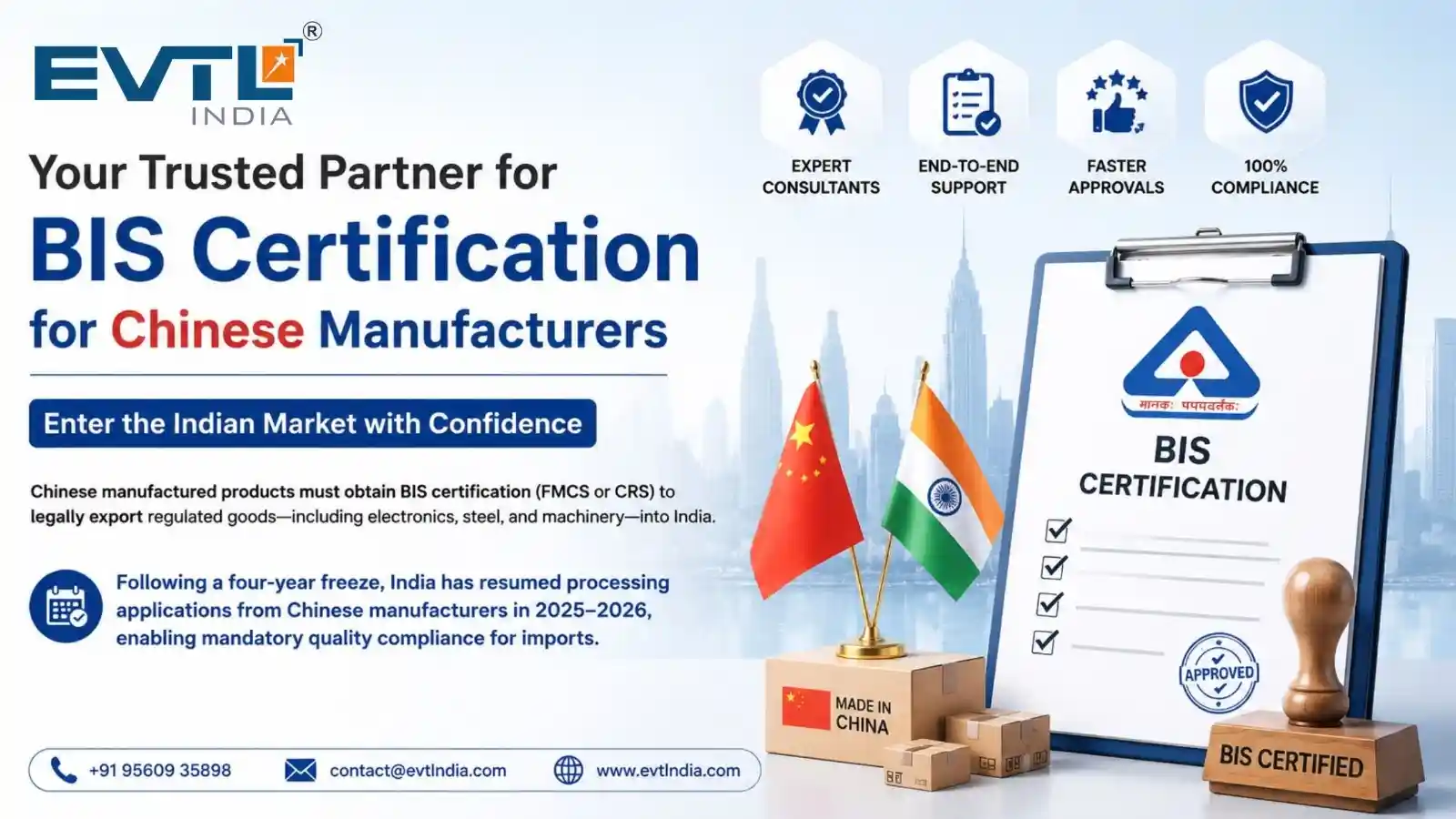
BIS Certification for Chinese Manufacturers is mandatory for companies in China exporting products to India. The certification ensures that products meet Indian quality, safety, and compliance standards set by the Bureau of Indian Standards (BIS). Products like electronics, electrical appliances, toys, chemicals, and machinery often require BIS approval before sale in India.
The process includes product testing, document submission, factory inspection, and compliance verification as per Indian Standards. After approval, manufacturers can use the BIS Standard Mark or CRS registration. BIS certification helps Chinese manufacturers legally access the Indian market, build customer trust, avoid import issues, and ensure product quality and safety.
Why BIS Certification is Important for Chinese Manufacturers
Chinese products are widely exported to India across multiple industries such as electronics, electrical appliances, chemicals, steel products, toys, machinery, footwear, and consumer goods. BIS certification is important because it:
Chinese products are widely exported to India across multiple industries such as electronics, electrical appliances, chemicals, steel products, toys, machinery, footwear, and consumer goods. BIS certification is important because it:
- Allows legal import and sale of products in India
- Builds trust among Indian buyers and distributors
- Prevents shipment delays and customs clearance issues
- Ensures compliance with Indian regulatory requirements
- Improves product credibility and market acceptance
Without BIS certification, products covered under mandatory certification schemes may face import restrictions, penalties, or rejection at Indian customs.
Types of BIS Certification Applicable to Chinese Manufacturers
Here are the commonly required documents for BIS Certification:
- Business Registration Certificate
- Factory License / Manufacturing License
- Trademark Registration Certificate (if applicable)
- Product Test Report from BIS Approved Lab
- Detailed Product Specification
- Manufacturing Process Flow Chart
- List of Manufacturing Machinery
- Quality Control and Testing Equipment Details
- Authorized Indian Representative (AIR) Documents (for foreign manufacturers)
- ISO Certificate (if available)
- Address Proof of Factory and Office
- Identity Proof of Authorized Signatory
- Layout Plan of Manufacturing Unit
- Calibration Certificates of Testing Equipment
- Undertaking and Declaration Forms
Additional Documents for Foreign Manufacturers
Foreign manufacturers applying under the Foreign Manufacturers Certification Scheme (FMCS) may also need:
- AIR Nomination Letter
- Passport and ID proof of manufacturer representative
- Factory registration documents from the origin country
- Authorization letter for Indian representative
Important Note
The exact documentation requirement may vary depending on:
- Product category
- Applicable Indian Standard (IS)
- Type of BIS scheme (ISI, CRS, FMCS, Scheme X, etc.)
- Manufacturer type (Domestic or Foreign)
Proper documentation helps speed up the BIS approval process and reduces chances of application rejection or delay.
BIS Certification Process for Chinese Manufacturers
Chinese manufacturers exporting products to India must obtain BIS certification before selling in the Indian market. Depending on the product category, BIS offers schemes like CRS Registration, ISI Certification, and FMCS Certification to ensure products meet Indian safety, quality, and performance standards.
Here is the step-by-step BIS Certification Process for Chinese Manufacturers:
1. Identify the Applicable BIS Scheme:
The first step is to determine under which BIS scheme the product falls. Common BIS schemes for Chinese manufacturers include:
- BIS CRS Registration for electronic and IT products
- BIS ISI Certification for products under mandatory QCO
- BIS FMCS Certification for foreign manufacturers
The applicable Indian Standard (IS Standard) must also be identified.
2. Appoint an Authorized Indian Representative (AIR):
Chinese manufacturers must appoint an Authorized Indian Representative (AIR) because BIS requires a local representative in India to coordinate with the BIS authority on behalf of the foreign manufacturer. The AIR handles:
- Communication with BIS
- Documentation support
- Compliance coordination
- Application management
3. Product Testing in BIS Approved Laboratory:
The product samples must be tested in a BIS-recognized laboratory in India. The testing is conducted according to the applicable Indian Standard to verify product safety, quality, and performance. The laboratory issues a test report after successful testing.
4. Preparation of Required Documents:
The manufacturer must prepare and submit various documents, including:
- Business license of the manufacturer
- Factory registration documents
- ISO certificate
- Product technical specifications
- Trademark certificate
- Authorization letter for AIR
- Test reports
- Manufacturing process details
Proper documentation is very important for smooth approval.
5. Submission of BIS Application:
After completing testing and documentation, the BIS application is submitted through the official BIS portal under the applicable certification scheme.
The application includes:
- Product details
- Manufacturing unit information
- Test reports
- Supporting documents
6. Factory Inspection by BIS Officials (If Applicable):
For schemes like FMCS or ISI Certification, BIS officials may conduct a factory inspection at the manufacturing facility in China. During inspection, BIS officers verify:
- Manufacturing process
- Quality control system
- Testing facilities
- Product consistency
- Production capability
7. Grant of BIS Certification:
If the product successfully meets all BIS requirements, BIS grants the certification or registration to the Chinese manufacturer.
After approval:
- The manufacturer can use the BIS Standard Mark or CRS number
- Products can be legally imported and sold in India
- Compliance with Indian regulations becomes mandatory
8. Marking and Ongoing Compliance:
After certification, manufacturers must ensure continuous compliance with BIS standards. Products must carry the required BIS marking and registration details. BIS may also conduct:
- Market surveillance
- Sample testing
- Periodic inspections
- Renewal verification
Challenges Faced by Chinese Manufacturers
Chinese manufacturers exporting products to India face many challenges. One of the biggest challenges is getting mandatory BIS certification for products covered under Indian Quality Control Orders (QCOs). The process includes product testing, document preparation, factory inspection, and following Indian quality standards, which can take a lot of time and effort.
Another challenge is understanding Indian rules and regulations, which are updated regularly. Many manufacturers also face communication problems, difficulties in preparing correct documents, and delays in testing from BIS-approved laboratories. Foreign manufacturers must also appoint an Authorized Indian Representative (AIR), which is compulsory for BIS certification.
If BIS requirements are not followed properly, manufacturers may face shipment delays, customs problems, penalties, or restrictions on selling products in India. Maintaining product quality and following compliance rules after getting certification can also be difficult. Therefore, many Chinese manufacturers take help from experienced BIS consultants for an easier and smoother certification process.
Conclusion
BIS certification is very important for Chinese manufacturers who want to sell their products in India. Different types of BIS certification apply to different products, and manufacturers must follow Indian quality and safety standards before exporting products to India. The certification process may involve product testing, documentation, factory inspection, and compliance verification, which can sometimes be complex for foreign manufacturers.
However, proper planning, accurate documentation, and compliance with Indian Standards can help manufacturers avoid delays, penalties, and customs issues. However, proper BIS compliance helps manufacturers avoid import problems, shipment delays, and legal issues in India. It also helps improve product trust and business growth in the Indian market. With proper guidance and support, Chinese manufacturers can complete the BIS certification process more easily and successfully expand their business in India.