
BIS Certificate: Meaning, Types, Online Verification, Validity & How to Get It
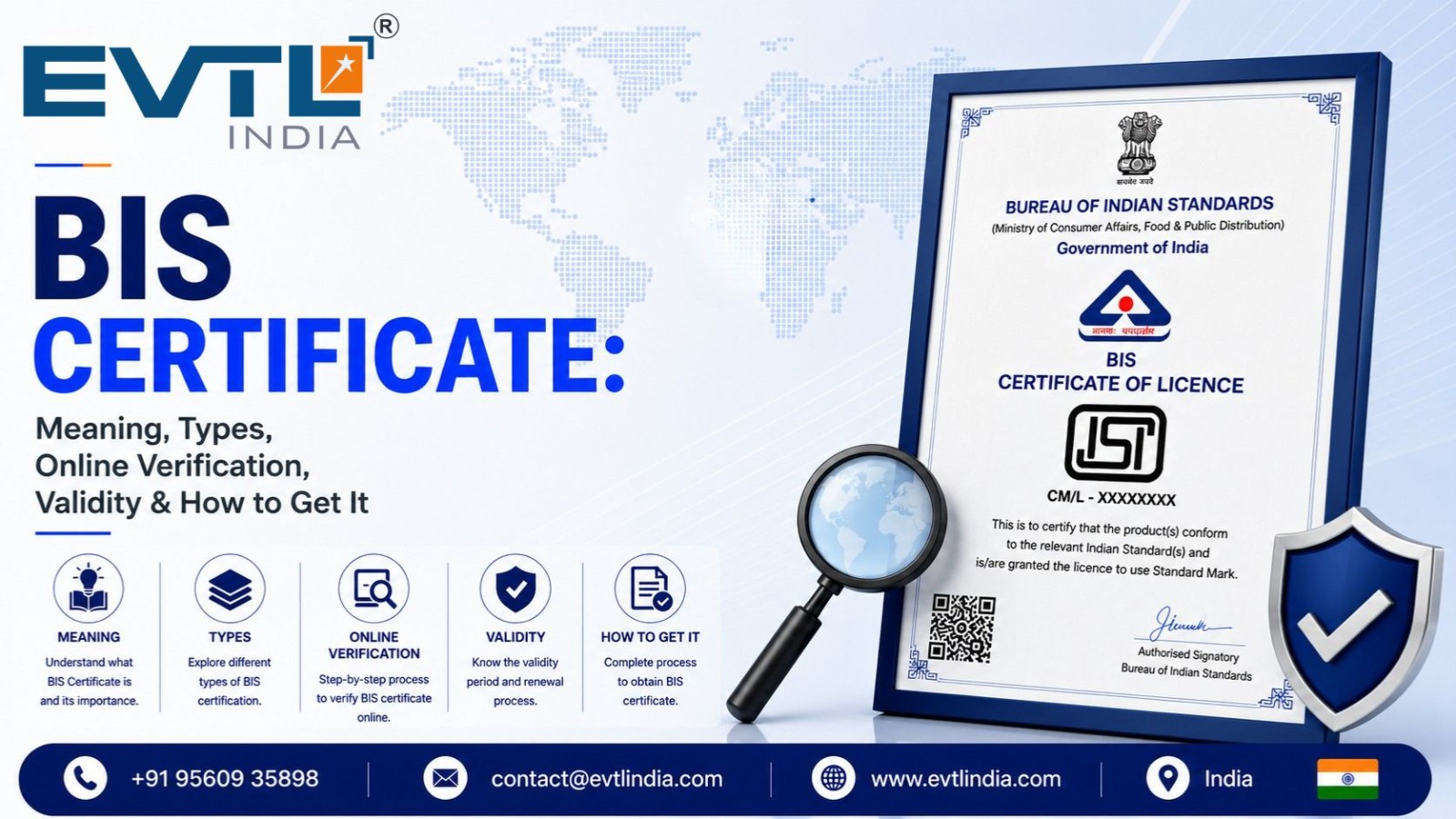
A BIS Certificate is an official certification issued by the Bureau of Indian Standards (BIS) that confirms a product complies with the applicable Indian Standard (IS) for quality, safety, and performance. Depending on the certification scheme, BIS issues either a Grant of Licence (CM/L Number) for ISI Mark products or a Registration (R-Number) for products covered under the Compulsory Registration Scheme (CRS). This certification allows eligible manufacturers to manufacture, import, or sell applicable products in the Indian market in accordance with the relevant BIS regulations.
Obtaining a BIS Certificate is important because many products are covered under mandatory Quality Control Orders (QCOs) and other BIS regulatory requirements. For such products, BIS certification is essential for legal market access, regulatory compliance, consumer confidence, and demonstrating conformity with the applicable Indian Standard. Whether you are an Indian manufacturer, a foreign manufacturer, or an importer, understanding the BIS Certificate, its contents, verification process, validity, and certification requirements is essential for ensuring smooth business operations and compliance in India.
What Does a BIS Certificate Look Like? (Sample Copy & Contents)
A BIS Certificate is an official licence or registration document issued by the Bureau of Indian Standards (BIS) after a product successfully complies with the applicable Indian Standard and the requirements of the relevant certification scheme. Depending on the certification scheme, the document is issued either as a Grant of Licence (CM/L Number) under the ISI Mark Scheme or as a Registration Certificate (R-Number) under the Compulsory Registration Scheme (CRS). Although the format may vary slightly between schemes, every BIS Certificate contains key information that identifies the certified manufacturer, the approved product, the applicable Indian Standard, and the certification status.
Sample BIS Certificate: A typical BIS Certificate includes the official BIS logo, licence or registration number, manufacturer details, product description, applicable Indian Standard (IS), scope of certification, date of grant, validity period, and other regulatory information. The certificate serves as documentary evidence that the product has been certified under the applicable BIS scheme and is authorised to use the relevant BIS certification mark in accordance with the licence conditions.
Note: The sample certificate shown below is for illustration purposes only. The actual certificate issued by BIS will contain the licence holder's details, approved product scope, applicable Indian Standard, and the unique CM/L Number or R-Number.
Information Available on a BIS Certificate
A genuine BIS Certificate generally contains the following information -
- BIS Licence / Registration Number (CM/L Number or R-Number)
- Name of the Licence Holder / Manufacturer
- Factory Address and Manufacturing Location
- Product Name and Description
- Applicable Indian Standard (IS Number)
- Certification Scheme (ISI, CRS, FMCS, Scheme X, etc.)
- Approved Product Scope, Models or Variants
- Brand Name(s) covered under the licence (where applicable)
- Date of Grant / Registration
- Validity Period and Current Licence Status
- Issuing Authority (Bureau of Indian Standards)
These details can also be verified through the official BIS ManakOnline Portal or the BIS CARE mobile application, allowing manufacturers, importers, distributors, and consumers to confirm the authenticity and validity of the certificate before purchasing, importing, or supplying BIS-certified products.
BIS CM/L Number and R-Number Explained
Every BIS-certified product is identified by a unique licence or registration number, depending on the applicable certification scheme. Products certified under the ISI Mark Scheme are issued a Certification Marks Licence (CM/L) Number, while products registered under the Compulsory Registration Scheme (CRS) receive a unique R-Number. These identifiers help manufacturers, importers, distributors, regulators, and consumers verify whether a product is genuinely certified by the Bureau of Indian Standards (BIS). Both numbers can be verified through the official BIS ManakOnline Portal and the BIS CARE mobile application.
What Is a CM/L Number?
A CM/L Number (Certification Marks Licence Number) is a unique licence number issued by BIS to manufacturers whose products are certified under the ISI Mark Certification Scheme (Scheme-I) or the Foreign Manufacturers Certification Scheme (FMCS). The CM/L Number appears on the BIS licence and is also displayed alongside the ISI Mark and the applicable Indian Standard (IS) on certified products.
Example: ISI Mark IS 302 (Part 1): 2024
CM/L-XXXXXXXXXX
The CM/L Number confirms that the product is manufactured under a valid BIS licence and complies with the applicable Indian Standard.
What Is an R-Number?
An R-Number (Registration Number) is issued by BIS under the Compulsory Registration Scheme (CRS) for notified electronic and IT products. Unlike the CM/L Number, the R-Number is used only for CRS-registered products and is printed on the product, packaging, or product label along with the BIS Standard Mark.
Example: R-12345678
The R-Number enables users to verify the registration status of electronic and IT products through the official BIS verification platforms.
CM/L Number vs R-Number
Latest 10-Digit CM/L Number Update
To standardize product certification licences and simplify online verification, BIS has upgraded Product Certification Licence numbers to a uniform 10-digit CM/L Number format. Existing licence numbers are being converted by adding leading zeros where required. For example, an existing licence number 1234567 is upgraded to 0001234567. This is only a numbering-format change and does not affect the validity or certification status of the licence. During the transition period, BIS accepts both the original licence number and the upgraded 10-digit format for verification through its official platforms.
BIS Certificate vs BIS Licence vs ISI Mark
The terms BIS Certificate, BIS Licence, and ISI Mark are often used interchangeably, but they have different meanings. Understanding the difference helps manufacturers, importers, distributors, and consumers correctly identify BIS-certified products and verify their authenticity.
In simple terms, BIS issues the certificate or licence, and the manufacturer is permitted to use the ISI Mark (or the applicable BIS Standard Mark) on certified products after obtaining the required approval.
How to Verify a BIS Certificate Online
The Bureau of Indian Standards (BIS) allows manufacturers, importers, distributors, retailers, and consumers to verify the authenticity of a BIS Certificate through its official online platforms. Whether a product is certified under the ISI Mark Scheme with a CM/L Number or registered under the Compulsory Registration Scheme (CRS) with an R-Number, the certification details can be verified using the BIS ManakOnline Portal or the BIS CARE mobile application. Verifying a BIS Certificate helps confirm that the licence or registration is genuine, active, and applicable to the product being purchased, manufactured, or imported.
Verify Through the ManakOnline Portal
The BIS ManakOnline Portal is the official online platform for checking BIS licence and registration details.
Steps to verify a BIS Certificate through ManakOnline -
- Visit the official BIS ManakOnline Portal.
- Open the Search a Licence or Licence Verification section.
- Enter the CM/L Number or R-Number.
- Complete the verification process and submit the details.
- Review the certification information displayed on the screen.
This method is commonly used by manufacturers, importers, compliance professionals, and businesses to verify the authenticity of BIS-certified products before procurement or regulatory compliance.
Verify Through the BIS CARE App
The BIS CARE App is the official mobile application developed by the Bureau of Indian Standards for quick certificate verification.
Steps to verify using the BIS CARE App -
- Download the BIS CARE App from the Google Play Store or Apple App Store.
- Open the application and select Verify Licence Details (for CM/L Number) or Verify R-Number (for CRS products).
- Enter the licence or registration number.
- Tap Go to retrieve the certification details.
- Verify the information displayed before purchasing or supplying the product.
The BIS CARE App provides a fast and convenient way to confirm the authenticity of BIS-certified products directly from a smartphone.
Details Displayed After Verification
After successful verification, the BIS portal or BIS CARE App generally displays the following information -
- Licence or Registration Number (CM/L Number or R-Number)
- Current Licence Status (Active, Expired, Suspended, or Cancelled, as applicable)
- Name of the Manufacturer or Licence Holder
- Factory Address and Manufacturing Location
- Product Name and Description
- Applicable Indian Standard (IS Number)
- Certification Scheme (ISI, CRS, FMCS, etc.)
- Approved Product Scope, Models, or Variants
- Brand Name(s), where applicable
- Date of Grant or Registration
- Licence Validity Period
Before relying on a BIS Certificate, ensure that the manufacturer's name, manufacturing location, product description, applicable Indian Standard, and current licence status exactly match the product being verified. If the information does not match or no record is found, the product should be investigated further before purchase, import, or distribution.
How to Identify a Fake or Invalid BIS Certificate
Verifying a BIS Certificate is one of the most effective ways to confirm whether a product is genuinely certified by the Bureau of Indian Standards (BIS). Counterfeit products may display an unauthorized ISI Mark, fake CM/L Number, or incorrect certification details to mislead consumers and businesses. Before purchasing, importing, manufacturing, or supplying a BIS-certified product, always verify the licence through the official BIS ManakOnline Portal or the BIS CARE App.
Common Verification Errors
If a BIS Certificate cannot be verified or displays unexpected information, it may be due to one of the following reasons -
- Incorrect CM/L Number or R-Number entered during verification.
- Typographical or formatting errors in the licence number.
- Expired, suspended, or cancelled BIS licence.
- Product not covered under the verified licence.
- Manufacturer or factory details do not match the verification results.
- Applicable Indian Standard (IS Number) differs from the product marking.
- Counterfeit product displaying an unauthorized BIS or ISI Mark.
- The licence has not yet been updated in the verification system (where applicable).
If any of these issues occur, recheck the details carefully. If the mismatch continues, avoid relying on the certification until the licence has been confirmed through official BIS sources.
Fake ISI Mark Checklist
Before purchasing or approving a BIS-certified product, verify the following -
- The product carries the official ISI Mark or applicable BIS Standard Mark.
- A valid CM/L Number (or R-Number for CRS products) is clearly mentioned.
- The licence number can be successfully verified on the BIS ManakOnline Portal or BIS CARE App.
- The manufacturer's name matches the official BIS verification record.
- The factory address corresponds to the verified licence details.
- The product description matches the approved product listed in the BIS database.
- The applicable Indian Standard (IS Number) is correct for the product.
- The licence status is shown as Active.
- The approved product scope, models, or brands (where applicable) match the product being supplied.
If the licence cannot be verified, the product details do not match the official BIS records, or the licence is shown as expired, suspended, or cancelled, the product should not be considered genuinely BIS certified until its authenticity has been confirmed through the Bureau of Indian Standards.
BIS Certificate Validity, Renewal and Licence Status
A BIS Certificate is issued for a specified validity period and must remain valid for manufacturers to continue using the applicable BIS Standard Mark, ISI Mark, or CRS Registration. The validity period depends on the applicable BIS certification scheme, and manufacturers must ensure timely renewal to maintain compliance with the BIS Act, 2016 and the relevant certification regulations.
Validity
The validity period varies depending on the BIS certification scheme -
- ISI Mark Certification (Scheme-I): A BIS licence is generally granted for 1 to 2 years initially and can be renewed for up to 5 years at a time, subject to compliance with the applicable BIS requirements.
- BIS CRS Registration: Generally valid for 2 years and renewable thereafter in accordance with BIS regulations.
- FMCS (Foreign Manufacturers Certification Scheme): The licence is generally granted for 1 year initially and can subsequently be renewed for up to 5 years, subject to continued compliance.
- Scheme X Certification: The validity is specified in the licence issued by BIS and is renewed as per the applicable regulatory provisions.
- BIS Hallmark Registration: Registration remains valid as per the applicable BIS hallmarking regulations and renewal requirements.
The exact validity period is mentioned on the BIS licence or registration certificate and can also be verified through the BIS ManakOnline Portal or the BIS CARE App.
Renewal: Manufacturers should apply for renewal before the licence expires, preferably 2–3 months in advance, to avoid any interruption in certification or business operations. The renewal process generally includes submission of the renewal application, applicable fees, compliance records, and any additional documents required by BIS. Continued compliance with the applicable Indian Standard and BIS licence conditions is essential for successful renewal.
Active, Suspended, Expired & Cancelled Status
During online verification, the BIS licence may display one of the following statuses -
- Active: The licence is valid, and the manufacturer is authorized to use the applicable BIS Standard Mark.
- Suspended: The licence has been temporarily suspended by BIS, and the manufacturer cannot use the BIS Standard Mark until the suspension is revoked.
- Expired: The licence validity has ended, and renewal is required before certification can continue.
- Cancelled: The licence has been permanently cancelled by BIS and is no longer valid for manufacturing, importing, or selling products under the applicable BIS certification.
Before purchasing, importing, or supplying a BIS-certified product, always verify that the licence status is Active and that the manufacturer name, product description, manufacturing location, applicable Indian Standard, and licence details exactly match the official BIS records. This helps ensure product authenticity, regulatory compliance, and consumer safety.
Note: Renewal periods and validity may vary for certain product categories or certification schemes based on the applicable BIS regulations and licence conditions.
How to Obtain a BIS Certificate
Obtaining a BIS Certificate involves identifying the correct certification scheme, complying with the applicable Indian Standard (IS), completing product testing, submitting the required documentation, and obtaining approval from the Bureau of Indian Standards (BIS). The exact process may vary depending on whether the product falls under the ISI Mark Scheme (Scheme-I), Compulsory Registration Scheme (CRS), Foreign Manufacturers Certification Scheme (FMCS), or another applicable BIS certification scheme. However, the overall certification process follows a similar sequence.
BIS Certification Process
The typical BIS certification process includes the following steps -
- Identify the Applicable Certification Scheme based on the product category and regulatory requirements.
- Determine the Relevant Indian Standard (IS) applicable to the product.
- Prepare the Required Documentation and technical information.
- Product Testing at a BIS-recognized laboratory (where applicable).
- Submit the BIS Application through the official ManakOnline Portal.
- Document Scrutiny by BIS officials.
- Factory Inspection (applicable for schemes such as ISI Mark and FMCS).
- 8Resolution of Queries or Non-Conformities, if any.
- Grant of BIS Licence or Registration Certificate after successful compliance.
- Ongoing Surveillance and Renewal to maintain certification.
Required Documents
The required documents may vary depending on the certification scheme and product category. Commonly required documents include -
- Company Incorporation Certificate or Business Registration
- GST Registration (where applicable)
- Manufacturing Licence or Factory Registration
- Factory Address Proof
- Product Technical Specifications
- Applicable Product Drawings or Catalogues
- Manufacturing Process Flow
- Quality Control Plan
- List of Manufacturing and Testing Equipment
- Calibration Certificates for Testing Equipment
- Product Test Reports (where applicable)
- Brand Authorization Letter (if applicable)
- Authorized Signatory Details
- Identity and Address Proof of the Authorized Representative
- AIR (Authorized Indian Representative) documents for foreign manufacturers
BIS may request additional documents depending on the applicable certification scheme and product requirements.
Cost & Timeline
The cost of obtaining a BIS Certificate varies based on several factors, including -
- Applicable BIS certification scheme
- Product category and Indian Standard
- Number of product models or variants
- Product testing requirements
- Factory inspection requirements
- Government application and licence fees
- Marking fees (where applicable)
- Consultancy and documentation support (if required)
The certification timeline also depends on the applicable scheme, product complexity, testing requirements, document readiness, and BIS processing time. Under normal circumstances -
- BIS CRS Registration: Approximately 4–8 weeks
- ISI Mark Certification (Scheme-I): Approximately 4–8 weeks, subject to successful testing and factory inspection.
- FMCS Certification: Approximately 4–6 months, depending on overseas factory inspection scheduling and application processing.
- Scheme X Certification: Timeline varies depending on the product category, technical evaluation, and regulatory requirements.
Proper documentation, timely testing, and prompt response to BIS queries can significantly reduce processing time and help obtain the BIS Certificate more efficiently.
Important Compliance Requirements After BIS Certification
Obtaining a BIS Certificate is not the end of the compliance process. Manufacturers must continue to comply with the applicable BIS licence conditions, Indian Standard (IS), and relevant regulations to keep their licence valid. Failure to meet these ongoing compliance requirements may result in suspension or cancellation of the BIS licence.
Key compliance requirements after obtaining a BIS Certificate include -
- Use the BIS Standard Mark, ISI Mark, or CRS Standard Mark only on products covered under the approved licence.
- Ensure continuous compliance with the applicable Indian Standard (IS) and product specifications.
- Maintain a documented Quality Control System and production records.
- Test products as required under the applicable BIS scheme and maintain test records.
- Keep all manufacturing and testing equipment properly calibrated.
- Inform BIS about any significant changes to the product design, manufacturing process, factory location, ownership, or brand name before implementation, where required.
- Cooperate with BIS during surveillance inspections and market surveillance activities.
- Renew the BIS licence before its expiry to avoid interruption in certification.
- Maintain complete records of production, testing, complaints, and corrective actions for inspection.
- Comply with all conditions mentioned in the BIS licence and applicable Quality Control Orders (QCOs), where relevant.
Following these compliance requirements helps manufacturers maintain product quality, regulatory compliance, and uninterrupted use of the BIS certification mark.
Why Businesses Choose EVTL India for BIS Certification?
Obtaining BIS Certification involves selecting the correct certification scheme, identifying the applicable Indian Standard, preparing technical documentation, coordinating product testing, managing factory inspections, and responding to BIS queries. EVTL India provides complete end-to-end consultancy to help manufacturers, importers, brand owners, and foreign manufacturers complete the certification process accurately and efficiently.
- Complete BIS Certification Consultancy under ISI Mark, CRS, FMCS, Scheme X, Hallmark, and other BIS schemes.
- Experienced Regulatory Professionals with extensive knowledge of BIS procedures and Indian Standards.
- Product Classification & Applicable IS Standard Identification to determine the correct certification route.
- Complete Documentation Support for accurate application preparation and submission.
- Coordination with BIS-Recognized Laboratories for product testing.
- Factory Inspection Assistance for both domestic and foreign manufacturers.
- AIR (Authorized Indian Representative) Services for overseas manufacturers applying under FMCS or CRS.
- BIS Portal Application Filing & Regulatory Query Handling to help reduce delays.
- Licence Renewal & Ongoing Compliance Support after certification.
- PAN India & International Client Support for manufacturers exporting products to the Indian market.
Whether you are applying for BIS Certification for the first time, introducing a new product, expanding your product range, or exporting products to India, EVTL India provides practical regulatory guidance and end-to-end support to help you achieve BIS certification smoothly and maintain long-term compliance.
Conclusion
Getting a BIS Certificate is an important step for businesses that manufacture, import, or supply products covered under the applicable BIS regulations. Selecting the correct certification scheme, identifying the applicable Indian Standard (IS), preparing the required documentation, completing product testing, and following the BIS application process correctly can help save time and avoid unnecessary delays.
Whether you require ISI Mark Certification, BIS CRS Registration, FMCS Certification, Scheme X Certification, or any other BIS approval, understanding the certification requirements and maintaining ongoing compliance is essential for smooth business operations and legal market access in India.
Choosing an experienced BIS certification consultant can simplify the entire process and help you obtain your BIS licence efficiently while ensuring compliance with all applicable BIS requirements.
Get Expert BIS Certification Support Need professional assistance with BIS Certification?
EVTL India provides complete BIS certification consultancy for Indian manufacturers, foreign manufacturers, importers, and brand owners. Our experts assist you throughout the entire certification process—from identifying the applicable Indian Standard and certification scheme to documentation, product testing, BIS application filing, factory inspection support, licence approval, renewal, and post-certification compliance.
Whether you are applying for BIS certification for the first time or require support for a new product or existing licence, our team is here to help.
Contact EVTL India today to discuss your requirements and receive expert guidance for a smooth, accurate, and hassle-free BIS certification process.