
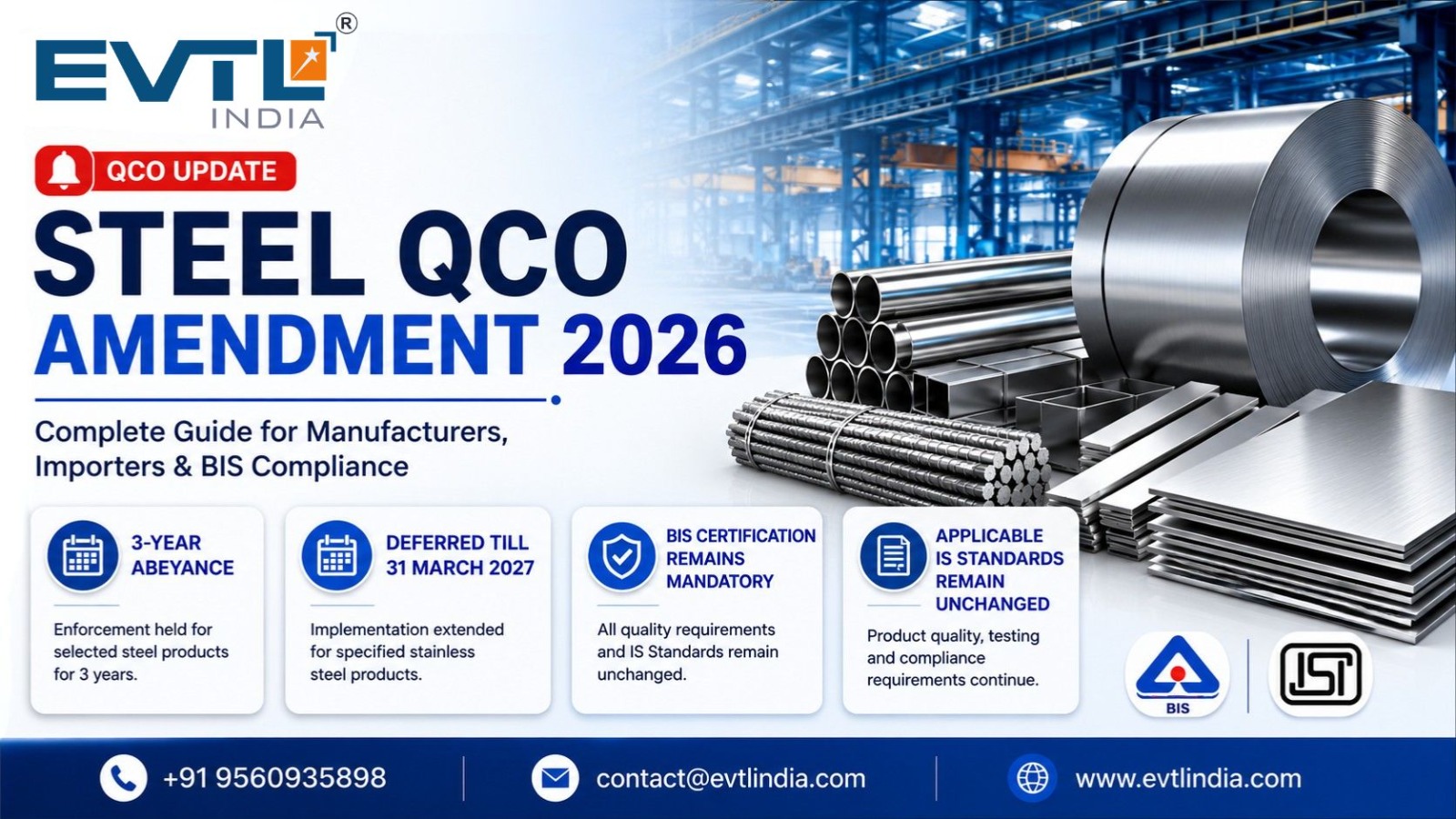
Steel QCO Amendment 2026: Complete Guide for Manufacturers, Importers & BIS Compliance
India's steel industry is one of the most important industries in the country. It supports infrastructure, construction, automobiles, engineering, manufacturing, energy, and many other sectors. To make sure steel products are safe and of good quality, the Government of India has introduced several Quality Control Orders (QCOs) under the Bureau of Indian Standards (BIS). These orders make BIS Certification mandatory for notified steel products.
The Ministry of Steel has recently issued the Steel and Steel Products (Quality Control) Amendment Order, 2026, which was published on 23 June 2026. This amendment updates the existing Steel QCO and aims to improve product quality, strengthen compliance, and ensure that only BIS-certified steel products are manufactured, imported, and sold in India. The new changes are important for Indian manufacturers, foreign manufacturers, importers, traders, EPC contractors, and all businesses dealing with notified steel products.
Many businesses thought that the amendment had removed the requirement for BIS Certification, but this is not true. The amendment only extends the implementation dates for some notified steel products. All Indian Standards and mandatory BIS compliance requirements remain the same. Businesses should use this additional time to complete product testing, prepare the required documents, and obtain BIS Certification before the new enforcement dates.
Understanding the Steel QCO Amendment 2026
The Steel and Steel Products (Quality Control) Amendment Order, 2026, issued by the Ministry of Steel, revises the implementation schedule for selected steel products covered under mandatory Quality Control Orders.
The primary objective of this amendment is to provide additional implementation time for specified products while maintaining the Government's commitment to quality assurance and regulatory compliance. It is important to understand that the amendment does not modify the technical requirements of the applicable Indian Standards, nor does it exempt businesses from obtaining BIS certification where it is mandatory.
Instead, the notification revises the enforcement timeline for certain notified products, allowing manufacturers and importers additional time to complete regulatory preparations before mandatory implementation.
What Has Changed?
The amendment primarily introduces two important changes -
- A three-year abeyance has been provided for certain notified steel products.
- The implementation date for specified stainless steel products has been extended until 31 March 2027.
These revised timelines are intended to help industries strengthen manufacturing processes, complete testing requirements, prepare technical documentation, and obtain the necessary BIS approvals without disrupting business operations.
What Has Not Changed?
Although the implementation schedule has been revised, several important regulatory requirements remain exactly the same.
These include -
- Mandatory compliance with the applicable Indian Standards (IS).
- BIS Certification remains compulsory for products covered under the notified Quality Control Orders.
- Product testing must still be conducted in accordance with the prescribed standards.
- Manufacturers and importers must obtain the applicable BIS licence before the revised enforcement dates become effective.
- BIS surveillance, regulatory inspections, and market compliance requirements continue to remain applicable.
Therefore, businesses should not interpret the amendment as a relaxation of compliance obligations. Instead, it should be viewed as a strategic opportunity to complete all certification activities well in advance of the revised implementation deadlines.
Major Changes Introduced Under the Steel QCO Amendment 2026
The Steel and Steel Products (Quality Control) Amendment Order, 2026 introduces important revisions to the implementation schedule for certain steel products covered under mandatory BIS Quality Control Orders (QCOs). These revisions are intended to provide industries with additional time to prepare for compliance while ensuring that product quality and safety requirements remain intact.
One of the most important aspects of this amendment is that it does not dilute the existing quality standards or regulatory framework. Instead, it revises the enforcement timelines for specified products, allowing businesses to complete their compliance activities before mandatory implementation.
Three-Year Abeyance for Specified Steel Products
Under the amendment, the Ministry of Steel has provided a three-year abeyance for certain notified steel products. During this period, the enforcement of the applicable Quality Control Order for these specified products will remain on hold.
This additional time enables manufacturers and importers to assess product applicability, improve manufacturing processes, strengthen quality management systems, complete technical documentation, and prepare for BIS certification without immediate enforcement pressure.
It is important to note that this abeyance does not remove the requirement for BIS certification in the future. Businesses dealing with these products should continue preparing for compliance to avoid delays once enforcement resumes.
Extension of Enforcement Timeline
The amendment also extends the implementation date for certain specified stainless steel products until 31 March 2027.
This revised timeline provides manufacturers, importers, and suppliers with additional time to -
- Complete product testing through BIS-recognized laboratories.
- Prepare mandatory technical documentation.
- Implement quality management systems.
- Submit BIS certification applications.
- Resolve compliance-related observations before enforcement becomes mandatory. Rather than postponing compliance efforts, businesses should use this transition period to ensure they are fully prepared before the revised implementation date.
Rather than postponing compliance efforts, businesses should use this transition period to ensure they are fully prepared before the revised implementation date.
Impact on Manufacturers and Importers
The Steel QCO Amendment 2026 offers businesses additional time to prepare for mandatory compliance, but it should not be viewed as a reason to delay regulatory planning. Manufacturers and importers who begin their compliance activities early are more likely to avoid certification bottlenecks, production delays, and supply chain disruptions.
Impact on Manufacturers
For domestic manufacturers, the revised timelines provide an opportunity to strengthen compliance systems before mandatory enforcement.
Manufacturers should use this period to -
- Identify whether their products are covered under the applicable Steel QCO.
- Review the relevant Indian Standards (IS) applicable to their products.
- Upgrade manufacturing and quality control processes where necessary.
- Prepare technical documentation required for BIS certification.
- Coordinate product testing through BIS-recognized laboratories.
- Submit BIS certification applications well before the revised implementation deadlines.
Early preparation helps manufacturers reduce approval delays, maintain uninterrupted production, and ensure continued legal access to the Indian market.
Impact on Importers
Importers of steel products should also begin preparing immediately, particularly if their products fall under the notified Quality Control Orders.
Importers should -
- Verify whether imported products are covered under the applicable Steel QCO.
- Coordinate with overseas manufacturers regarding BIS compliance requirements.
- Arrange product testing and certification where applicable.
- Complete documentation and regulatory approvals before enforcement begins.
- Plan future imports based on the revised compliance timelines.
Waiting until the final implementation date may increase the risk of shipment delays, customs-related issues, and interruptions in product availability.
Why Early BIS Compliance Matters
Although the Steel QCO Amendment 2026 extends implementation timelines for certain products, businesses should not postpone their compliance activities. Obtaining BIS certification is a structured process that involves multiple stages, including product testing, documentation, application review, and regulatory approvals.
Starting the certification process early offers several advantages -
- Sufficient time to identify and address compliance gaps.
- Faster completion of product testing and documentation.
- Reduced risk of approval delays.
- Improved production and supply chain planning.
- Smooth transition before mandatory enforcement begins.
- Continued market access without regulatory interruptions.
- Stronger customer confidence through compliance with Indian quality standards.
Businesses that treat the extended timeline as a preparation period rather than a delay are better positioned to remain competitive and fully compliant.
How EVTL India Can Help
Navigating BIS regulations and Quality Control Orders can be complex, particularly when products are covered under evolving regulatory requirements. EVTL India provides comprehensive consultancy services to help manufacturers, importers, exporters, OEMs, MSMEs, startups, and foreign manufacturers achieve timely and hassle-free BIS compliance.
Our services include -
- Product Applicability Assessment
- BIS Certification Consultancy
- ISI Mark Certification Support
- Product Testing Coordination
- Technical Documentation Preparation
- BIS Application Filing
- Regulatory Compliance Assistance
- Factory Audit Support
- Licence Renewal & Post-Certification Compliance
With extensive experience across multiple industries, EVTL India helps businesses simplify the certification process while ensuring compliance with the latest BIS regulations and Quality Control Orders.
Conclusion
The Steel and Steel Products (Quality Control) Amendment Order, 2026 provides additional implementation time for specified steel products, but it does not remove the obligation to obtain BIS certification. The applicable Indian Standards, quality requirements, and regulatory framework remain unchanged.
Manufacturers and importers should use this transition period to complete product testing, prepare technical documentation, strengthen quality systems, and obtain the necessary BIS approvals well before the revised enforcement dates.
Early compliance helps businesses reduce regulatory risks, avoid last-minute certification challenges, maintain uninterrupted market access, and build greater confidence among customers and stakeholders.
If your products fall under the applicable Steel Quality Control Orders, now is the ideal time to begin your compliance journey.
EVTL India offers end-to-end support for BIS Certification, ISI Mark Certification, and regulatory compliance for steel products covered under mandatory Quality Control Orders.
Contact EVTL India 📞 +91 9560935898 📧 contact@evtlindia.com 🌐 www.evtlindia.com
Our team is ready to help you achieve timely BIS certification and ensure your products comply with the latest Government of India regulations.