
BIS Certification for Liquefied Petroleum Gas (LPG) Containers for Automotive Use ensures the safety, quality, and reliability of fuel storage systems used in LPG-powered vehicles. In India, these containers must comply with standards set by the Bureau of Indian Standards (BIS). Since LPG containers operate under high pressure and varying environmental conditions, strict compliance with safety and performance requirements is essential.
The certification covers key aspects such as material quality, design, manufacturing processes, testing, and inspection. It helps minimize risks like leakage, explosion, or mechanical failure. Additionally, BIS certification enhances product credibility and ensures adherence to regulatory mandates under Quality Control Orders (QCOs), making it mandatory for manufacturers and importers.
The Indian Standard IS 14899 is the applicable standard for LPG containers used in automotive applications. It lays down comprehensive requirements for the design, construction, fabrication, testing, inspection, and performance of LPG containers intended to be permanently fitted in motor vehicles as fuel tanks.
The BIS certification process for Liquefied Petroleum Gas (LPG) Containers for Automotive Use (IS 14899) involves multiple regulatory and technical steps:
Online Registration (Manak Portal) : Manufacturers are required to register on the BIS Manak Portal and submit their application online under the applicable scheme. Foreign manufacturers must also submit a physical copy of the application along with all supporting documents to BIS.
Testing at BIS recognised laboratory (Manak Portal) : Product samples of LPG containers are tested in a BIS-recognized laboratory as per IS 14899 standards. The testing ensures compliance with critical parameters such as pressure resistance, material strength, welding quality, safety features, and leakage prevention. Foreign manufacturers are advised to conduct pre-testing to ensure conformity with Indian Standards.
Application Submission: The manufacturer submits the complete application along with test reports, technical specifications, manufacturing details, and KYC documents. In the case of foreign manufacturers, an Authorized Indian Representative (AIR) must be appointed, and BIS communicates inspection details via official correspondence.
Factory Inspection: BIS officials conduct a detailed inspection of the manufacturing facility to assess production processes, quality control measures, raw material verification, welding procedures, hydrostatic testing facilities, and overall compliance with IS 14899 requirements.
Grant of BIS License: After successful evaluation of documents, test reports, and factory inspection, BIS grants the certification license. For foreign manufacturers, the test report is submitted to the Foreign Manufacturers Certification Department (FMCD), and upon approval, the BIS license is issued.
Use of CML Number: Once certified, the manufacturer receives a unique Certification Marks License (CML) number. This number must be marked on each LPG container along with the ISI mark, ensuring traceability, safety assurance, and compliance with Indian regulatory standards.
The following documents are typically required for obtaining BIS Certification:
Basic Details
Legal Documents
Manufacturing Details
Raw Material Details
Testing & Quality Control
Production Details
Product & Packaging Details
Management Details
Brand & Certification Documents
Additional Documents
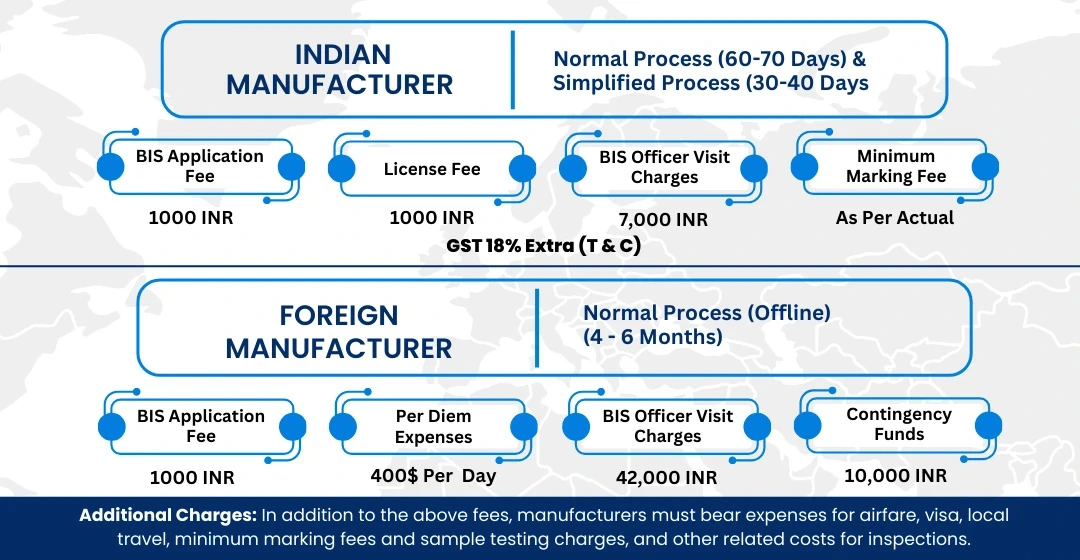
Manufacturers obtaining BIS certification are required to comply with strict marking guidelines to ensure product authenticity and traceability. After the grant of the license, the product must bear the ISI Mark, which signifies conformity with the applicable Indian Standard (such as IS 14899 for LPG containers). The marking should include:
The marking must be applied in a visible, legible, and non-removable manner on each product. In certain cases, where direct marking is not feasible, it may be allowed on packaging, subject to BIS approval.
The BIS certification license is generally granted for an initial period of one year. After this, it can
be renewed for a period ranging from one to five years, depending on compliance and
manufacturer preference. Continuous adherence to BIS standards, regular factory inspections,
and successful product testing are essential for maintaining the validity of the license.
The overall BIS certification process typically takes around 30 to 45 days, depending on factors such as:
Delays may occur if there are non-conformities in product testing or gaps in submitted documents. Ensuring proper preparation can significantly speed up the certification process.
BIS Certification for Liquefied Petroleum Gas (LPG) Containers for Automotive Use under IS 14899 is a mandatory requirement in India to ensure safety, quality, and reliability. The standard defines guidelines for design, manufacturing, material selection, testing, and inspection to prevent hazards like leakage and explosions.
The certification process involves online registration, testing at BIS-approved laboratories, document submission, and factory inspection before the issuance of a BIS license with a CML number. Proper marking, including the ISI mark and product details, is also required for traceability.
The license is initially valid for one year and can be renewed. Overall, it ensures compliance, improves product credibility, and builds trust in the automotive sector.