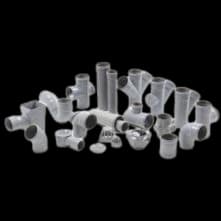
Injection-moulded PVC socket fittings are plumbing components made from polyvinyl
chloride (PVC) using a moulding process. These fittings are used to connect pipes in
water supply systems through solvent cement joints, ensuring a tight and leak-proof
connection. They are widely used in residential, commercial, and irrigation pipelines due
to their lightweight nature, corrosion resistance, and easy installation. These fittings play
an important role in maintaining smooth water flow and durable piping networks.
To ensure these fittings meet required quality and performance standards, the Bureau of
Indian Standards has defined guidelines under IS 7834 (Part 1): 1987. Manufacturers
must obtain BIS certification before supplying these products in the Indian market,
confirming that they comply with specified requirements for safe and reliable water
supply applications.
Overview of IS 7834 (Part 1): 1987 Standard
This is an Indian standard that specifies the general requirements for injection-moulded
PVC socket fittings used in water supply systems. It is issued by the Bureau of Indian
Standards to ensure these fittings are safe, reliable, and suitable for plumbing use.
The standard ensures that the product is:
- Made from proper PVC material for strength and durability
- Suitable for joining pipes using solvent cement joints without leakage
- Manufactured with correct dimensions and proper fit
- Resistant to corrosion and suitable for long-term water use
- Tested for important parameters like strength, dimensions, and overall quality
Who Requires BIS Certification for PVC Socket Fittings?
BIS certification under IS 7834 (Part 1): 1987 is required for all businesses involved in
the manufacturing and supply of these socket fittings used in water supply systems in
India.
It applies to:
Manufacturers – Must obtain BIS certification before selling fittings produced in India
Importers – Need to ensure imported fittings comply with BIS standards
Suppliers/Distributors – Should deal only in BIS-certified products in the market
This certification is regulated by the Bureau of Indian Standards.
- Manufacturers– Must obtain BIS certification before selling fittings produced in India
- Importers– Need to ensure imported fittings comply with BIS standards
- Suppliers/Distributors– Should deal only in BIS-certified products in the market
This certification is regulated by the Bureau of Indian Standards.
Benefit: BIS certification ensures product quality, leak-proof performance and builds
trust among buyers, helping in wider market acceptance.
BIS Testing & Quality Standards for PVC Solvent Cement Joint Fittings
To ensure proper quality and performance in water supply systems, the Bureau of
Indian Standards has defined testing and inspection requirements under IS 7834 (Part
1): 1987. These checks are carried out during manufacturing and quality control to
ensure fittings are safe, leak-proof, and durable.
What are R and S?
- R (Required): Tests conducted in the manufacturer’s in-house lab
- S (Subcontracting Allowed): Tests that can be done in BIS-approved or
NABL-accredited external labs
Raw Material Verification
- PVC Resin Check (R): Ensures the raw material meets required quality before
production
- Material Consistency (R): Confirms uniform composition for proper strength and
durability
Dimensional and Physical Checks
- Socket Size and Diameter (R): Verifies correct internal and external dimensions
- Wall Thickness Check (R): Ensures fittings have proper strength
- Out-of-Roundness Check (R):Confirms proper shape for tight pipe fitting
- Length and Taper Check (R): Ensures proper jointing and alignment
Performance Testing
- Stress Relief Test (R): Checks resistance to internal stress and deformation
- Hydrostatic Pressure Test (R): Ensures fittings can handle water pressure
without leakage or failure
Water and Safety Tests
- Effect on Water Test (S): Ensures fittings do not release harmful substances
into drinking water
- Opacity Test (S): Confirms the material prevents light penetration within limits
BIS License Process for Injection Moulded PVC fittings
To obtain BIS certification, manufacturers and other entities involved must follow the
standard approval process defined by the Bureau of Indian Standards to ensure
compliance with the standard.
- Online Registration: Register on the BIS Manak Online Portal with company details, factory address, and
product information. Foreign manufacturers must appoint an Authorized Indian
Representative (AIR) in India.
- Product Testing: The PVC socket fittings are tested in BIS-approved laboratories for dimensional
accuracy, hydrostatic pressure resistance, impact strength, joint integrity, and overall
quality performance as per the standard .
- Application Submission: Submit the application along with test reports, manufacturing details, and quality
documents. AIR documents are required for foreign applicants.
- Factory Inspection: BIS officials inspect the manufacturing unit to check the production process, equipment,
and quality control systems.
- License Approval: If all requirements are satisfied, BIS issues the license under Scheme-I for
manufacturing and selling the product in India.
- ISI Mark Usage: After approval, the manufacturer can use the ISI mark with a CM/L number on the
product, confirming compliance with the standard.

Required BIS Documents for PVC socket fittings
The following documents are generally required to obtain BIS approval for spoke-nipple
steel wires:
| Basic Details | - GST Certificate
- Email ID & Contact Number
- Factory & Office Address
- Rent Agreement / Lease Deed (if applicable)
|
| Legal Documents | - Partnership Deed (if partnership firm)
|
| Manufacturing Details | - List of machinery
- Process flow chart
- Layout Plan of Factory
|
| Raw Material Details | - List of Raw Materials
- Supplier Details
- Raw Material Invoices
- Raw Material Test Certificates
|
| Testing & Quality Control | - List of Testing Equipment
- Calibration Certificates
- QC / Lab In-charge Appointment Letter & Qualification
|
| Production Details | - Annual Installed Capacity
- Last Year Production Value
|
| Product & Packaging Details | - Quantity per Package
- Nature of Packing
- Nature of Printing / Marking on Product
|
| Management Details | - Top Management Details
- Concerned Person for BIS Communication
|
| Brand & Certification Documents | - Trademark / Brand Certificate
- Consent Letter from BIS Recognized Laboratory
|
| Additional Documents | - Weekly Off Details
- Hygiene Document (if applicable)
- Relaxation Letter (if applicable)
- Any Other Relevant Document
|
Foreign manufacturers must additionally appoint an Authorized Indian Representative
(AIR) to coordinate with the Bureau of Indian Standards (BIS) and manage compliance
requirements in India.
Marking Requirements and ISI Labeling
After obtaining the BIS license, the ISI mark for PVC plumbing fittings must be clearly
and permanently applied on the product or its packaging. Other required details are
provided in the table below. This ensures the product is compliant with applicable quality
and safety standards.
| Requirement | Details |
|---|
| ISI Mark | Indicates that the product is BIS certified and conforms to standards |
| Standard Number | IS 7834(part 1) |
| CML Number | Certification Marks License (CML) number issued by BIS |
| Manufacturer Details | Name of manufacturer or registered trademark |
| Batch / Date | Batch number, heat number, or manufacturing date for traceability |
Note:
Marking should be done using stamping, tags, or permanent printing so the product can
be easily identified during handling, storage, and transport, as per BIS requirements.
BIS License Validity for Injection Moulded PVC Pipe Fittings
After getting BIS certification, the license is valid for a limited period. Manufacturers
must follow BIS rules and maintain product quality to keep the license active.
License Validity Details
| Parameter | Details |
|---|
| Initial Validity | Usually valid for 1 to 2 years, based on BIS approval |
| Renewal | Must be renewed before expiry with required documents and fees |
| Surveillance | BIS conducts factory inspections and may test market samples |
| Compliance | Continuous compliance with IS standards and QCOs is required |
| Risk | May lead to suspension or cancellation of the license |
BIS Approval Cost for Injection Moulded PVC Pipe Fittings
The cost of BIS License includes charges for application, inspection, license, testing,
and marking. These fees are paid to BIS as per Scheme I guidelines.
| Charge Type | Indian Manufacturers | Foreign Manufacturers |
|---|
| Application Fee | INR 1,000 | USD 15 |
| Audit Charges | INR 7,000 | USD 3,200 – 5,900 |
| License Fee | INR 1,000 | USD 15 |
| Marking Fee | As applicable | As applicable |
| Testing Charges | As applicable | As applicable |
| EVTL India Consultancy Fee | As per actual | As per actual |
Note:
- Application fee for foreign manufacturers is payable via SWIFT (SAARC
countries may pay in INR with applicable GST).
- Audit charges for foreign manufacturers vary based on country/location.
- Marking fee depends on the product category and production volume (MSME
benefits may apply).
- Testing charges are paid directly to BIS-approved laboratories.
- Consultancy fees depend on product type and factory location.
Conclusion
BIS certification for injection-moulded PVC socket fittings under IS 7834 (Part 1): 1987
ensures that the product meets required quality standards for use in water supply
systems. It confirms that the fittings are properly tested for dimensions, pressure
handling, material quality, and safety for potable water use, ensuring reliable and
leak-proof performance.
With proper testing, documentation, and compliance with BIS guidelines, manufacturers
can complete the certification process smoothly and supply their products in the Indian
market without issues. Support from an experienced consultant like EVTL India can
further simplify the process and help achieve faster approval.