Electric coffee makers are widely used appliances that help in preparing coffee quickly
and consistently by heating water, passing it through ground coffee, and delivering a
ready-to-drink beverage. These machines are commonly found in homes, offices, cafes,
and commercial spaces because they are easy to use, save time, and provide uniform
taste without much manual effort.
To ensure that these appliances perform properly and operate safely under Indian conditions, they must comply with IS 302 (Part 1): 2024, a standard set by the Bureau of Indian Standards.
what is is 302 (part 1):2024
IS 302 (Part 1): 2024 is the Indian Standard for electric coffee makers, used in homes,
offices, and commercial spaces for preparing coffee. It is a standard set by the Bureau
of Indian Standards to ensure that these appliances meet the required technical and
safety guidelines for use in India.
This standard makes sure that these coffee makers are:
- Properly designed with safe electrical construction
- Equipped with reliable heating elements for consistent performance
- Insulated to prevent electrical hazards during operation
- Protected against overheating and short circuits
- Built to handle regular usage without failure
- Manufactured with consistent quality, design, and components
Testing and Inspection Requirements for coffee makers
To ensure proper functioning, electrical safety, and performance of coffee machines, the
Bureau of Indian Standards has defined clear testing and inspection requirements under
the standard, which are carried out during manufacturing.
What are R and S?
- R (Required): Test must be conducted in the manufacturer’s in-house laboratory
- S (Subcontracting Allowed): Test can be conducted in a BIS-approved external
laboratory
Electrical Safety Tests
- Protection Against Electric Shock (R) – Ensures users are protected from live
electrical parts
- Insulation Resistance Test (R) – Checks proper insulation between electrical
components
- High Voltage Test (R) – Verifies the appliance can withstand high voltage
without failure
- Earthing Continuity Test (R) – Ensures proper grounding for safety
Heating and Performance Tests
- Input Power Test (R) – Confirms the appliance operates within rated power
limits
- Heating Performance Test (R) – Checks efficient heating of water for coffee
preparation
- Temperature Rise Test (R) – Ensures components do not overheat during
operation
Construction and Durability Tests
- Mechanical Strength Test (R) – Ensures the appliance can handle normal
handling and usage
- Stability Test (R) – Checks that the coffee maker remains stable during
operation
- Endurance Test (S) – Verifies long-term performance under repeated use
Safety and Protection Tests
- Abnormal Operation Test (R) – Ensures safety during misuse or fault conditions
- Overload Protection Test (R/S) – Checks protection against excessive current
or heating
- Moisture Resistance Test (R) – Ensures safe operation in humid or wet
conditions
Material and Component Tests
- Component Quality Check (R) – Ensures internal parts meet required
standards
- Wiring and Connection Test (R) – Verifies proper and secure electrical
connections
- Heat Resistance Test (R) – Ensures materials can withstand operating
temperatures
process of bis certification
The BIS
certification process for BIS certification for Electric Coffee Makers involves
multiple steps designed to thoroughly evaluate a product's compliance with the
required standards. Here is a general overview of the certification process:
- Application
Submission:Manufacturers must submit an application form along with the
required documentation to BIS.
- Documentation
Review: BIS reviews the submitted documents to ensure completeness and
correctness.
- Factory
Inspection: BIS officials conduct an on-site inspection of the manufacturing
facility to assess the production process and quality control measures.
- Sample Testing:
Product samples are taken and tested in BIS-approved laboratories to verify
compliance with Indian standards.
- Certification
Grant: Upon successful completion of the inspection and testing, BIS grants
certification, allowing the manufacturer to use the BIS mark on their products.

documents required for bis certification
| Basic Details | - GST certificate
- Contact details
- Factory address
- Lease / ownership proof
|
| Legal Documents | - Partnership Deed (if partnership firm)
|
| Manufacturing Details | - List of machinery
- Process flow chart
- Factory layout
|
| Raw Material Details | - List of Raw Materials
- Supplier Details
- Raw Material Invoices
- Raw Material Test Certificates
|
| Testing & Quality Control | - List of Testing Equipment
- Calibration Certificates
- QC / Lab In-charge Appointment Letter & Qualification
|
| Production Details | - Annual Installed Capacity
- Last Year Production Value
|
| Product & Packaging Details | - Quantity per Package
- Nature of Packing
- Nature of Printing / Marking on Product
|
| Management Details | - Top Management Details
- Concerned Person for BIS Communication
|
| Brand & Certification Documents | - Trademark / Brand Certificate
- Consent Letter from BIS Recognized Laboratory
|
| Additional Documents | - Weekly Off Details
- Hygiene Document (if applicable)
- Relaxation Letter (if applicable)
- Any Other Relevant Document
|
Foreign manufacturers must additionally appoint an Authorized Indian Representative
(AIR) to coordinate with the Bureau of Indian Standards (BIS) and manage compliance
requirements in India.
Marking Requirements & License Validity
Marking Requirements
When a manufacturer obtains the BIS license, the ISI mark for coffee makers must be
applied clearly and permanently on the product or its packaging. In addition to the ISI
Mark, other important details must also be provided on the product or packaging, as
specified in the table below. This ensures the product meets all quality and safety
standards.
| Requirement | Details |
|---|
| ISI Mark | Indicates that the product is BIS certified and follows to the
standard
|
| Standard Number | IS 302 (Part 1): 2024 |
| CML Number | Certification Marks Licence (CML) number issued by BIS |
| Manufacturer Details | Name of manufacturer or registered trademark |
| Batch / Date | Batch number, heat number, or manufacturing date for traceability |
Note: Marking is typically applied using durable stamping, tagging, or permanent printing to
ensure clear identification during handling, storage, and transportation, as per BIS
marking requirements.
Validity of BIS licenses for Coffee Makers
After obtaining BIS certification for the product, the license is valid for a fixed period and
must be maintained by following BIS rules and standards.
| Particulars | Details |
|---|
| Initial Validity | Typically 1 to 2 years, depending on BIS approval conditions |
| Renewal | Must be renewed before expiry by submitting the application along with the prescribed fee and updated documents |
| Surveillance | Includes periodic factory inspections and market sample testing conducted by BIS |
| Compliance | Continuous following to standard and applicable Quality Control Orders (QCOs) is mandatory |
| Risk | Non-compliance or failed sample testing may lead to suspension or cancellation of the BIS license |
BIS ISI Mark Certification Costing And Timeline
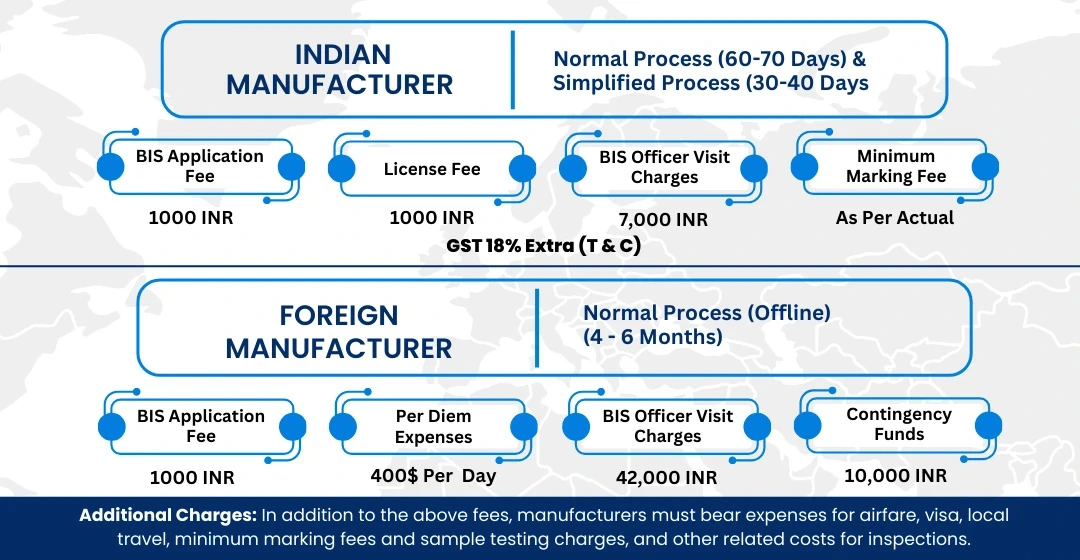
The cost of BIS certification includes charges for application, inspection, license, testing,
and marking. These fees are paid to BIS as per Scheme I guidelines.
Cost Breakdown
Indian Manufacturers
| No. | Major Charges | Particulars | Amount | Remark |
| 1 | BIS Fees | Application Fee | INR 1,000 | — |
|
| Audit / Inspection Fee | INR 7,000 | — |
|
| License Fee | INR 1,000 | — |
|
| Marking Fee | Depends on product | Discount as per MSME |
| 2. | Testing Charges | Sample Testing Fee | As Applicable | Payable to a BIS-approved laboratory. |
| 3. | EVTL India Service Fee | Consultancy & Support | As per actual | Depends on product type and factory location. |
Foreign Manufacturers
| No. | Major Charges | Particulars | Amount | Remark |
| 1. | BIS Fees | Application Fee | USD 15 | Payable via SWIFT to BIS. SAARC countries can pay INR with 18% GST. |
|
| Audit Charges | USD 3,200 – 5,900 | Depend on Country |
|
| License Fee | USD 15 | — |
|
| Marking Fee | Depends on product | — |
| 2. | Testing Charges | Sample Testing Fee | As Applicable | Payable to a BIS-approved laboratory. |
| 3. | EVTL India Service Fee | Consultancy & Support | As per actual
| Based on product and manufacturing location. |
Note: Additional costs such as pre-testing or factory pre-inspection may apply. The total
cost may vary depending on product type, testing requirements, and current BIS
guidelines.
To Know The Process In Detail, Please Visit
Under BIS Registration Products ISI and CRS
conclusion
BIS certification for electric coffee makers, as per IS 302 (Part 1): 2024, ensures that
the appliance meets the required technical and performance standards for use in homes
and commercial spaces. It confirms that the coffee maker has been properly tested for
electrical construction, heating efficiency, insulation, and safe operation, making it
suitable for regular use.
With the support and guidance of an experienced BIS consultant like EVTL India,
manufacturers can complete the certification process smoothly, avoid delays, and obtain
approval faster for market compliance.

%20_%202024%20Electric%20Coffee%20Makers.webp&w=828&q=75)