In the rapidly
growing Indian consumer market, electrical appliances have become an integral
part of daily life, and domestic water heaters are no exception. Whether in
urban households or rural setups, water heaters (often referred to as geysers)
are essential for ensuring hot water supply, particularly during the colder
months. However, with their widespread use comes the responsibility to ensure
that these appliances meet stringent safety and performance standards to
protect consumers.
The Bureau of
Indian Standards (BIS) plays a pivotal role in this process. With the recent
Quality Control Order (QCO) introduced by the Ministry of Commerce and Industry
in 2024, BIS certification for electric
water heaters has become mandatory.
This article delves deep into the importance of BIS certification for
electrical appliances used for domestic water heating, and the implications of
the recent order for manufacturers and consumers alike.
Understanding
BIS Certification and Its Importance
The Bureau of
Indian Standards (BIS) is the national standards body of India. Established
under the Bureau of Indian Standards Act, 2016, BIS is responsible for
developing standards, certification, and quality assurance for products across
various industries. Its aim is to ensure product safety, quality, and
reliability for Indian consumers.
For electrical
appliances like water heaters, obtaining a BIS certification means that the
product has been rigorously tested and meets the defined Indian Standard for
safety and performance. The certification process involves conformity
assessment through product testing, factory inspections, and continuous
monitoring. This process ensures that consumers can trust the quality of the
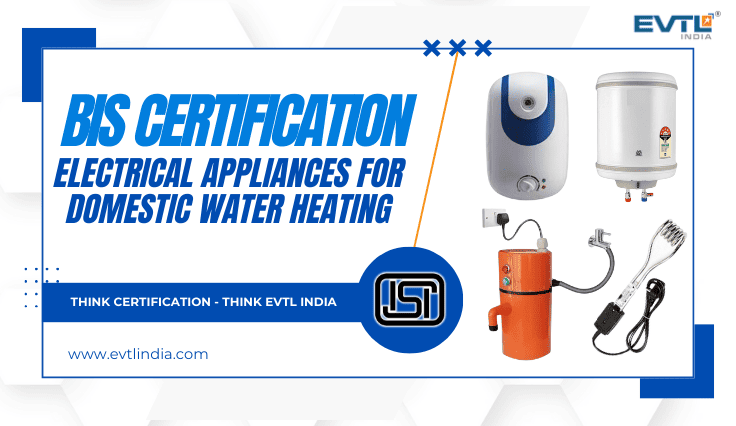
products they purchase, knowing they meet strict national standards. The BIS certification is prominently indicated by the ISI Mark
Certification, a symbol that signifies compliance with Indian standards. For manufacturers, displaying this
mark is crucial as it not only enhances the credibility of their products but is now legally
mandated.
Electrical Appliances for Domestic Water Heating (Quality Control) Order, 2023 : On 5th March
2024, the Ministry of Commerce and Industry, under its Department for Promotion
of Industry and Internal Trade (DPIIT), issued the Electrical Appliances for
Domestic Water Heating (Quality Control) Order, 2023. This order marks a
significant step towards strengthening consumer safety and standardizing
product quality in the water heater market. As per this QCO,
manufacturers of electric water heaters must now obtain BIS certification to
use the standard ISI mark and sell their products in the Indian market. The
move is aimed at regulating the manufacturing quality of electric water heaters
to safeguard consumers from substandard products, which could pose potential
safety hazards, such as electrical fires or malfunctioning components.
Key points from
the order include: - Mandatory BIS certification: Manufacturers are now required by law to
obtain BIS certification
before they can manufacture, import, or sell electric water heaters in India.
- Use of the ISI mark: Only
products that meet the stipulated standards and pass BIS’s rigorous tests are
allowed to bear the ISI Mark Certification, signaling adherence to the relevant
Indian Standard.
- Legal Implications: Any
person or manufacturer found violating the provisions of the order shall face
penalties under the **Bureau of Indian Standards Act, 2016**. This includes
punitive actions such as fines or legal proceedings for failing to comply with
certification and standard requirements.
Why the ISI
Mark Matters for Water Heaters?
The ISI mark is
a widely recognized symbol of product safety and quality in India. For
consumers purchasing water heaters, seeing the ISI mark is an assurance that
the appliance has been tested and certified to meet Indian Standards.
Electric water
heaters, given their direct interaction with water and electricity, require
special attention to safety standards. The risk of electric shock or fire makes
it crucial for these appliances to meet stringent quality standards. The ISI
mark confirms that the product: - Meets safety guidelines: The
BIS
certification process ensures that the product does not pose undue risk to the
consumer during normal usage.
- Offers reliable performance:
Beyond
safety, the ISI mark assures consumers that the product has been tested for
durability, energy efficiency, and overall performance.
- Complies with regulatory requirements: With
the QCO in place, the ISI mark is now a legal requirement for manufacturers. It
assures consumers that the product complies with the latest government regulations.
The Indian
Standard for Electrical Appliances For Domestic Water Heating
Every product
that receives BIS certification must conform to a specific Indian Standard
(IS). For electric water heaters, this Indian Standard covers various
parameters such as safety against electric shocks, resistance to overheating,
energy efficiency, durability of materials, and more. The products covered
under this quality control order are as follows:
The Indian
Standard for electric water heaters includes comprehensive guidelines that
cover both the internal components and the external design of the appliance,
ensuring it functions safely and efficiently.
Process for BIS Certification
The BIS certification
process for Electric Water Heaters involves multiple steps, designed to
thoroughly evaluate a product's compliance with the required standards. Here is
a general overview of the certification process:
- Application Submission: Manufacturers
must submit an application form along with required documentation to BIS.
- Documentation Review: BIS reviews the
submitted documents to ensure completeness and correctness.
- Factory Inspection: BIS officials
conduct an on-site inspection of the manufacturing facility to assess the
production process and quality control measures.
- Sample Testing: Product samples are
taken and tested in BIS-approved laboratories to verify compliance with Indian
standards.
- Certification Grant: Upon successful
completion of the inspection and testing, BIS grants certification, allowing
the manufacturer to use the BIS mark on their products.
Documents Required for BIS Certification
To apply for BIS
certification, manufacturers need to submit the following documents:
- Application
form
- Manufacturing
process details
- Quality control
plan
- Test reports from
BIS-approved
laboratories
- Factory layout and
equipment
details
- Proof of business
registration
- Product
specifications and
technical details
- Declaration of
conformity to
Indian standards
- Additionally,
manufacturers may be required to provide proof of compliance with environmental
and safety regulations, depending on the specific type of product being
certified.
Benefits for
Consumers
For consumers,
the mandatory BIS certification is a positive development. It means that any
water heater they purchase will be certified for safety, quality, and
performance. Consumers can now make informed choices, looking for the ISI mark
when selecting a water heater for their home.
Some of the key
benefits for consumers include : - Safety assurance: With
the ISI mark in
place, consumers can be confident that the product will not malfunction in ways
that could endanger their safety.
- Energy efficiency:
Water heaters
certified by BIS are likely to be more energy-efficient, helping consumers
reduce their electricity consumption and save money over time.
- Product reliability: BIS certification
ensures that the water heater has undergone rigorous testing, so consumers are
less likely to encounter premature breakdowns or malfunctions.
Manufacturers
who fail to comply with the QCO face serious repercussions. Besides legal
penalties, they risk losing consumer trust and market share as uncertified
products are likely to be phased out.
Enforcement
and Compliance under BIS Act, 2016
Under the Bureau
of Indian Standards Act, 2016, any individual or company that contravenes the
provisions of the Electrical Appliances for Domestic Water Heating (Quality
Control) Order, 2023 will face penalties. This could range from fines to legal
action, depending on the severity of the violation. The goal of this stringent
enforcement is to ensure that only high-quality, safe products are available to
Indian consumers, thereby reducing the risk of accidents and promoting fair
competition among manufacturers.
Conclusion
The recent
mandate for BIS certification under the Electrical Appliances for Domestic
Water Heating (Quality Control) Order, 2023, is a critical development in
ensuring the safety and quality of electric water heaters in India. For
manufacturers, the ISI mark has now become an essential part of doing business,
while consumers can take comfort in knowing that the products they purchase
meet stringent Indian Standards. This move by the Ministry of Commerce and
Industry will undoubtedly raise the bar for product quality in the domestic
water heating market, benefiting both manufacturers who prioritize quality and
consumers who seek safe, reliable appliances.
Navigating the BIS
certification
process can be challenging, especially for small and medium-sized enterprises.
EVTL India is a leading consultancy firm dedicated to assisting manufacturers
in obtaining BIS certification (ISI Mark) efficiently. With expertise in
managing BIS portal submissions, documentation, and regulatory fees, EVTL India
ensures a smooth and successful certification process. By choosing EVTL India,
manufacturers can enhance their product's marketability both in India and
internationally, securing a competitive edge. Additionally, EVTL India provides
ongoing support post-certification, helping manufacturers maintain compliance
with BIS standards and renew their licenses as needed.