
COS-1 vs COS-2: Key Differences in CDSCO Cosmetic Import Registration
Importing cosmetics into India requires compliance with the Cosmetics Rules, 2020 and the regulations issued by the Central Drugs Standard Control Organisation (CDSCO). One of the most common areas of confusion during the cosmetic import registration process is the difference between COS-1 and COS-2. Many importers, particularly first-time applicants, assume these are similar forms or believe both need to be submitted as part of the registration process. In reality, they serve entirely different purposes, and understanding their roles is essential for a smooth approval process.
Whether you are importing skincare products, hair care products, perfumes, makeup, or other cosmetic products into India, knowing the distinction between COS-1 and COS-2 can help you avoid documentation errors, application delays, and compliance issues. While COS-1 is the application submitted to CDSCO for cosmetic import registration, COS-2 is the Import Registration Certificate issued after successful approval, making each form a separate and important part of the registration process.
What is COS-1 Form?
COS-1 is the official application form used to apply for a Cosmetic Import Registration Certificate in India under the Cosmetics Rules, 2020. Any importer or authorized Indian agent who wants to import cosmetics into India must submit this form to the Central Drugs Standard Control Organisation (CDSCO) through the online SUGAM portal.
The COS-1 form is the first step in the cosmetic import registration process. It contains important details about the applicant, manufacturer, manufacturing site, cosmetic products, brand names, product categories, and supporting regulatory documents. After the CDSCO reviews the application and finds it compliant with the applicable rules, it issues the COS-2 Registration Certificate, which legally authorizes the import of the approved cosmetic products into India.
A properly completed COS-1 application should include -
- Applicant and authorized agent details
- Manufacturer and manufacturing site information
- Product names, brands, and cosmetic categories
- Free Sale Certificate (FSC) or equivalent regulatory documents
- Product ingredient list and labels
- Power of Attorney (if applicable)
- Other supporting documents required by CDSCO
What is COS-2 Form?
The COS-2 Form is the Certificate of Registration issued by the Central Drugs Standard Control Organisation (CDSCO) under the Cosmetics Rules, 2020. It serves as official proof that a cosmetic product has been approved for import into India after the successful review of the COS-1 application and supporting documents.
Once the CDSCO is satisfied that all regulatory requirements have been met, it grants the registration certificate in Form COS-2. This certificate authorizes the importer to legally import and market the approved cosmetic products in India, subject to compliance with applicable laws and conditions.
A COS-2 certificate contains important details such as -
- Name and address of the importer
- Name and address of the foreign manufacturer
- Registered cosmetic product categories and brands
- Registration certificate number
- Date of issue and validity period
- Terms and conditions of the registration
Importers must obtain a valid COS-2 certificate before importing cosmetics into the Indian market. Customs authorities may require this certificate during customs clearance, and selling imported cosmetics without a valid registration can lead to regulatory action.
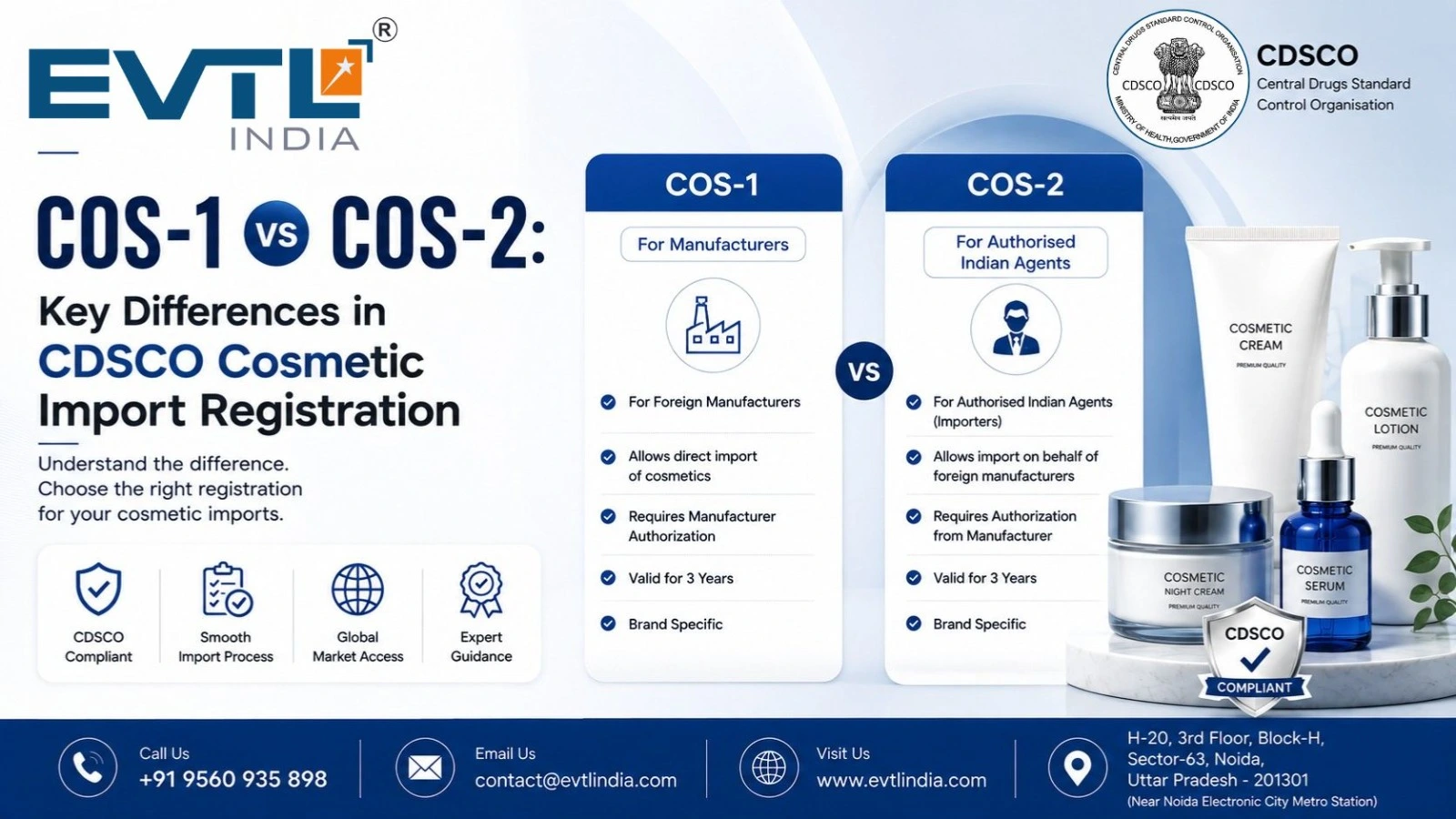
COS-1 vs COS-2: Key Differences
When importing cosmetics into India, understanding the difference between COS-1 and COS-2 is essential for smooth CDSCO compliance. Although both are part of the cosmetic import registration process under the Cosmetics Rules, 2020, they serve completely different purposes.
- COS-1 is the application form submitted to the Central Drugs Standard Control Organisation (CDSCO) to apply for cosmetic import registration. It contains details about the importer, manufacturer, manufacturing site, and cosmetic products being imported.
- COS-2 is the Registration Certificate issued by CDSCO after the application is reviewed and approved. It confirms that the cosmetic products are legally registered and permitted for import into India.
Key Differences Between COS-1 and COS-2
When to File COS-1 and When Is COS-2 Issued?
Understanding the timing of COS-1 and COS-2 is essential for a smooth cosmetic import registration process in India. While both forms are part of the same CDSCO registration procedure, they serve different purposes and are used at different stages.
When Should You File COS-1?
COS-1 is the application form submitted to the Central Drugs Standard Control Organisation (CDSCO) to obtain a cosmetic import registration certificate. It must be filed before importing any cosmetic product into India. Under the Cosmetics Rules, 2020, the application is submitted online through the SUGAM portal by the foreign manufacturer, its authorised Indian agent, importer, or an authorised Indian subsidiary.
You should file COS-1 when -
- Importing a cosmetic product into India for the first time.
- Registering a new foreign manufacturer or manufacturing site.
- Registering new cosmetic products, variants, or pack sizes that require approval.
- Appointing an authorised Indian agent to apply on behalf of the foreign manufacturer.
- Seeking a valid cosmetic import registration before commercial import and sale in India.
The application must be submitted along with the prescribed government fee and all required documents, including product details, ingredient information, manufacturing site information, authorisation letter, Free Sale Certificate, labels, and other supporting documents.
When Is COS-2 Issued?
COS-2 is the Cosmetic Import Registration Certificate issued by CDSCO after the COS-1 application has been reviewed and approved. It serves as official proof that the cosmetic product has been registered for import into India under the Cosmetics Rules, 2020.
CDSCO issues COS-2 only after -
- The COS-1 application is found complete.
- All submitted documents satisfy regulatory requirements.
- The product, manufacturing site, and importer comply with the Cosmetics Rules, 2020.
- Any queries or deficiencies raised by CDSCO have been successfully addressed.
Once COS-2 is granted, the importer can legally import the registered cosmetic products into India, subject to continued compliance with applicable regulations and the conditions of the registration certificate.
Registration Process: From COS-1 to COS-2
The CDSCO cosmetic import registration process follows a clear sequence, beginning with the submission of the COS-1 application and ending with the issuance of the COS-2 Registration Certificate. Understanding each stage helps importers avoid delays, documentation errors, and compliance issues.
Here's how the process works -
Before filing the application, the importer or authorised Indian agent must gather all necessary documents, including -
- Power of Attorney or authorisation letter from the foreign manufacturer
- Product ingredient list and specifications
- Manufacturing licence or certificate
- Free Sale Certificate (if applicable)
- Labels and packaging details
- Other documents required under the Cosmetics Rules, 2020
Ensuring that all documents are complete and accurate is essential for a smooth registration process.
The applicant submits Form COS-1 to CDSCO along with the prescribed government fee and supporting documents. This form contains information about -
- The foreign cosmetic manufacturer
- The authorised Indian importer or agent
- Product details
- Manufacturing facility
- Compliance declarations
COS-1 serves as the official application requesting permission to import cosmetics into India.
Once the application is submitted, CDSCO examines the documents to verify that the cosmetic products comply with the Cosmetics Rules, 2020 and other applicable regulatory requirements. During this stage, the authority may -
- Review technical documents
- Verify manufacturing details
- Examine product formulations
- Request additional information or clarifications if required
Any deficiencies must be addressed promptly to prevent unnecessary delays.
If CDSCO identifies missing documents or requires further clarification, the applicant must submit the requested information within the specified timeline. Timely responses help keep the registration process moving efficiently.
After successful evaluation and approval of the COS-1 application, CDSCO issues Form COS-2, the Cosmetic Import Registration Certificate. The COS-2 certificate confirms that -
- The cosmetic products are registered for import into India.
- The importer is authorised to import the approved products.
- The products comply with the applicable CDSCO requirements.
Only after receiving COS-2 can the registered cosmetic products be legally imported and marketed in India, subject to continued compliance with regulatory requirements.
Document Preparation → Submit COS-1 Application → CDSCO Review → Query Resolution (if required) → COS-2 Registration Certificate Issued → Import and Market the Cosmetic Products Legally
Documents Required for COS-1 Application
A COS-1 application is the first and most important step in obtaining a COS-2 Cosmetic Import Registration Certificate from the Central Drugs Standard Control Organisation (CDSCO). To avoid delays or queries during the review process, applicants must submit a complete set of documents through the CDSCO SUGAM portal. The required documents help the authority verify the manufacturer, product quality, safety, and compliance with the Cosmetics Rules, 2020.
The following documents are generally required for a COS-1 application -
- Covering Letter explaining the purpose of the application (fresh registration, endorsement, or re-registration).
- Duly Filled COS-1 Application Form submitted through the CDSCO SUGAM portal.
- Authorisation Letter/Power of Attorney from the foreign manufacturer appointing the Indian authorised agent, duly authenticated.
- Information and Undertaking as prescribed in Part I of the Second Schedule of the Cosmetics Rules, 2020.
- Complete List of Ingredients with their percentage composition.
- Product Labels proposed for sale in India, complying with applicable labelling requirements.
- Product Specifications and Testing Methods demonstrating compliance with quality and safety standards.
- Package Insert (if applicable).
- Manufacturing Licence or an undertaking where such a licence is not issued in the country of origin.
- Free Sale Certificate (FSC) issued by the competent authority of the exporting country and duly authenticated.
- Non-Animal Testing Declaration confirming that the cosmetic has not been tested on animals where required.
- Declaration for Heavy Metals and Hexachlorophene Content confirming compliance with prescribed limits.
- Bharatkosh Fee Payment Receipt as proof of payment of the prescribed government fee.
- Any Additional Supporting Documents requested by CDSCO for specific product categories or applications.
Common Mistakes Importers Make
Many cosmetic importers, especially those applying for registration for the first time, make avoidable mistakes that can delay the approval process or lead to rejection of their application. Understanding the difference between COS-1 and COS-2 is only one part of the compliance process. Importers should also ensure that all documentation and regulatory requirements are met before submitting an application.
Some of the most common mistakes include -
- Confusing COS-1 with COS-2 - Many businesses assume both forms serve the same purpose. In reality, COS-1 is the application form, while COS-2 is the registration certificate issued by CDSCO after approval.
- Submitting incomplete or incorrect documents - Missing manufacturer details, incorrect product information, or incomplete supporting documents can result in delays or rejection.
- Providing inaccurate product information - Any mismatch in product names, ingredients, labels, or manufacturing details may lead to additional queries from CDSCO.
- Applying through an unauthorised representative - Foreign manufacturers must appoint an authorised Indian agent to submit the application on their behalf.
- Ignoring product labelling requirements - Cosmetic labels must comply with the Cosmetics Rules, 2020. Non-compliant labels can delay registration or create issues during import clearance.
- Delaying the registration process - Waiting until products are ready for shipment before filing COS-1 can postpone imports, as registration must be completed before the products are imported into India.
- Failing to respond to CDSCO queries promptly - If the authority requests clarification or additional documents, delayed responses can significantly extend the approval timeline.
Why Understanding the Difference Matters
Understanding the difference between COS-1 and COS-2 is essential for anyone involved in importing cosmetics into India. Although both forms are part of the CDSCO cosmetic import registration process, they serve completely different purposes. Confusing them can lead to incomplete applications, regulatory delays, and unnecessary compliance issues.
COS-1 is the application form submitted to the Central Drugs Standard Control Organisation (CDSCO) to request cosmetic import registration. It contains details about the foreign manufacturer, authorised Indian agent, cosmetic products, and supporting documents required for evaluation.
COS-2, on the other hand, is the Cosmetic Import Registration Certificate issued by CDSCO after the application has been reviewed and approved. This certificate confirms that the cosmetic products are legally registered for import into India under the Cosmetics Rules, 2020.
Understanding this distinction is important because it helps importers -
- Submit the correct documents at the appropriate stage of the registration process.
- Avoid delays caused by incomplete or incorrect applications.
- Ensure compliance with the Cosmetics Rules, 2020 and CDSCO requirements.
- Plan product launches and imports without regulatory setbacks.
- Communicate more effectively with consultants, manufacturers, and regulatory authorities.
Why Choose EVTL India as Your Trusted Cosmetic Import Registration Consultant
Importing cosmetics into India involves strict compliance with the Cosmetics Rules, 2020 and the regulations administered by the Central Drugs Standard Control Organisation (CDSCO). Even minor errors in documentation or application filing can result in unnecessary delays, additional costs, or rejection of the registration application. EVTL India simplifies the entire process by providing expert guidance from initial documentation to the final registration certificate.
Here are the key reasons why businesses choose EVTL India for cosmetic import registration -
- Experienced Regulatory Experts - Our team has extensive experience in handling CDSCO cosmetic import registration applications for Indian importers, authorised agents, and international cosmetic manufacturers.
- Complete End-to-End Support - We manage every stage of the registration process, including eligibility assessment, document preparation, application filing, regulatory coordination, and post-registration assistance.
- Accurate Documentation - We ensure that all required documents are properly prepared and verified before submission, reducing the chances of queries or application rejection.
- Faster Registration Process - With a structured approach and thorough compliance checks, we help minimise delays and streamline the registration timeline.
- Support for Global Cosmetic Brands - Whether you are importing skincare, haircare, makeup, fragrances, or personal care products, our experts understand the specific documentation requirements for different cosmetic categories.
Conclusion
Understanding the difference between COS-1 and COS-2 is crucial for a successful cosmetic import registration process in India. While COS-1 is the application form submitted to CDSCO to obtain approval for importing cosmetics, COS-2 is the official Registration Certificate issued after the application has been reviewed and approved. Both forms play distinct yet interconnected roles in ensuring compliance with the Cosmetics Rules, 2020.
Importers who clearly understand when to file COS-1, the documents required, and the significance of the COS-2 certificate can avoid unnecessary delays, regulatory queries, and compliance issues. A well-prepared application supported by accurate documentation not only speeds up the approval process but also enables the legal import and marketing of cosmetic products in India.
Whether you are a first-time importer or an established international cosmetic brand, staying compliant with CDSCO regulations is essential for uninterrupted business operations. Partnering with an experienced regulatory consultant like EVTL India can simplify the entire registration process, ensure complete documentation, and help you obtain your COS-2 Registration Certificate efficiently, allowing you to bring your cosmetic products to the Indian market with confidence.